↗ View this article in the original PDF newsletter
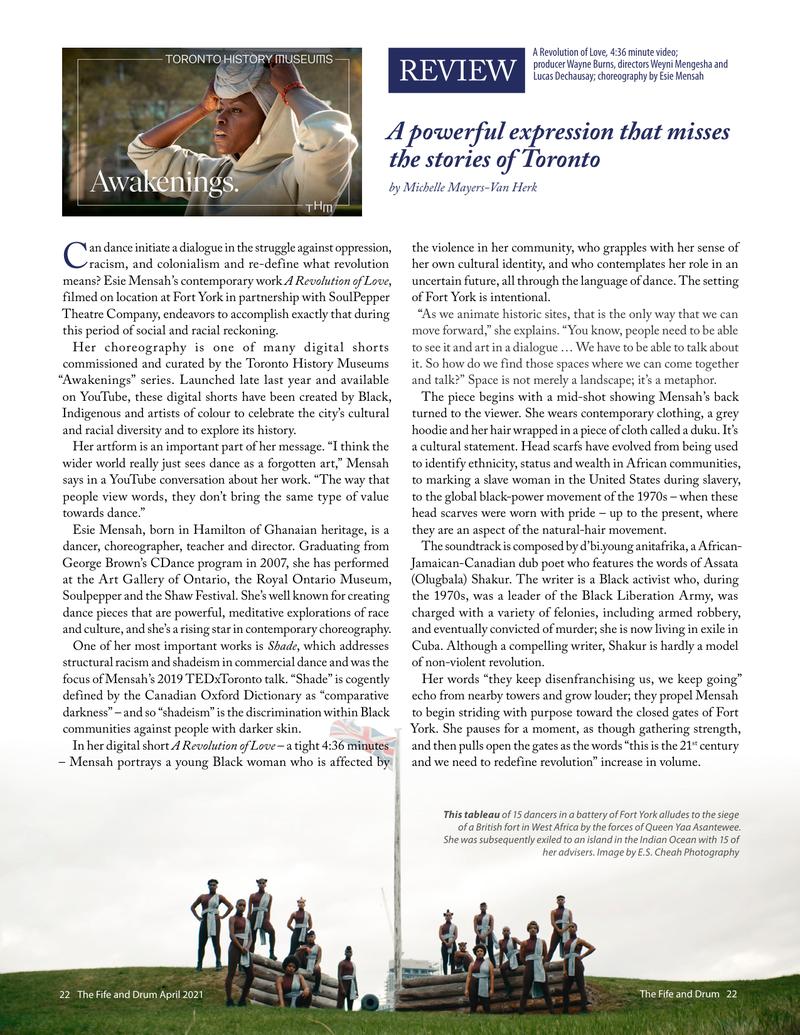
an dance initiate a dialogue in the struggle against oppression, C racism, and colonialism and re-define what revolution means? Esie Mensah’s contemporary work A Revolution of Love, filmed on location at Fort York in partnership with SoulPepper Theatre Company, endeavors to accomplish exactly that during this period of social and racial reckoning. Her choreography is one of many digital shorts commissioned and curated by the Toronto History Museums “Awakenings” series. Launched late last year and available on YouTube, these digital shorts have been created by Black, Indigenous and artists of colour to celebrate the city’s cultural and racial diversity and to explore its history. Her artform is an important part of her message. “I think the wider world really just sees dance as a forgotten art,” Mensah says in a YouTube conversation about her work. “The way that people view words, they don’t bring the same type of value towards dance.” Esie Mensah, born in Hamilton of Ghanaian heritage, is a dancer, choreographer, teacher and director. Graduating from George Brown’s CDance program in 2007, she has performed at the Art Gallery of Ontario, the Royal Ontario Museum, Soulpepper and the Shaw Festival. She’s well known for creating dance pieces that are powerful, meditative explorations of race and culture, and she’s a rising star in contemporary choreography. One of her most important works is Shade, which addresses structural racism and shadeism in commercial dance and was the focus of Mensah’s 2019 TEDxToronto talk. “Shade” is cogently defined by the Canadian Oxford Dictionary as “comparative darkness” – and so “shadeism” is the discrimination within Black communities against people with darker skin. In her digital short A Revolution of Love – a tight 4:36 minutes – Mensah portrays a young Black woman who is affected by
an dance initiate a dialogue in the struggle against oppression, C racism, and colonialism and re-define what revolution means? Esie Mensah’s contemporary work A Revolution of Love, filmed on location at Fort York in partnership with SoulPepper Theatre Company, endeavors to accomplish exactly that during this period of social and racial reckoning. Her choreography is one of many digital shorts commissioned and curated by the Toronto History Museums “Awakenings” series. Launched late last year and available on YouTube, these digital shorts have been created by Black, Indigenous and artists of colour to celebrate the city’s cultural and racial diversity and to explore its history. Her artform is an important part of her message. “I think the wider world really just sees dance as a forgotten art,” Mensah says in a YouTube conversation about her work. “The way that people view words, they don’t bring the same type of value towards dance.” Esie Mensah, born in Hamilton of Ghanaian heritage, is a dancer, choreographer, teacher and director. Graduating from George Brown’s CDance program in 2007, she has performed at the Art Gallery of Ontario, the Royal Ontario Museum, Soulpepper and the Shaw Festival. She’s well known for creating dance pieces that are powerful, meditative explorations of race and culture, and she’s a rising star in contemporary choreography. One of her most important works is Shade, which addresses structural racism and shadeism in commercial dance and was the focus of Mensah’s 2019 TEDxToronto talk. “Shade” is cogently defined by the Canadian Oxford Dictionary as “comparative darkness” – and so “shadeism” is the discrimination within Black communities against people with darker skin. In her digital short A Revolution of Love – a tight 4:36 minutes – Mensah portrays a young Black woman who is affected by
the violence in her community, who grapples with her sense of her own cultural identity, and who contemplates her role in an uncertain future, all through the language of dance. The setting of Fort York is intentional. “As we animate historic sites, that is the only way that we can move forward,” she explains. “You know, people need to be able to see it and art in a dialogue … We have to be able to talk about it. So how do we find those spaces where we can come together and talk?” Space is not merely a landscape; it’s a metaphor. The piece begins with a mid-shot showing Mensah’s back turned to the viewer. She wears contemporary clothing, a grey hoodie and her hair wrapped in a piece of cloth called a duku. It’s a cultural statement. Head scarfs have evolved from being used to identify ethnicity, status and wealth in African communities, to marking a slave woman in the United States during slavery, to the global black-power movement of the 1970s – when these head scarves were worn with pride – up to the present, where they are an aspect of the natural-hair movement. The soundtrack is composed by d’bi.young anitafrika, a AfricanJamaican-Canadian dub poet who features the words of Assata (Olugbala) Shakur. The writer is a Black activist who, during the 1970s, was a leader of the Black Liberation Army, was charged with a variety of felonies, including armed robbery, and eventually convicted of murder; she is now living in exile in Cuba. Although a compelling writer, Shakur is hardly a model of non-violent revolution. Her words “they keep disenfranchising us, we keep going” echo from nearby towers and grow louder; they propel Mensah to begin striding with purpose toward the closed gates of Fort York. She pauses for a moment, as though gathering strength, 21st and then pulls open the gates as the words “this is the century and we need to redefine revolution” increase in volume.

22 The Fife and Drum April 2021 22 The Fife and Drum April 2021 The Fife and Drum 22
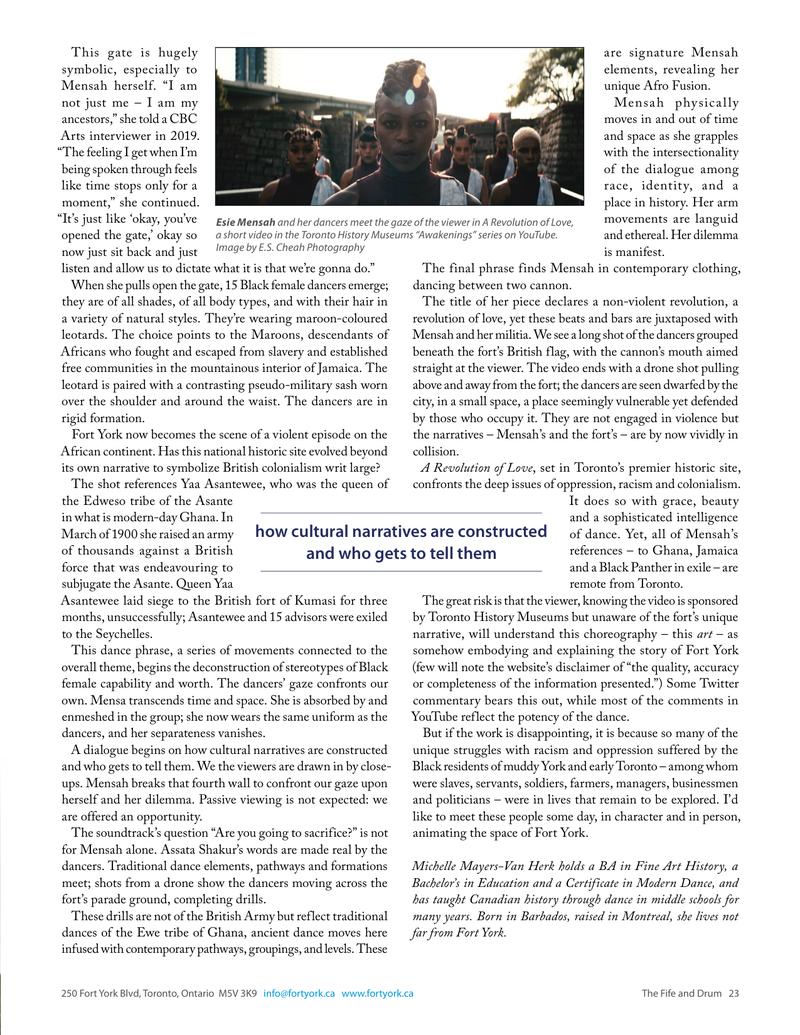
This gate is hugely symbolic, especially to Mensah herself. “I am not just me – I am my ancestors,” she told a CBC Arts interviewer in 2019. “The feeling I get when I’m being spoken through feels like time stops only for a moment,” she continued. Esie Mensah and her dancers meet the gaze “It’s just like ‘okay, you’ve a short video in the Toronto History Museums opened the gate,’ okay so Image by E.S. Cheah Photography now just sit back and just listen and allow us to dictate what it is that we’re gonna do.” When she pulls open the gate, 15 Black female dancers emerge; they are of all shades, of all body types, and with their hair in a variety of natural styles. They’re wearing maroon-coloured leotards. The choice points to the Maroons, descendants of Africans who fought and escaped from slavery and established free communities in the mountainous interior of Jamaica. The leotard is paired with a contrasting pseudo-military sash worn over the shoulder and around the waist. The dancers are in rigid formation. Fort York now becomes the scene of a violent episode on the African continent. Has this national historic site evolved beyond its own narrative to symbolize British colonialism writ large? The shot references Yaa Asantewee, who was the queen of the Edweso tribe of the Asante in what is modern-day Ghana. In how cultural narratives March of 1900 she raised an army and who gets of thousands against a British force that was endeavouring to subjugate the Asante. Queen Yaa Asantewee laid siege to the British fort of Kumasi for three months, unsuccessfully; Asantewee and 15 advisors were exiled to the Seychelles. This dance phrase, a series of movements connected to the overall theme, begins the deconstruction of stereotypes of Black female capability and worth. The dancers’ gaze confronts our own. Mensa transcends time and space. She is absorbed by and enmeshed in the group; she now wears the same uniform as the dancers, and her separateness vanishes. A dialogue begins on how cultural narratives are constructed and who gets to tell them. We the viewers are drawn in by closeups. Mensah breaks that fourth wall to confront our gaze upon herself and her dilemma. Passive viewing is not expected: we are offered an opportunity. The soundtrack’s question “Are you going to sacrifice?” is not for Mensah alone. Assata Shakur’s words are made real by the dancers. Traditional dance elements, pathways and formations meet; shots from a drone show the dancers moving across the fort’s parade ground, completing drills. These drills are not of the British Army but reflect traditional dances of the Ewe tribe of Ghana, ancient dance moves here infused with contemporary pathways, groupings, and levels. These
This gate is hugely symbolic, especially to Mensah herself. “I am not just me – I am my ancestors,” she told a CBC Arts interviewer in 2019. “The feeling I get when I’m being spoken through feels like time stops only for a moment,” she continued. Esie Mensah and her dancers meet the gaze “It’s just like ‘okay, you’ve a short video in the Toronto History Museums opened the gate,’ okay so Image by E.S. Cheah Photography now just sit back and just listen and allow us to dictate what it is that we’re gonna do.” When she pulls open the gate, 15 Black female dancers emerge; they are of all shades, of all body types, and with their hair in a variety of natural styles. They’re wearing maroon-coloured leotards. The choice points to the Maroons, descendants of Africans who fought and escaped from slavery and established free communities in the mountainous interior of Jamaica. The leotard is paired with a contrasting pseudo-military sash worn over the shoulder and around the waist. The dancers are in rigid formation. Fort York now becomes the scene of a violent episode on the African continent. Has this national historic site evolved beyond its own narrative to symbolize British colonialism writ large? The shot references Yaa Asantewee, who was the queen of the Edweso tribe of the Asante in what is modern-day Ghana. In how cultural narratives March of 1900 she raised an army and who gets of thousands against a British force that was endeavouring to subjugate the Asante. Queen Yaa Asantewee laid siege to the British fort of Kumasi for three months, unsuccessfully; Asantewee and 15 advisors were exiled to the Seychelles. This dance phrase, a series of movements connected to the overall theme, begins the deconstruction of stereotypes of Black female capability and worth. The dancers’ gaze confronts our own. Mensa transcends time and space. She is absorbed by and enmeshed in the group; she now wears the same uniform as the dancers, and her separateness vanishes. A dialogue begins on how cultural narratives are constructed and who gets to tell them. We the viewers are drawn in by closeups. Mensah breaks that fourth wall to confront our gaze upon herself and her dilemma. Passive viewing is not expected: we are offered an opportunity. The soundtrack’s question “Are you going to sacrifice?” is not for Mensah alone. Assata Shakur’s words are made real by the dancers. Traditional dance elements, pathways and formations meet; shots from a drone show the dancers moving across the fort’s parade ground, completing drills. These drills are not of the British Army but reflect traditional dances of the Ewe tribe of Ghana, ancient dance moves here infused with contemporary pathways, groupings, and levels. These
are signature Mensah elements, revealing her unique Afro Fusion. Mensah physically moves in and out of time and space as she grapples with the intersectionality of the dialogue among race, identity, and a place in history. Her arm of the viewer in A Revolution of Love, movements are languid “Awakenings” series on YouTube. and ethereal. Her dilemma is manifest. The final phrase finds Mensah in contemporary clothing, dancing between two cannon. The title of her piece declares a non-violent revolution, a revolution of love, yet these beats and bars are juxtaposed with Mensah and her militia. We see a long shot of the dancers grouped beneath the fort’s British flag, with the cannon’s mouth aimed straight at the viewer. The video ends with a drone shot pulling above and away from the fort; the dancers are seen dwarfed by the city, in a small space, a place seemingly vulnerable yet defended by those who occupy it. They are not engaged in violence but the narratives – Mensah’s and the fort’s – are by now vividly in collision. A Revolution of Love, set in Toronto’s premier historic site, confronts the deep issues of oppression, racism and colonialism. It does so with grace, beauty and a sophisticated intelligence are constructed of dance. Yet, all of Mensah’s to tell them references – to Ghana, Jamaica and a Black Panther in exile – are remote from Toronto. The great risk is that the viewer, knowing the video is sponsored by Toronto History Museums but unaware of the fort’s unique narrative, will understand this choreography – this art – as somehow embodying and explaining the story of Fort York (few will note the website’s disclaimer of “the quality, accuracy or completeness of the information presented.”) Some Twitter commentary bears this out, while most of the comments in YouTube reflect the potency of the dance. But if the work is disappointing, it is because so many of the unique struggles with racism and oppression suffered by the Black residents of muddy York and early Toronto – among whom were slaves, servants, soldiers, farmers, managers, businessmen and politicians – were in lives that remain to be explored. I’d like to meet these people some day, in character and in person, animating the space of Fort York.
Michelle Mayers-Van Herk holds a BA in Fine Art History, a Bachelor’s in Education and a Certificate in Modern Dance, and has taught Canadian history through dance in middle schools for many years. Born in Barbados, raised in Montreal, she lives not far from Fort York. The Fife and Drum 23
Original printed pages