Sydney, Australia, and Toronto, settled five years apart, share some early connections. Their founders, Governors Arthur Phillip and John Graves Simcoe, are both well known for living in canvas houses while establishing their capitals. This was no coincidence: Simcoe having heard of the structure Phillip took to Australia asked for something similar. In both cases the supplier was Nathan Smith of St. George’s Fields, London, an established manufacturer of patented floorcloths, waterproof tents, awnings, and the like. His specialty was oilcloth: stout canvas suffused using heat and pressure with rosin, pitch, iron oxide, beeswax, and linseed oil.
On 26 January 1788, seven and a half months after leaving England, Capt. Phillip sailed into Sydney Cove, named for Lord Sydney, the home secretary. Phillip’s canvas house, erected within a few days of his arrival, served for several months while a more permanent residence was built. It was said to be “45 feet long 17 ft. 6 ins Wide 8 under the Halls [hauls] … with five windows of a Side 3 ft. 9 by 3 ft.” and was reported to have cost £130. In his first dispatch home, however, the Governor noted it was neither wind nor water proof.
The dimensions of Simcoe’s houses are known from Nathan Smith’s invoice. They were each 38 ft. 4 in. long, 12 ft. wide, and 7 ft. 2 in. high at the sides, with six glazed windows and a partition. The interiors were papered and the outsides painted in oil colour. Smith charged £100 for each structure, £200 the pair. A hundred square yards of wove haircloth sewn and fitted for the floors cost extra, as did six pine tables and two dozen camp chairs with cane seats from another supplier. This equipment was packed and loaded aboard the Scipio when it sailed from London for Quebec on 27 April 1792.
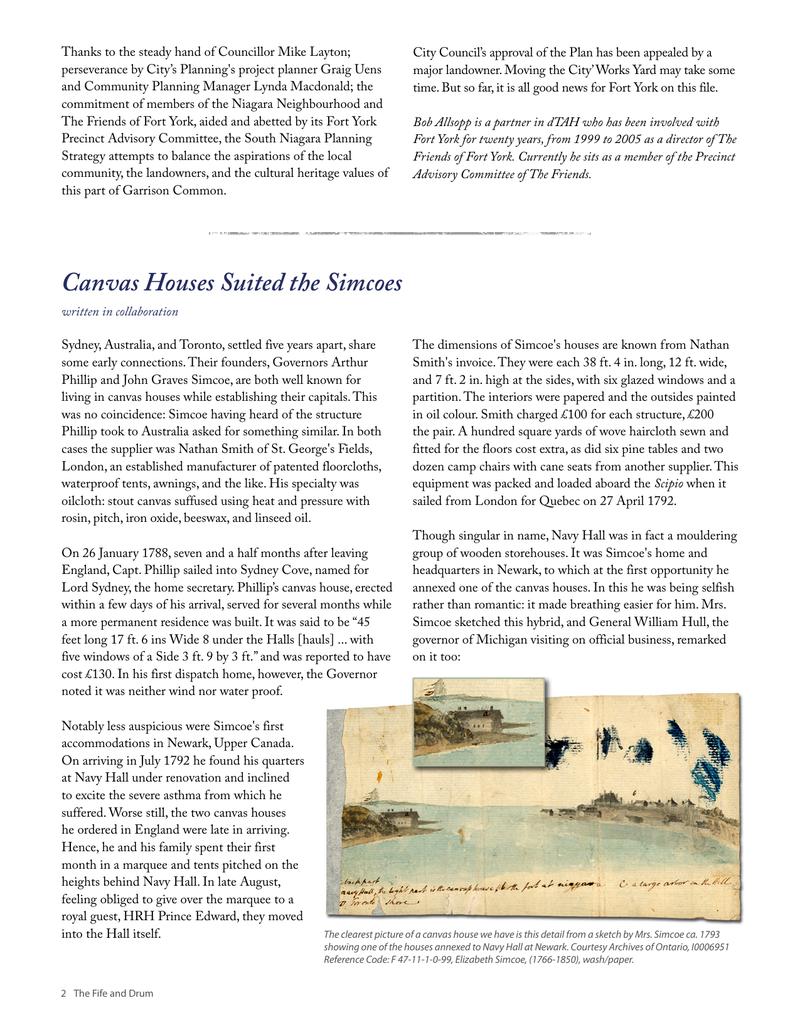
Though singular in name, Navy Hall was in fact a mouldering group of wooden storehouses. It was Simcoe’s home and headquarters in Newark, to which at the first opportunity he annexed one of the canvas houses. In this he was being selfish rather than romantic: it made breathing easier for him. Mrs. Simcoe sketched this hybrid, and General William Hull, the governor of Michigan visiting on official business, remarked on it too:
Notably less auspicious were Simcoe’s first accommodations in Newark, Upper Canada. On arriving in July 1792 he found his quarters at Navy Hall under renovation and inclined to excite the severe asthma from which he suffered. Worse still, the two canvas houses he ordered in England were late in arriving. Hence, he and his family spent their first month in a marquee and tents pitched on the heights behind Navy Hall. In late August, feeling obliged to give over the marquee to a royal guest, HRH Prince Edward, they moved into the Hall itself.
On my account the Governor ordered supper in his canvas-house, which he brought from Europe. It was joined to his dwelling house. It is a room twenty-two feet by fifteen, with a floor, windows, and doors, and warmed by a stove. It is papered and painted, and you would suppose you were in a common house. The floor is the case for the whole of the room. It is quite a curiosity.
Mrs. Simcoe occupied one of the portable houses during her pregnancy at Newark with daughter Katharine, born in February 1793. “I have taken the canvas house we brought from England for my own apartment; it makes two very comfortable and remarkably warm private rooms,” she said. “The comfort I derived from these apartments was extremely great when I lay in, because, being in a manner separate from the rest of the house, it was so very quiet.”
In winter the houses were boarded for warmth and protection from the snow while the interiors were divided into smaller spaces with carpets and hangings for easier heating. When the viceregal’s returned to Newark both buildings were left at the capital. Occasionally the houses attracted notice, for example, when Peter Russell, administrator of the Province, was lining up accommodation for the Provincial Parliament meeting at York in June 1797:
I beg likewise that you desire Mr. Graham to examine the two Canvas Houses and report the practicability of removing the best of them to the Town, to be raised there for giving Dinners in to the Members of the two Houses; Mr. Pilkington tells me that the Screws which fasten them together will no longer act, and that larger ones must be provided if they are again removed.
They were still standing in 1799 when the officers of Queen’s Rangers invited the town’s upper crust to a Ball “at the Canvas Houses.” Also in August 1801 when a dozen carpenters and four masons made repairs to the structures, likely to level and rebuild the floors, weakened perhaps by too many dances.
How to explain the tradition that Simcoe acquired the canvas houses at a sale of Capt. Cook’s effects? In fact, neither Simcoe nor his wife mention their equipment having a Cook connection and no record of a sale of Cook’s effects has been found. Henry Scadding writing in 1873 may have been the first to assert a link: “The canvas house had been the property of Capt. Cook.” But we know this is untrue; both houses came from Nathan Smith’s factory in London, as confirmed by his invoices. Undeterred, John Ross Robertson said Simcoe may have acquired a tent that Cook used in 1769 to observe the Transit of Venus on Tahiti. But could a tent which last saw hard service before 1770 have survived in usable condition into the 1790s? For our part, we leave it to others to confirm this myth where we have failed.
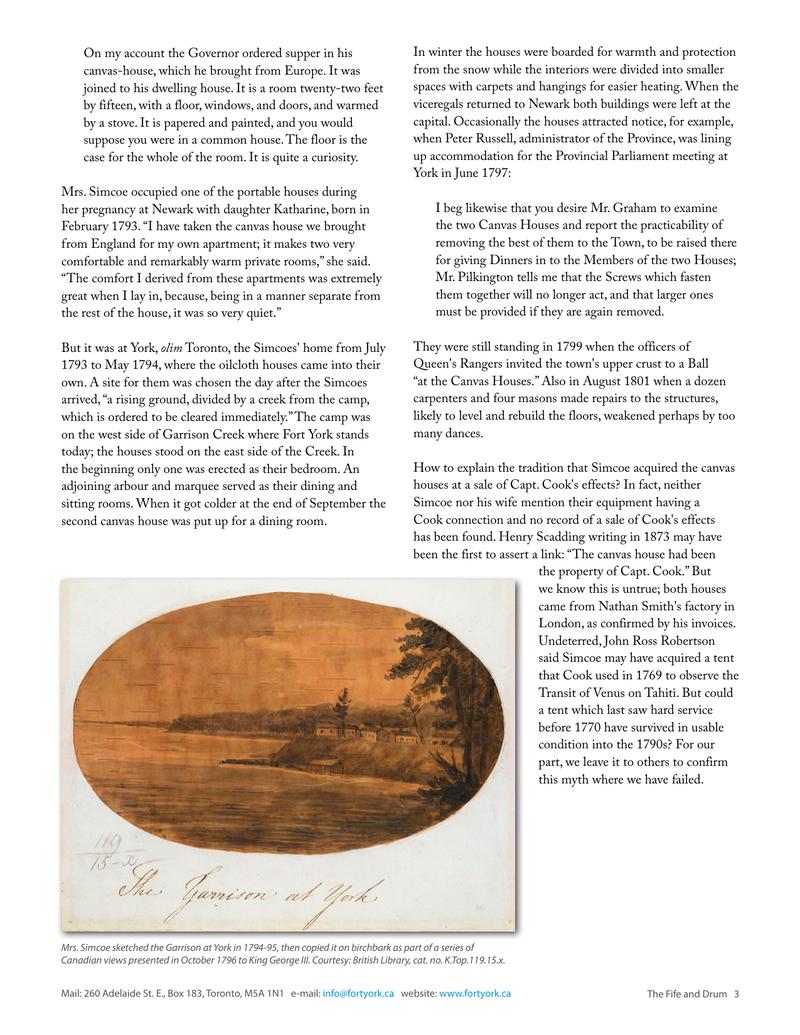
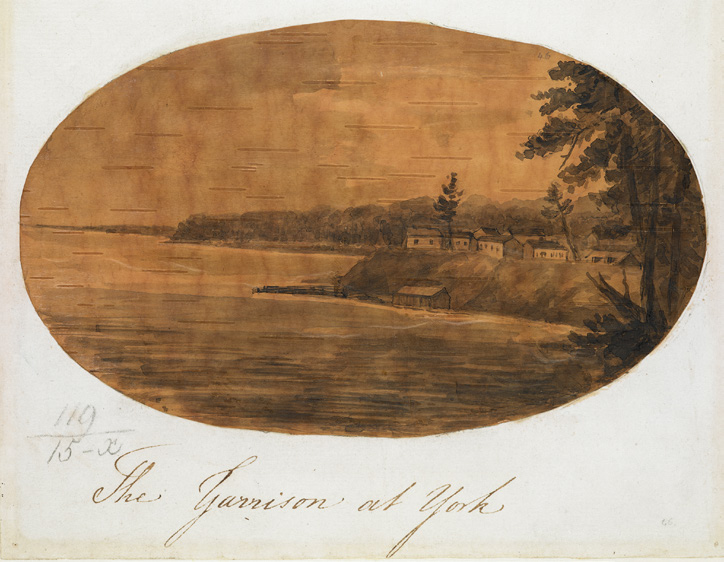
But it was at York, olim Toronto, the Simcoes’ home from July 1793 to May 1794, where the oilcloth houses came into their own. A site for them was chosen the day after the Simcoes arrived, “a rising ground, divided by a creek from the camp, which is ordered to be cleared immediately.” The camp was on the west side of Garrison Creek where Fort York stands today; the houses stood on the east side of the Creek. In the beginning only one was erected as their bedroom. An adjoining arbour and marquee served as their dining and sitting rooms. When it got colder at the end of September the second canvas house was put up for a dining room.
Original printed pages