↗ View this article in the original PDF newsletter
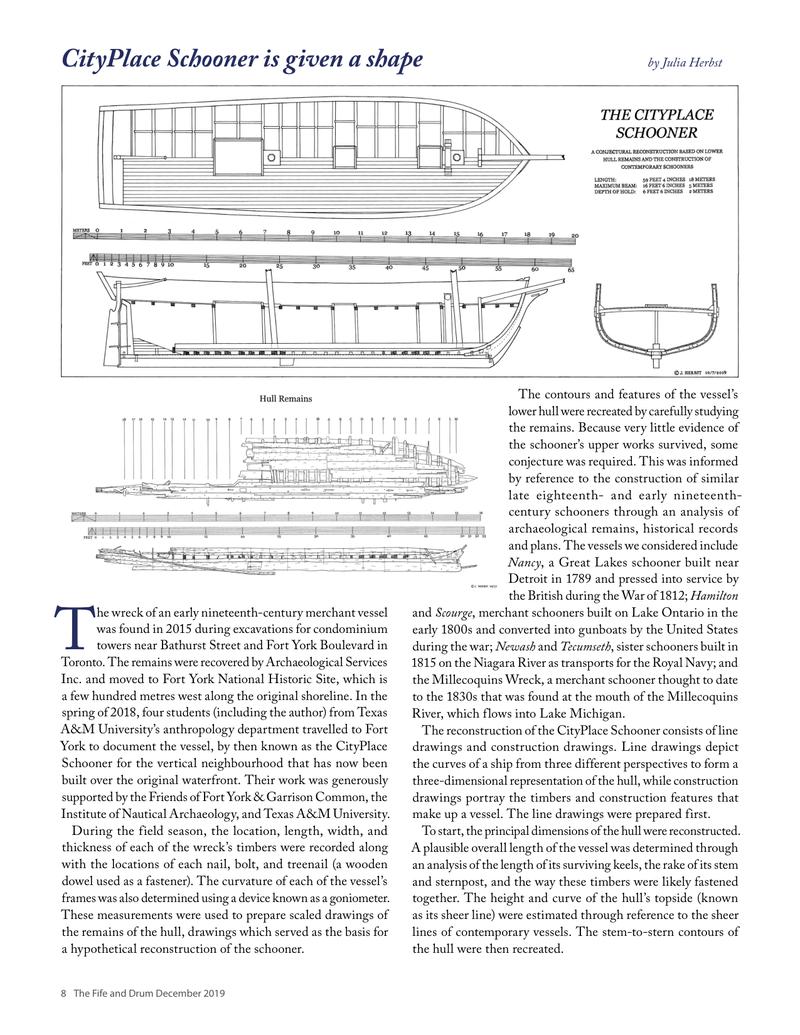
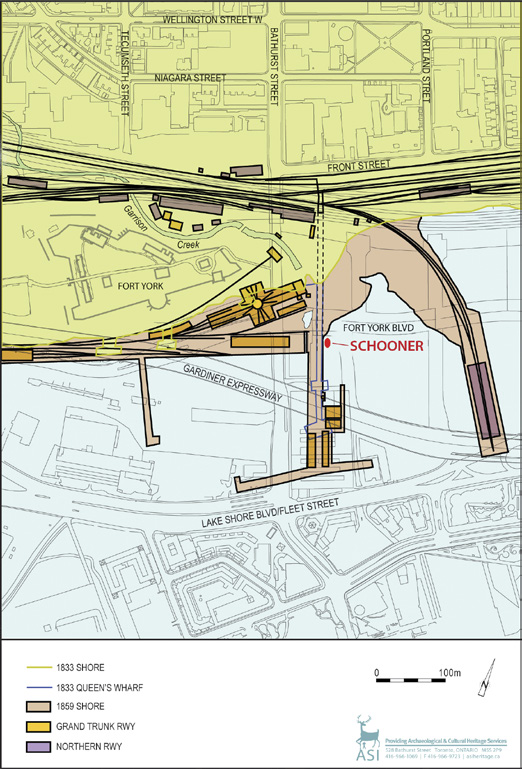
The wreck of an early nineteenth-century merchant vessel was found in 2015 during excavations for condominium towers near Bathurst Street and Fort York Boulevard in Toronto. The remains were recovered by Archaeological Services Inc. and moved to Fort York National Historic Site, which is a few hundred metres west along the original shoreline. In the spring of 2018, four students (including the author) from Texas A&M University’s anthropology department travelled to Fort York to document the vessel, by then known as the CityPlace Schooner for the vertical neighbourhood that has now been built over the original waterfront. Their work was generously supported by the Friends of Fort York & Garrison Common, the Institute of Nautical Archaeology, and Texas A&M University. During the field season, the location, length, width, and thickness of each of the wreck’s timbers were recorded along with the locations of each nail, bolt, and treenail (a wooden dowel used as a fastener). The curvature of each of the vessel’s frames was also determined using a device known as a goniometer. These measurements were used to prepare scaled drawings of the remains of the hull, drawings which served as the basis for a hypothetical reconstruction of the schooner.
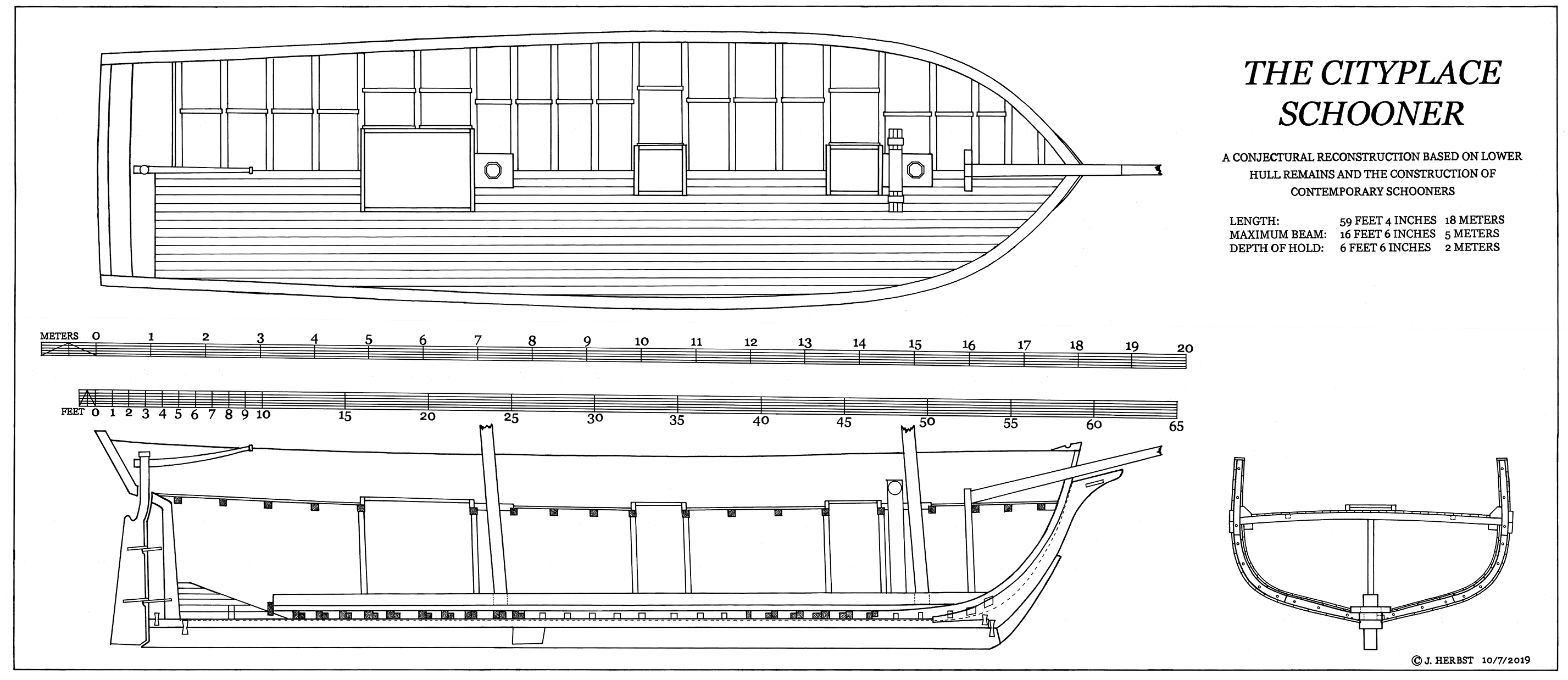
A CONJECTURAL RECONSTRUCTION BASED ON LOWER HULL REMAINS AND THE CONSTRUCTION OF CONTEMPORARY GREAT LAKES SCHOONERS
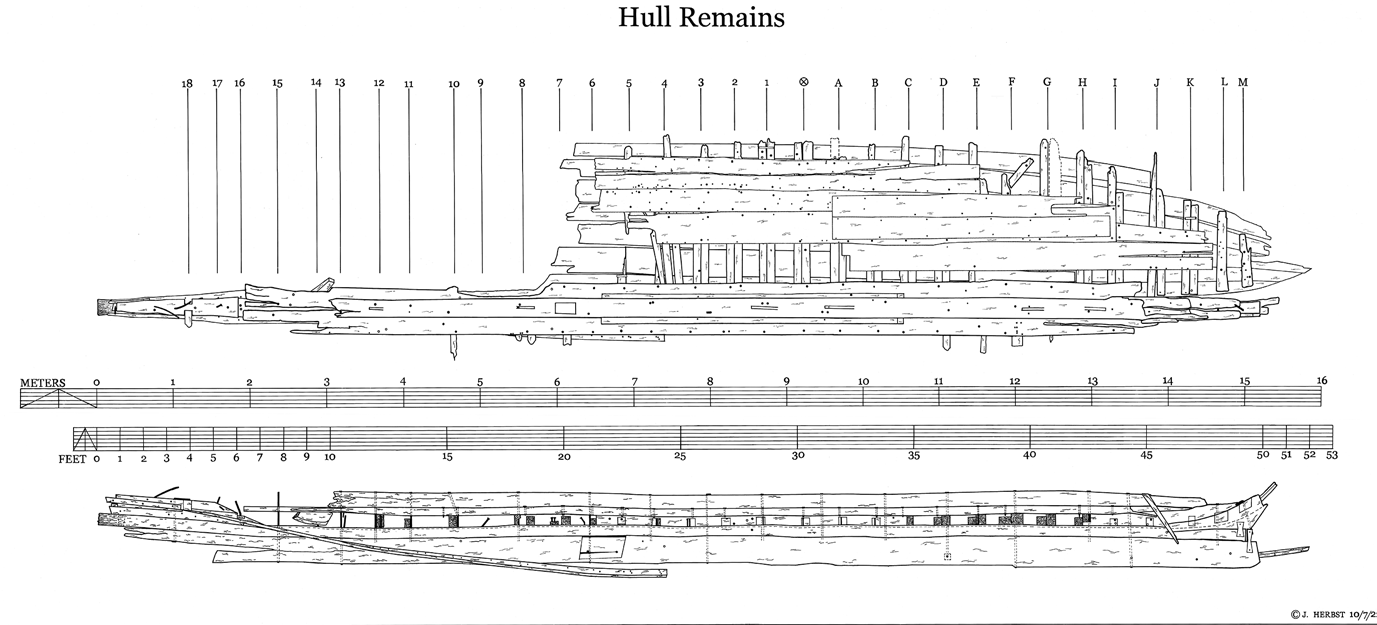
The contours and features of the vessel’s lower hull were recreated by carefully studying the remains. Because very little evidence of the schooner’s upper works survived, some conjecture was required. This was informed by reference to the construction of similar late eighteenth- and early nineteenth-century schooners through an analysis of archaeological remains, historical records and plans. The vessels we considered include Nancy, a Great Lakes schooner built near Detroit in 1789 and pressed into service by the British during the War of 1812; Hamilton and Scourge, merchant schooners built on Lake Ontario in the early 1800s and converted into gunboats by the United States during the war; Newash and Tecumseth, sister schooners built in 1815 on the Niagara River as transports for the Royal Navy; and the Millecoquins Wreck, a merchant schooner thought to date to the 1830s that was found at the mouth of the Millecoquins River, which flows into Lake Michigan.
The reconstruction of the CityPlace Schooner consists of line drawings and construction drawings. Line drawings depict the curves of a ship from three different perspectives to form a three-dimensional representation of the hull, while construction drawings portray the timbers and construction features that make up a vessel. The line drawings were prepared first. To start, the principal dimensions of the hull were reconstructed. A plausible overall length of the vessel was determined through an analysis of the length of its surviving keels, the rake of its stem and sternpost, and the way these timbers were likely fastened together. The height and curve of the hull’s topside (known as its sheer line) were estimated through reference to the sheer lines of contemporary vessels. The stem-to-stern contours of the hull were then recreated.
The midships frame, which was the widest point of the schooner, was reconstructed by following the angle of the surviving remains and completing the upper portion with a fair curve. The shapes of eight other frames, spread out along the vessel’s keel, were then recreated using a similar method. To complete its overall form, the schooner’s depth of hold (the height of its deck) was estimated through an analysis of the depths of hold of contemporary vessels.
The result is a relatively small vessel with a design that favoured carrying capacity over speed. As reconstructed, the schooner had an overall length of 59 feet, 4 inches, a maximum beam of 16 feet, 6 inches, and a depth of hold of 6 feet, 6 inches.
a design that favoured carrying capacity over speed
The drawings of the hull’s remains and the reconstructed lines were then used to prepare the vessel’s construction drawings. The lower portion of the hull was recreated by continuing the wreck’s surviving timbers to their likely termination points based upon the surrounding construction features and through reference to similar features on contemporary vessels. Because there was so little preserved structure, the reconstruction of the schooner’s upper works (including the deck, its supporting structure, and its features) required additional reliance on the construction of similar, contemporary vessels. After all the structural components were completed, features that would have been necessary for the vessel’s operation were added, such as a rudder and tiller for steering and a windlass (a horizontal winch) to raise and lower the anchor.
The identity of the CityPlace Schooner remains unknown. Searches of Toronto’s harbour records, old newspapers, and online databases like that of the Wisconsin Maritime Museum have not yet revealed any definitive information about the vessel, its construction or its modification. Moreover, it is unlikely that its demise would have been recorded at the time, as it appears to have been abandoned after heavy use; the disposal of dilapidated vessels is not typically newsworthy. Dendrochronology and species testing of the wreck’s timbers may yet provide more information on the date and location of the vessel’s original construction and modification, which could help narrow the search, but none of that work has been planned.
When the remains were found, they were located alongside the buried remains of the original Queen’s Wharf. The vessel was painted south. ASI conducted a preliminary analysis of the wreck when it was discovered and was able to tentatively date its construction to the late 1820s or early 1830s, based in part on the recovered artifacts. These include a United States Coronet Head cent, likely dating to 1828, which was found in the vessel’s aft mast step. The wreck was discovered within the remains of a shore wall that was built in the 1870s, indicating that the vessel had sunk, been abandoned or scuttled by then.
Because of its unknown identity and the wreck’s deterioration, the original appearance of the schooner cannot be precisely known. However, through an analysis of the surviving remains and the construction of contemporary vessels, we have prepared a plausible reconstruction. The drawings provide some insight into the vessel’s construction and use as well as the development of shipbuilding practices on the Great Lakes during the early nineteenth century.
Original printed pages