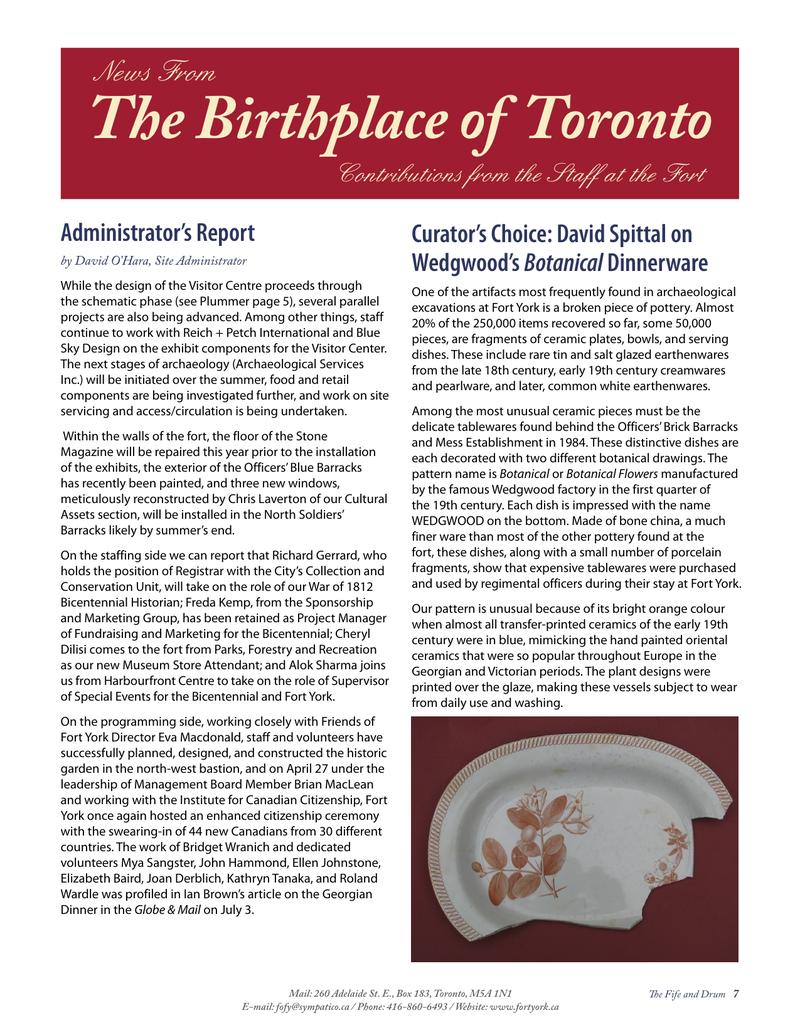
Curator’s Choice: David Spittal on Wedgwood’s Botanical Dinnerware One of the artifacts most frequently found in archaeological excavations at Fort York is a broken piece of pottery. Almost 20% of the 250,000 items recovered so far, some 50,000 pieces, are fragments of ceramic plates, bowls, and serving dishes. These include rare tin and salt glazed earthenwares from the late 18th century, early 19th century creamwares and pearlware, and later, common white earthenwares. Among the most unusual ceramic pieces must be the delicate tablewares found behind the Officers’ Brick Barracks and Mess Establishment in 1984. These distinctive dishes are each decorated with two different botanical drawings. The pattern name is Botanical or Botanical Flowers manufactured by the famous Wedgwood factory in the first quarter of the 19th century. Each dish is impressed with the name WEDGWOOD on the bottom. Made of bone china, a much finer ware than most of the other pottery found at the fort, these dishes, along with a small number of porcelain fragments, show that expensive tablewares were purchased and used by regimental officers during their stay at Fort York. Our pattern is unusual because of its bright orange colour when almost all transfer-printed ceramics of the early 19th century were in blue, mimicking the hand painted oriental ceramics that were so popular throughout Europe in the Georgian and Victorian periods. The plant designs were printed over the glaze, making these vessels subject to wear from daily use and washing.
Ceramics with the design under the glaze are less susceptible to fading and wear. The interlacing ovals on the rim are also overglaze, as is the heavy, hand painted gold line. In addition to their noteworthy colour and decorating technique, the Botanical dishes stand out because of the number of sherds found in one place. In fact, it is not the number of pieces found but the number of nearly complete vessels. A half-dozen dinner plates, several serving platters, and several broad soup plates were recovered, all of them nearly complete. This is very unusual in the archaeological record where each broken dish is represented by only one small fragment. Complete or even nearly complete dishes are very rare. In this case, a large part of a dinner service was found in one spot. We can only surmise why these dishes were in the midden behind the Officers’ Mess. It seems apparent that a whole set, or at least many dishes from one set, were thrown away at the same time and in the same place. The breaks on the dishes show that they were not broken before they were discarded. The reason for discarding an expensive set of dishes is hard to imagine. One explanation is that they were thrown away by their officer owners when the regiment left Fort York and returned to England. Table services like this one, however, were normally owned by a regimental mess and would have accompanied that mess wherever it went.
The botanical prints on these dishes illustrate the widespread passion of Georgian and Victorian Britain to collect, classify, and illustrate new plant and animal species. A table in the Officers’ Mess set with this service would have provided a virtual herbarium of plants from around the world at every meal. The genus on the 12-inch serving platter illustrated here is probably Carissa (Natal Plum).
It is important to note here that a devastating outbreak of cholera occurred in 1832 in the Town of York and that the garrison was not exempt from this disease. Indeed, many sick were housed in the buildings of the fort during this time. A regiment experiencing this dread disease might have abandoned some of its possessions as it left, throwing away entire sets of dishes. Or the next regiment arriving at the fort may have found dishes and other articles still in the mess and, fearing the spread of disease, discarded the contents. Additional artifacts in the midden include large fragments of blue printed ceramics, lead crystal glass, finely painted porcelain teacup sherds, a creamware tureen lid, bottles, and many other items. Of the fifty or so identified patterns of decorated pottery found at the fort, Wedgwood’s Botanical has actually been recorded in more places than any other pattern. Seen so far in at least fifteen different layers and places in the fort, Botanical has been found not only in the midden behind the Officers’ Mess but as far away as Blockhouse Number 2. The presence of this distinctive pattern in so many places shows the complex ways in which artifacts and soils are deposited and re-deposited on an archaeological site.
Original printed pages