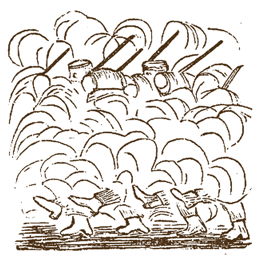
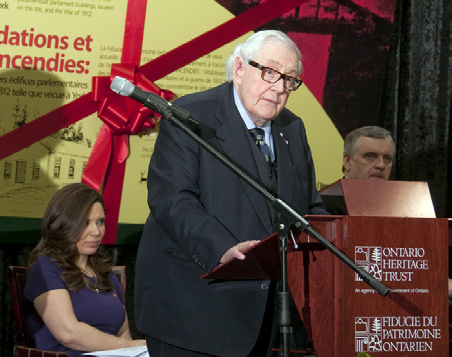
With the kind permission of Dr. Symons we present here an excerpt from his remarks at the launch of Heritage Week and the Opening of the Parliament Interpretive Centre, featuring the exhibit Foundations & Fire: Early Parliament and the War of 1812 Experience at York.
This year, Heritage Week takes on a particular significance as Ontario reflects on the theme of “defending a nation” through its commemoration of the Bicentennial of the War of 1812. The opening of the Interpretive Centre here today, and the numerous special events and initiatives taking place across Ontario this week, and in the months to come, demonstrate the central place of this conflict within the collective memory and symbolic experience of the Province.
In this year of its Bicentennial, the War of 1812 can be remembered as the most traumatic event in the history of Ontario. Put simply, the Province was attacked and invaded. It resisted and, indeed, successfully expelled the invaders, but not before its young capital city, including this very site, was captured and burned. And, in an early example of a different kind of reciprocity, the Royal Navy and British forces responded by capturing Washington and burning the White House.
In what was then Upper Canada, the War brought together disparate elements of the Province’s small population in defence of its territory and institutions. Aboriginal Peoples, United Empire Loyalists, French-speaking inhabitants, members of the Black community, and many other settlers, fought alongside British Regulars, achieving a remarkable degree of success against a much larger opponent.
While much of the fighting, and a good deal of the fiercest fighting, took place in or in relationship to Upper Canada, Quebec and Atlantic Canada were also directly affected and involved in the struggle with the United States. The War precipitated a closer relationship between the British North American colonies, reminding them of common interests and much shared heritage, and laying the seeds for a confederation to come and for its extension in due time to the West and to the North.
There may be debate as to who won the War of 1812. But for Canadians the answer is clear. Had there been a different outcome, as desired by the invaders, there would be no Canada today. The successful defence of this Province was the cornerstone in the struggle for a yet unborn nation to survive.
The War of 1812 therefore represents a crucial point in the evolution of this Province’s identity, institutions, and values. But, as we commemorate the War’s Bicentennial here in Ontario, and across the country, we should realize that there is also much for Canada and the United States to celebrate together. In particular, the gradual emergence of a state of permanent peace between our two countries arising from the steady growth of the view that discourse and negotiation are the correct and only way for two such neighbours to resolve differences. This, too, is ample cause for rejoicing.
Out of the ashes of 1813, came the opportunity to build a province and a nation with an identity distinct from that of its neighbour to the south, and with a unique and evolving role to play within North America, within the Commonwealth, and on the world stage.
As we gather here today, at this historic site, to celebrate Heritage Week, I cannot think of a more appropriate place from which to consider the growth of a province and a nation.
This site is of great heritage value to Toronto, to Ontario, and to Canada. As the location of Upper Canada’s first purpose-built parliament buildings, it played an important role in the evolution and development of the Province’s democratic traditions.
Legislation passed at this site contributed to the further development of the Province’s military, legal, political, social, and economic institutions and practices. Much of the planning and preparations for the successful defence of the Province was done here. At the same time, more was added to an already significant legislative record, which included the adoption of a resolution as early as June 1793, acknowledging French language rights in the Province by stipulating “that such Acts as have already passed or may hereafter pass at the Legislature of this Province be translated into the French language for the benefit of the Western District of this province and other French settlers who may come to reside within this Province.”
The first anti-slavery legislation in the British Empire was also passed by the Province’s Legislature, meeting at Newark in 1793. This legislation set the stage for the abolition of the transatlantic slave trade by Britain in 1807 and the outright abolition of slavery across the British Empire on August 1, 1834, three decades before its abolition in the United States. An important point of pride not only for Ontarians, but for people concerned with parliamentary government and civil liberties everywhere.
Legislation specific to this site continued to promote the welfare and well-being of the citizens of Upper Canada, including An Act to provide for the Education and Support of Orphan Children; An Act for the better regulation of the practice of Law; and An Act to establish Public Schools in each and every District of this Province. Such measures represented a truly impressive record of progressive legislation for such a young province.
With the opening of the Interpretive Centre here today, the Ontario Heritage Trust looks forward to continuing to work with members of the community; with local, provincial, and federal organizations; and with First Nations, whose members played such a key role in the successful defence of the Province, to achieve and maintain the shared goal of protecting and commemorating this significant site.
Original printed pages