Like many early Canadian companies in the food business, the Moffat Stove Company of Weston, Ontario, published its own cookbook “with the object,” it said, “of standardizing Canadian cookery.” According to Elizabeth Driver’s Culinary Landmarks, the recipes were solicited from the public and organized by an unnamed teacher.
She was probably Margaret Davidson, who was then the Director of Domestic Science at the entirely up-to-date Toronto Technical School (which has become the familiar Central Tech). By including reference tables and sample menus, the Moffat cookbook made itself useful as a textbook, too.
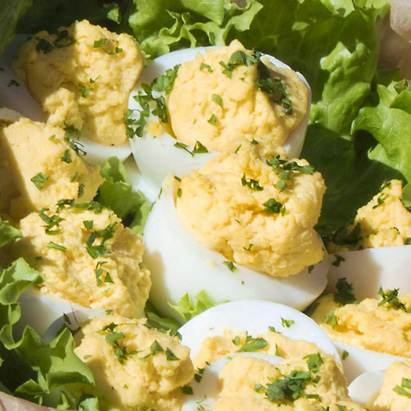
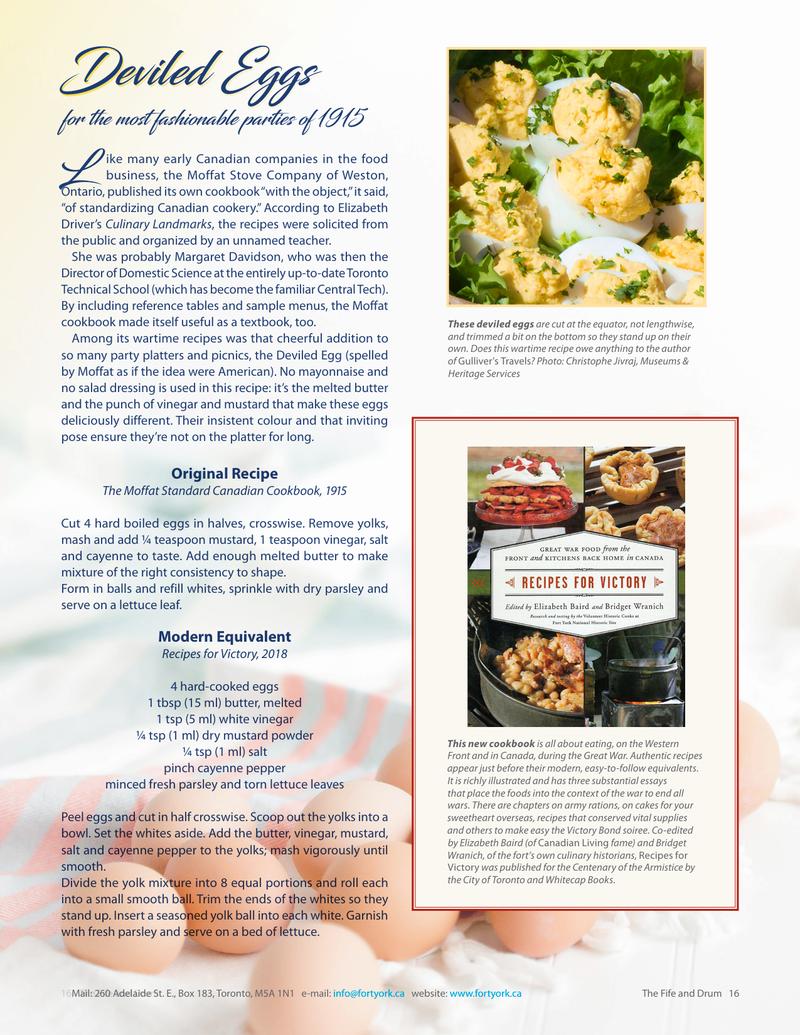
Among its wartime recipes was that cheerful addition to so many party platters and picnics, the Deviled Egg (spelled by Moffat as if the idea were American). No mayonnaise and no salad dressing is used in this recipe: it’s the melted butter and the punch of vinegar and mustard that make these eggs deliciously different. Their insistent colour and that inviting pose ensure they’re not on the platter for long.
Original Recipe
The Moffat Standard Canadian Cookbook, 1915
Cut 4 hard boiled eggs in halves, crosswise. Remove yolks, mash and add ¼ teaspoon mustard, 1 teaspoon vinegar, salt and cayenne to taste. Add enough melted butter to make mixture of the right consistency to shape. Form in balls and refill whites, sprinkle with dry parsley and serve on a lettuce leaf.
Modern Equivalent
Recipes for Victory, 2018
4 hard-cooked eggs
1 tbsp (15 ml) butter, melted
1 tsp (5 ml) white vinegar
¼ tsp (1 ml) dry mustard powder
¼ tsp (1 ml) salt
pinch cayenne pepper
minced fresh parsley and torn lettuce leaves
Peel eggs and cut in half crosswise. Scoop out the yolks into a bowl. Set the whites aside. Add the butter, vinegar, mustard, salt and cayenne pepper to the yolks; mash vigorously until smooth.
Divide the yolk mixture into 8 equal portions and roll each into a small smooth ball. Trim the ends of the whites so they stand up. Insert a seasoned yolk ball into each white. Garnish with fresh parsley and serve on a bed of lettuce.

Original printed pages