The declaration of war in early August 1914 was not a surprise to Torontonians. The newspapers had warned of the possibility for months and throughout that summer residents paid close attention to events in Europe. Indeed, on the Civic Holiday of 3 August 1914 thousands gathered at newspaper offices for the latest news when they could have been at a city park or enjoying an excursion to the Toronto Islands. A few days later, the Toronto Star reported sales of 100,000 copies of its Extra edition containing the news that on 4 August 1914 Great Britain had declared war on Germany and that perforce, Canada was at war.
Within days, officials in Ottawa announced that an expeditionary force of volunteers would be assembled at Valcartier military camp north of Quebec City. Thousands from across Canada, having anticipated war, headed there immediately. From Toronto, men from numerous militia units readily joined the trek, including officers and men from the Queen’s Own Rifles, the 10th Royal Grenadiers, the Governor General’s Body Guard, and the 48th Highlanders. In just a month a Canadian Expeditionary Force of some 30,000 men left for England, arriving at Salisbury Plain in October 1914.

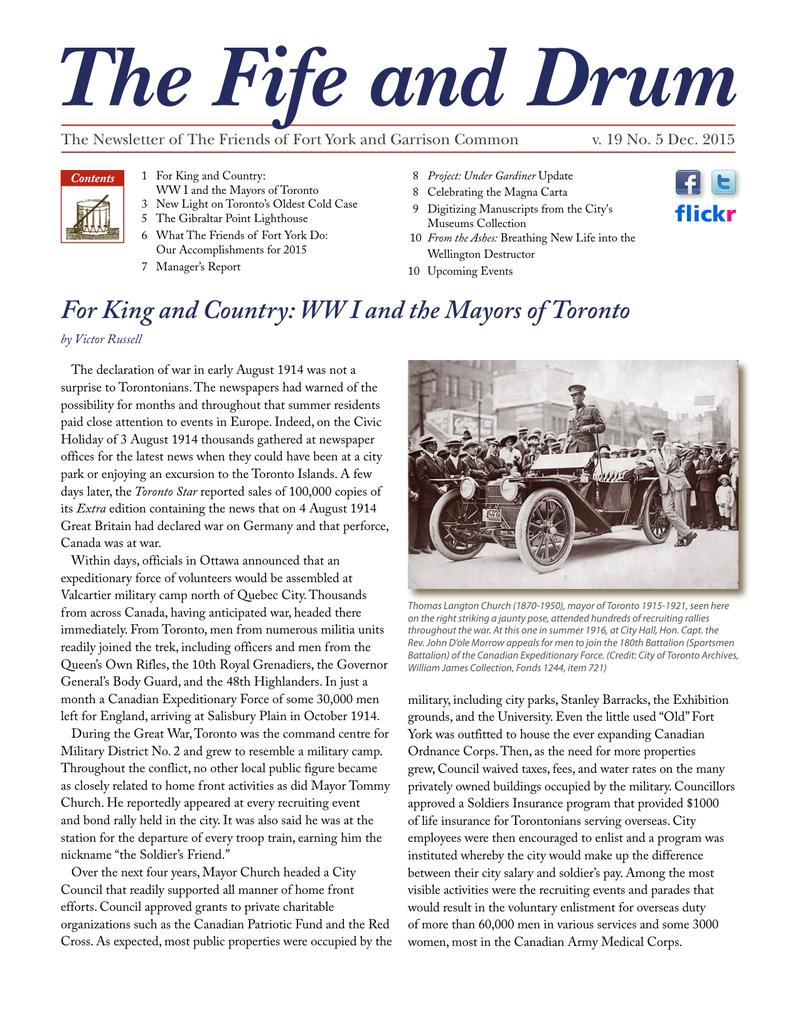
During the Great War, Toronto was the command centre for Military District No. 2 and grew to resemble a military camp. Throughout the conflict, no other local public figure became as closely related to home front activities as did Mayor Tommy Church. He reportedly appeared at every recruiting event and bond rally held in the city. It was also said he was at the station for the departure of every troop train, earning him the nickname “the Soldier’s Friend.”
Over the next four years, Mayor Church headed a City Council that readily supported all manner of home front efforts. Council approved grants to private charitable organizations such as the Canadian Patriotic Fund and the Red Cross. As expected, most public properties were occupied by the military, including city parks, Stanley Barracks, the Exhibition grounds, and the University. Even the little used “Old” Fort York was outfitted to house the ever expanding Canadian Ordnance Corps. Then, as the need for more properties grew, Council waived taxes, fees, and water rates on the many privately owned buildings occupied by the military. Councillors approved a Soldiers Insurance program that provided $1000 of life insurance for Torontonians serving overseas. City employees were then encouraged to enlist and a program was instituted whereby the city would make up the difference between their city salary and soldier’s pay. Among the most visible activities were the recruiting events and parades that would result in the voluntary enlistment for overseas duty of more than 60,000 men in various services and some 3000 women, most in the Canadian Army Medical Corps.

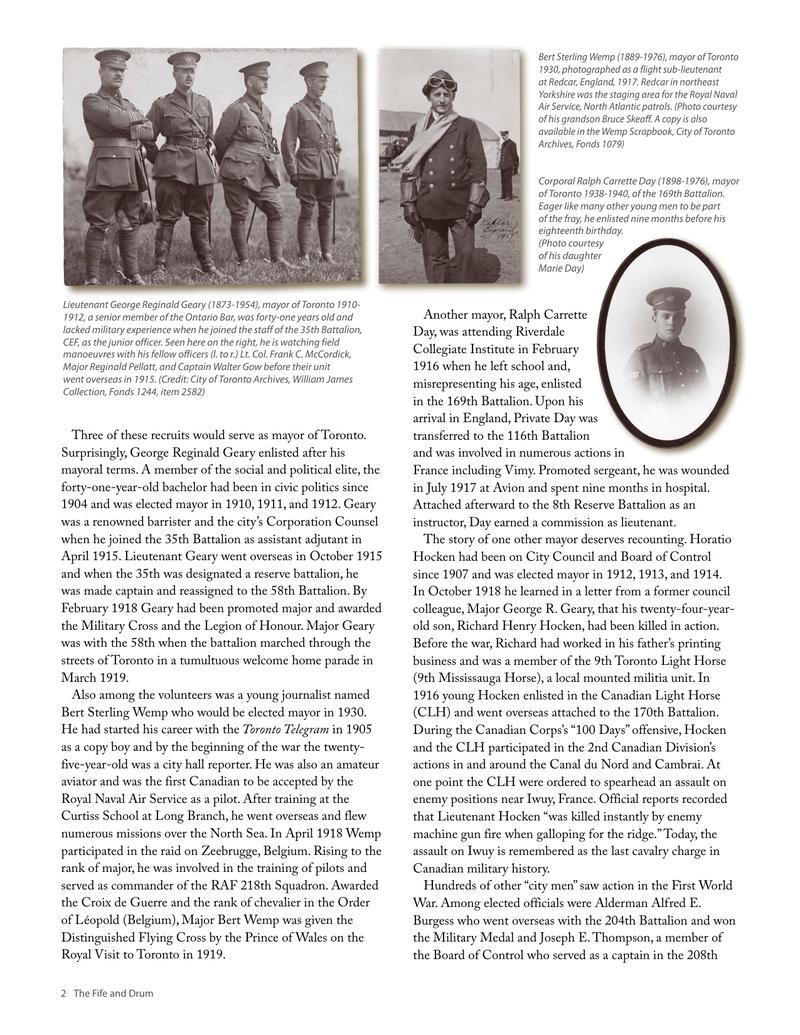
Three of these recruits would serve as mayor of Toronto. Surprisingly, George Reginald Geary enlisted after his mayoral terms. A member of the social and political elite, the forty-one-year-old bachelor had been in civic politics since 1904 and was elected mayor in 1910, 1911, and 1912. Geary was a renowned barrister and the city’s Corporation Counsel when he joined the 35th Battalion as assistant adjutant in April 1915. Lieutenant Geary went overseas in October 1915 and when the 35th was designated a reserve battalion, he was made captain and reassigned to the 58th Battalion. By February 1918 Geary had been promoted major and awarded the Military Cross and the Legion of Honour. Major Geary was with the 58th when the battalion marched through the streets of Toronto in a tumultuous welcome home parade in March 1919.

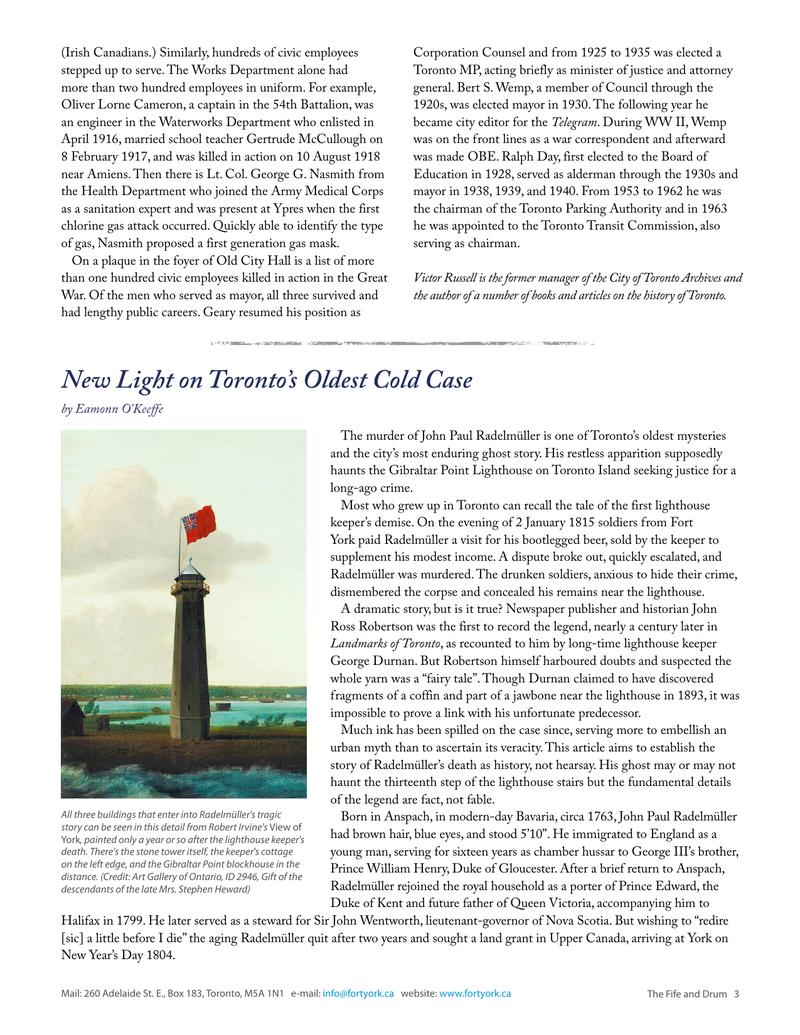
Also among the volunteers was a young journalist named Bert Sterling Wemp who would be elected mayor in 1930. He had started his career with the Toronto Telegram in 1905 as a copy boy and by the beginning of the war the twenty-five-year-old was a city hall reporter. He was also an amateur aviator and was the first Canadian to be accepted by the Royal Naval Air Service as a pilot. After training at the Curtiss School at Long Branch, he went overseas and flew numerous missions over the North Sea. In April 1918 Wemp participated in the raid on Zeebrugge, Belgium. Rising to the rank of major, he was involved in the training of pilots and served as commander of the RAF 218th Squadron. Awarded the Croix de Guerre and the rank of chevalier in the Order of Léopold (Belgium), Major Bert Wemp was given the Distinguished Flying Cross by the Prince of Wales on the Royal Visit to Toronto in 1919.

Another mayor, Ralph Carrette Day, was attending Riverdale Collegiate Institute in February 1916 when he left school and, misrepresenting his age, enlisted in the 169th Battalion. Upon his arrival in England, Private Day was transferred to the 116th Battalion and was involved in numerous actions in France including Vimy. Promoted sergeant, he was wounded in July 1917 at Avion and spent nine months in hospital. Attached afterward to the 8th Reserve Battalion as an instructor, Day earned a commission as lieutenant.
The story of one other mayor deserves recounting. Horatio Hocken had been on City Council and Board of Control since 1907 and was elected mayor in 1912, 1913, and 1914. In October 1918 he learned in a letter from a former council colleague, Major George R. Geary, that his twenty-four-year-old son, Richard Henry Hocken, had been killed in action. Before the war, Richard had worked in his father’s printing business and was a member of the 9th Toronto Light Horse (9th Mississauga Horse), a local mounted militia unit. In 1916 young Hocken enlisted in the Canadian Light Horse (CLH) and went overseas attached to the 170th Battalion. During the Canadian Corps’s “100 Days” offensive, Hocken and the CLH participated in the 2nd Canadian Division’s actions in and around the Canal du Nord and Cambrai. At one point the CLH were ordered to spearhead an assault on enemy positions near Iwuy, France. Official reports recorded that Lieutenant Hocken “was killed instantly by enemy machine gun fire when galloping for the ridge.” Today, the assault on Iwuy is remembered as the last cavalry charge in Canadian military history.
Hundreds of other “city men” saw action in the First World War. Among elected officials were Alderman Alfred E. Burgess who went overseas with the 204th Battalion and won the Military Medal and Joseph E. Thompson, a member of the Board of Control who served as a captain in the 208th (Irish Canadians.) Similarly, hundreds of civic employees stepped up to serve. The Water Department, for instance, had more than two hundred employees in uniform. For example, Oliver Lorne Cameron, a captain in the 54th Battalion, was an engineer in the Waterworks Department who enlisted in April 1916, married school teacher Gertrude McCullough on 8 February 1917, and was killed in action on 10 August 1918 near Amiens. Then there is Lt. Col. George G. Nasmith from the Health Department who joined the Army Medical Corps as a sanitation expert and was present at Ypres when the first chlorine gas attack occurred. Quickly able to identify the type of gas, Nasmith proposed a first generation gas mask.
On a plaque in the foyer of Old City Hall is a list of more than one hundred civic employees killed in action in the Great War. Of the men who served as mayor, all three survived and had lengthy public careers. Geary resumed his position as Corporation Counsel and from 1925 to 1935 was elected a Toronto MP, acting briefly as minister of justice and attorney general. Bert S. Wemp, a member of Council through the 1920s, was elected mayor in 1930. The following year he became city editor for the Telegram. During WW II, Wemp was on the front lines as a war correspondent and afterward was made OBE. Ralph Day, first elected to the Board of Education in 1928, served as alderman through the 1930s and mayor in 1938, 1939, and 1940. From 1953 to 1962 he was the chairman of the Toronto Parking Authority and in 1963 he was appointed to the Toronto Transit Commission, also serving as chairman.
Original printed pages