↗ View this article in the original PDF newsletter
Fort York famously was isolated, in that particularly silly Toronto way where things like railway tracks create nearly insurmountable psychological barriers. Though just on the edge of downtown, it was just over-the-way enough to feel like a trek. Those who come to the fort by car don’t experience this as driving distorts how cities are put together by compressing distance, but most everyone else comes via the Bathurst bridge, either on foot or by streetcar. It was the most direct route from downtown or otherwise, but the route passed through a bit of desolate territory over and before the tracks, the kind that makes even brief distances seem longer. When walking through a dense urban area, the distractions keep us from thinking about the walk. So the fort remained over there rather than right here.
For years much of the land around the fort was impenetrable to the average Torontonian. The urban explorers and nighttime infiltrators might likely have entered the old Molson’s plant that stood on the north side of Lake Shore Boulevard, or wandered into the cement yard that helped supply Toronto’s building boom for the last decade, but for most everyone else it was one of those chunks of the city that became black holes on our mental maps. Add in the Gardiner running along the top of this small industrial parcel and it was an official nowhere. We manoeuvred around it to get to where we were going; to Fort York, the CNE, or we drove by it on the way in to or out of downtown without a thought.
That’s changed, radically. Over the last half-decade or so, those industrial operations between the Gardiner and Lake Shore have been removed. First Molson’s was demolished, and then finally the cement trucks went elsewhere for their loads. Holes were dug, cranes were erected, and what seemed like an eternal construction site has slowly given way to a partial neighbourhood. Partial because it’s still half under construction but there’s enough there now to see the form and shape of the neighbourhood that’s been created here.
What’s most remarkable is that what was impenetrable is now permeable, with streets and other passages crossing the area. This means there’s a new way to get to the fort, from the south, previously an unappealing stop due to the walk around the industrial buildings. The 509 Harbourfront streetcar line stops two blocks south of the fort and from there the fortifications and tops of the blockhouses are visible. These new, albeit narrow, vistas are as close as we can get to seeing the fort as somebody might have during the War of 1812, aboard a ship a few hundred metres out in the lake, perhaps on the attack. The Gardiner is conveniently high enough to see under and it also marks where the original shoreline was. Suddenly, the fort has a new public transit route direct from Union Station.
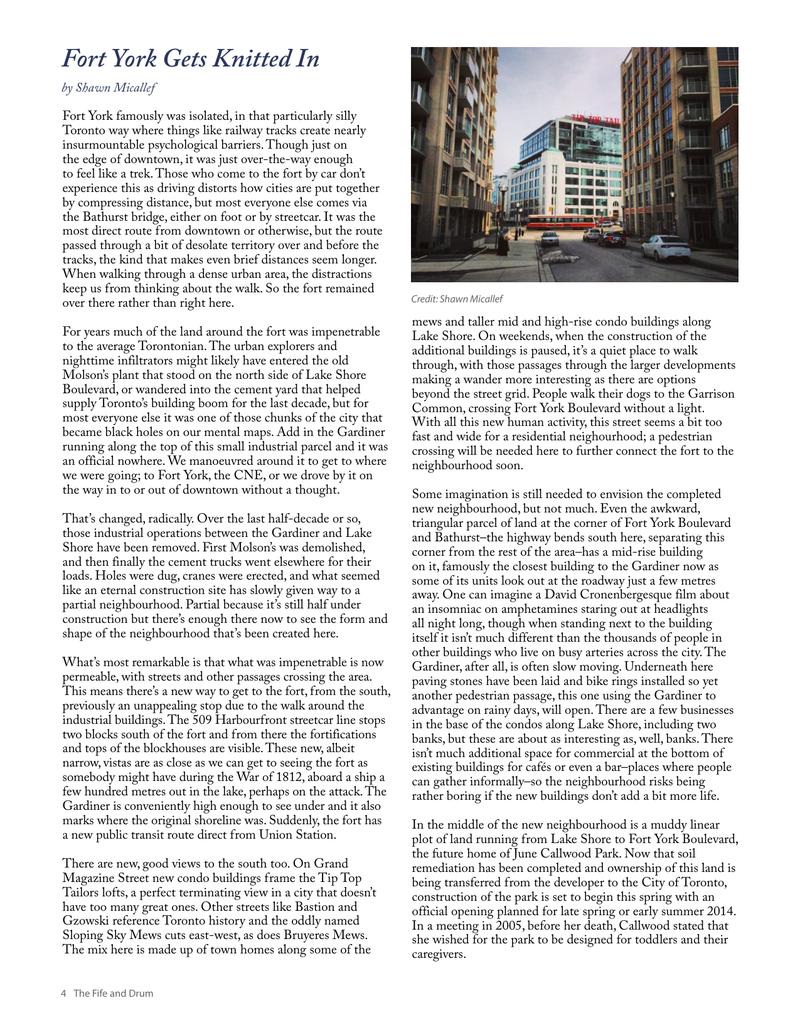
There are new, good views to the south too. On Grand Magazine Street new condo buildings frame the Tip Top Tailors lofts, a perfect terminating view in a city that doesn’t have too many great ones. Other streets like Bastion and Gzowski reference Toronto history and the oddly named Sloping Sky Mews cuts east-west, as does Bruyeres Mews. The mix here is made up of town homes along some of the mews and taller mid and high-rise condo buildings along Lake Shore. On weekends, when the construction of the additional buildings is paused, it’s a quiet place to walk through, with those passages through the larger developments making a wander more interesting as there are options beyond the street grid. People walk their dogs to the Garrison Common, crossing Fort York Boulevard without a light. With all this new human activity, this street seems a bit too fast and wide for a residential neighbourhood; a pedestrian crossing will be needed here to further connect the fort to the neighbourhood soon.
Some imagination is still needed to envision the completed new neighbourhood, but not much. Even the awkward, triangular parcel of land at the corner of Fort York Boulevard and Bathurst–the highway bends south here, separating this corner from the rest of the area–has a mid-rise building on it, famously the closest building to the Gardiner now as some of its units look out at the roadway just a few metres away. One can imagine a David Cronenbergesque film about an insomniac on amphetamines staring out at headlights all night long, though when standing next to the building itself it isn’t much different than the thousands of people in other buildings who live on busy arteries across the city. The Gardiner, after all, is often slow moving. Underneath here paving stones have been laid and bike rings installed so yet another pedestrian passage, this one using the Gardiner to advantage on rainy days, will open. There are a few businesses in the base of the condos along Lake Shore, including two banks, but these are about as interesting as, well, banks. There isn’t much additional space for commercial at the bottom of existing buildings for cafés or even a bar–places where people can gather informally–so the neighbourhood risks being rather boring if the new buildings don’t add a bit more life.
In the middle of the new neighbourhood is a muddy linear plot of land running from Lake Shore to Fort York Boulevard, the future home of June Callwood Park. Now that soil remediation has been completed and ownership of this land is being transferred from the developer to the City of Toronto, construction of the park is set to begin this spring with an official opening planned for late spring or early summer 2014. In a meeting in 2005, before her death, Callwood stated that she wished for the park to be designed for toddlers and their caregivers.
This raises the ongoing issue in Toronto’s new condo neighbourhoods of unit size. Will toddlers even live in these buildings if some aren’t built family sized? Developers have said the market will not bear these larger, more expensive units, though some city councillors are trying to change this.
Unit size and the poor sidewalk commercial levels of the condo buildings were concerns brought up at a recent meeting regarding development of the Ordnance Triangle, just over the tracks to the north. They’re valid concerns for residents but also for the fort, as a vibrant street culture is good for everybody. Once Fort York Boulevard is extended east across Bathurst, the new Toronto Public Library branch and other services in City Place will connect to and continue the fort neighbourhood so there will be more variety and people. When Ordnance is built up there will be continuous life connecting the fort to Liberty Village just across Strachan, and the pedestrian and cycling bridge will further connect with residences due north.
Within a few years the fort will be completely knitted into a continuous urban residential neighbourhood. When that happens, people will come to Fort York from any direction and never think of how far they’ve walked.
Original printed pages