The beehives are buzzing on the grounds of Fort York once more. They’ve been fully restored from the damage they suffered last winter. While still subtle, the security of the apiary has been tightened.
It was in early January when fort staff discovered that three of the seven hives had been badly vandalized, leaving many thousands of bees to die of exposure. Honey was stolen. “We’re heartbroken” tweeted the staff, which had come to know the industrious little critters from their frequent visits to the fort’s community gardens and especially from the delicious honey they’d been supplying to the kitchen.
Productive beehives have been on the fort’s grounds since 2013, when arrangements were made with Toronto Honeys. Not exactly a business, Toronto Honeys is (according to its web site) “a love story between two beekeepers, thousands of bees, and millions of flowers.” The beekeepers are Shawn Caza and Melissa Berney; Shawn calls the project a “passion” that some day “might break even.” Donations from friends of the project—notably the fort’s culinary historians—helped rebuild the hives.
The apiary can produce as much as 250 kg of honey per year and in late summer might house an astonishing 400,000 bees. Provided their hive is not threatened, these bees will ignore admiring humans and forage as far as five kilometres from the hive. Fort York’s bees don’t have to go that far. Within easy range are the abundant wildflowers of the fort’s north slope, flowering trees like basswood, sumac, and especially apple trees—including remnants of orchards in the Niagara neighbourhood—as well as the waterfront Music Garden, where there’s always something blooming.
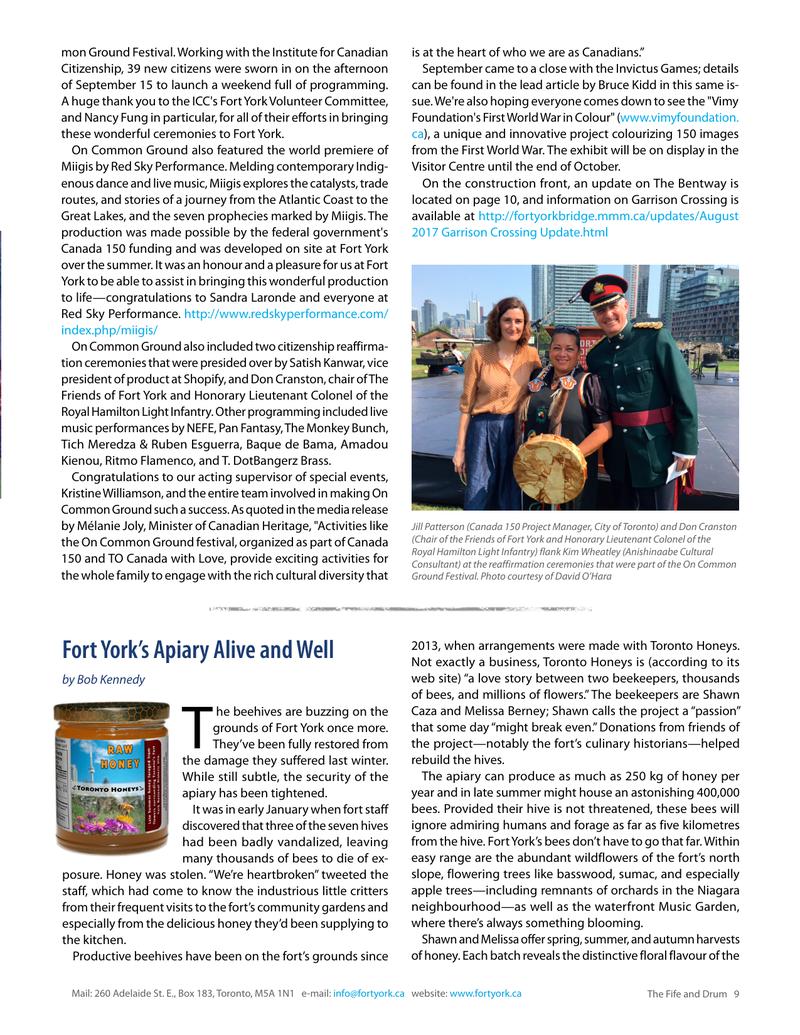
Shawn and Melissa offer spring, summer, and autumn harvests of honey. Each batch reveals the distinctive floral flavour of the season. All of the batches are raw and unfiltered, “straight from comb to jar with beneficial enzymes, traces of pollen and all the other natural goodness of honey intact.”
One who knows the honey well is Bridget Wranich, program officer at the fort and a founder of the Culinary Historians of Canada. “We love using the honey,” she says. Like the produce of the fort’s own gardens, “it’s really a taste of local food.”
Curiously, by Georgian times—the days of Toronto’s earliest settlement and the War of 1812—”the use of honey as a sweetener disappears,” she says. “It had been replaced by cane sugar” of the sort that still arrives here by the boat load. Long before the industrialization of sweetness, though, innovative cooks valued their honey. “We’re working on some medieval recipes that used honey,” Bridget reports, “recipes from the time of the Magna Carta.”
While we look forward to those, Toronto Honeys will be harvesting the autumn labours of Fort York’s congenial honey bees. Jars of their golden fluid are always available for sale in the fort’s well-stocked Canteen.
Original printed pages