↗ View this article in the original PDF newsletter
Archaeology at Fort York dates back sixty years to at least 1956 when staff undertook exploration of the fort’s well prior to its restoration. This was followed by a more ‘scientific’ dig in 1968 along the east wall of the Officers’ Mess to support the restoration of that building. Professional archaeological excavations can be traced to 1973 when the Royal Ontario Museum excavated the former site of the Guardhouse and Artillery Barracks over a period of three years. During the 1990s and 2000s capital projects involving earth moving at the fort were monitored routinely by city archaeologists, although most of the actual field work was completed by contract archaeological firms doing cultural resource management (CRM) assessments prior to and during capital projects. It is the City of Toronto’s Museums and Heritage Services’ (MHS) practice to work with Ontario’s Ministry of Tourism, Culture & Sport to repatriate collections excavated at city museums from the archaeological consultants who excavated them. According to the Ontario Heritage Act (R.S.O. 1990, c. 0.18 (sect.66(1)) artifacts may be held in trust: “The Minister may direct that any artifact taken under the authority of a licence or a permit be deposited in such public institution as the Minister may determine, to be held in trust for the people of Ontario.” As a result, tucked away in MHS storage building are 682 boxes of specimens. The fort’s is by far the largest single collection at 520 boxes but there are another 162 boxes from digs at other city-run museums or where we were the archaeological licence holder. There are even a few antiquarian collections we acquired before the Ontario Heritage Act came into being! Over the last year, we have transferred more than eighty boxes of material from work done at Fort York by Archaeological Services Incorporated and Strata Consulting. In addition, we accepted specimens from Queen’s Wharf (another twelve boxes, plus three ‘big and heavy’ specimens: 50 foot long schooner remains, a sample of wharf cribbing, and 9 foot length of iron U-rail). More accruals are expected from the work now underway for the pedestrian bridge. In most cases the collections come prepared to enter long-term storage, but sometimes re-packaging or conservation treatment can be needed, as is the case for the wooden artifacts recovered with the schooner. Coming out of a wet soil, they needed to be carefully dried and stabilized before they can be packaged for storage. This can require our conservator to occasionally be quite inventive in her approach to treatment (figure 1).
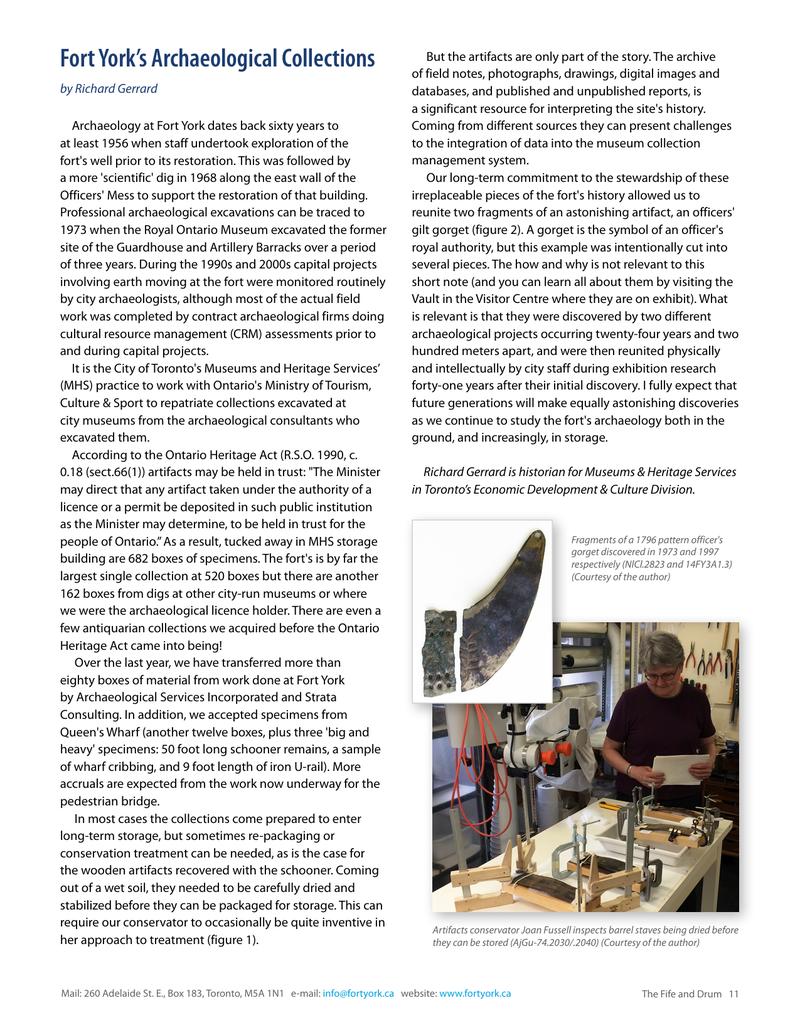
But the artifacts are only part of the story. The archive of field notes, photographs, drawings, digital images and databases, and published and unpublished reports, is a significant resource for interpreting the site’s history. Coming from different sources they can present challenges to the integration of data into the museum collection management system. Our long-term commitment to the stewardship of these irreplaceable pieces of the fort’s history allowed us to reunite two fragments of an astonishing artifact, an officers’ gilt gorget (figure 2). A gorget is the symbol of an officer’s royal authority, but this example was intentionally cut into several pieces. The how and why is not relevant to this short note (and you can learn all about them by visiting the Vault in the Visitor Centre where they are on exhibit). What is relevant is that they were discovered by two different archaeological projects occurring twenty-four years and two hundred meters apart, and were then reunited physically and intellectually by city staff during exhibition research forty-one years after their initial discovery. I fully expect that future generations will make equally astonishing discoveries as we continue to study the fort’s archaeology both in the ground, and increasingly, in storage. Richard Gerrard is historian for Museums & Heritage Services in Toronto’s Economic Development & Culture Division.
Fragments of a 1796 pattern officer’s gorget discovered in 1973 and 1997 respectively (NlCl.2823 and 14FY3A1.3) (Courtesy of the author)

Original printed pages