

It’s not clear whether the previous tenants had made any improvements to the property or erected any buildings. Before long, noted John B. Smith & Sons Limited: Hundredth Anniversary Year (1951), the property contained “offices, a large planing mill and carpenter shops, storage sheds, [a] new wallboard warehouse, three dry-kilns and a paved storage and timber yard” that was three acres in size. The new site—as had each of the company’s previous locations—was situated in close proximity to Toronto’s rail corridors that connected the Smith factory with its sources of timber in northern Ontario.
With a sawmill at Angus, near Barrie, Smith had been harvesting timber from Essa, Tosorontio, and Sunnidale, since the Northern Railway first passed through the area in 1853-54. The company continued to acquire new timber limits and parcels of land between the 1850s and late 1870s. When the availability of timber in the area declined, the company moved its operation further north. The sawmill was established at Frank’s Bay at the mouth of French River on Lake Nipissing in the 1880s, then across the lake to Callander by the turn of the century. According to its centennial publication, the company was “unique in the annals of Canadian lumbering because…it carries out its own operations from the tree to the finished product.”
By the mid-1890s, when the Strachan lumber yard and planing mill was extensively described in Toronto, The Queen City of Canada (1893), “it [was] one of the largest and most important in its line in Canada.” It employed 75 workers (along with another 125 in northern Ontario). The factory occupied a three-storey building, measuring 50 x 225 feet, that was equipped with state-of-the-art machinery to develop the raw timber into “dressed lumber, doors, sash, blinds, mouldings, boxes” shipped to market across North America. More raw wood was used for bridges, hydro-poles and crossarms, and in railway construction. In particular, the company supplied the Toronto Street Railway for fifty years, and the Grand Trunk Railway. Smith lumber was used to build the Great Western Railway Station at the foot of Yonge, as well as the Crystal Palace and Gooderham’s mill, already noted, and for new homes and other construction. The company even provided hardwood flooring for bowling alleys. A second retail stock shed was later operated at Dundas Street and St. Helens Avenue.
John B. Smith died at his Grenville Street house on 7 March 1894. Of Smith’s twelve children from three marriages, three of his sons had been actively involved in the business since at least 1887 (when the firm began operating as John B. Smith & Sons, although it would not be incorporated as such until 1904). One of the sons, William J., headed the company after his father’s death. Upon William’s death in 1925, his brother Robert succeeded him. Their brothers, John M. and James H., managed the sawmill in Callander. After Robert’s 1938 death, Jaffray Smith—the founder’s grandson—took over, followed by his brother Christie in 1950.
Their centennial publication in 1951 boasted of the thriving company’s success and its cutting edge machinery and production techniques. When John B. Smith & Sons ceased operations in 1967, the property was used for a variety of purposes, including as a storage facility for the Toronto Historical Board.
By the 1990s, there was a proposal to reuse the John B. Smith factory for a novel approach to housing the homeless. However, the Homes First Society’s rather innovative idea fell outside the scope of the Ministry of Housing’s strict guidelines. So it took some time for the provincial government to commit the $4 million required for the project.
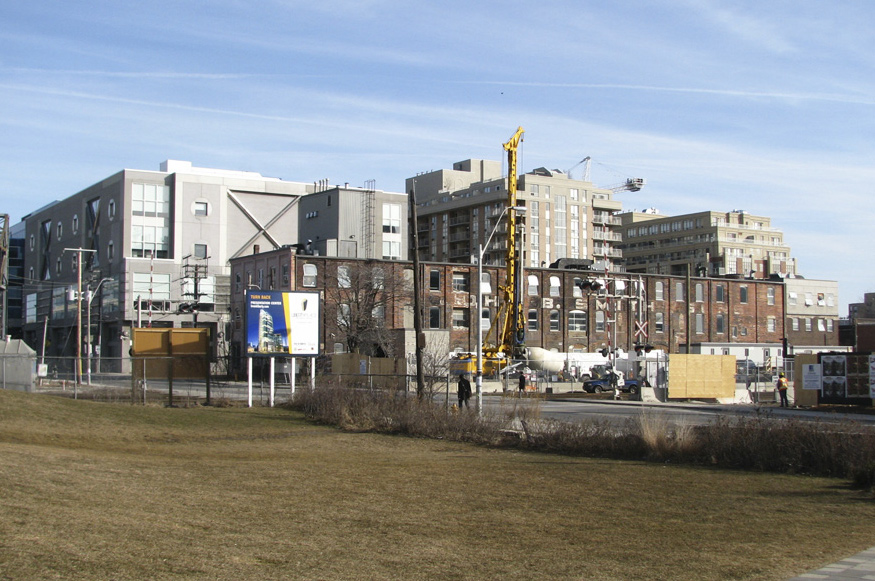
In 1996, the John B. Smith building was reborn as Strachan House. “Half-demolished unpainted brick walls frame the hall,” Rae Bridgman writes in StreetCities (Broadview Press, 2006). “The timber columns and beams, rough lumber, and exterior lighting fixtures all reference the outside brought in.” Within the building, twelve houses contain five to seven private bedrooms, and a shared kitchen, bathroom, and common area. From a front door and porch, each house looks out over an interior street that meanders—widening and narrowing—along the length of the building. Its gypsum concrete floor mimics an exterior roadway, stained, cracked, and embedded with an old screwdriver, a broken bicycle wheel, and other found objects donated by potential tenants. The street leads to a Town Hall, near the old smokestack at the building’s east end, where a glassed-in atrium provides a gathering space for residents. Strachan House’s design, by architects Janna Levitt and Dean Goodman with extensive consultation with those who would be living there, won a Governor General’s Gold Medal for Architecture in 1999.
“The industrial remnants make for a setting both dignified and serene,” Adele Freeman observed in Toronto Life (June 1997), “as if the past were lingering on the premises to provide a shoulder to lean on.”
The building’s derelict roughness now provides comfort to those used to living on the street as they transition to mainstream housing.
As an innovative housing solution, Strachan House—still marked with the painted advertisement for the John B. Smith & Sons lumber company—is both a symbol of the neighbourhood’s industrial heritage and also of the neighbourhood’s future.
Original printed pages


