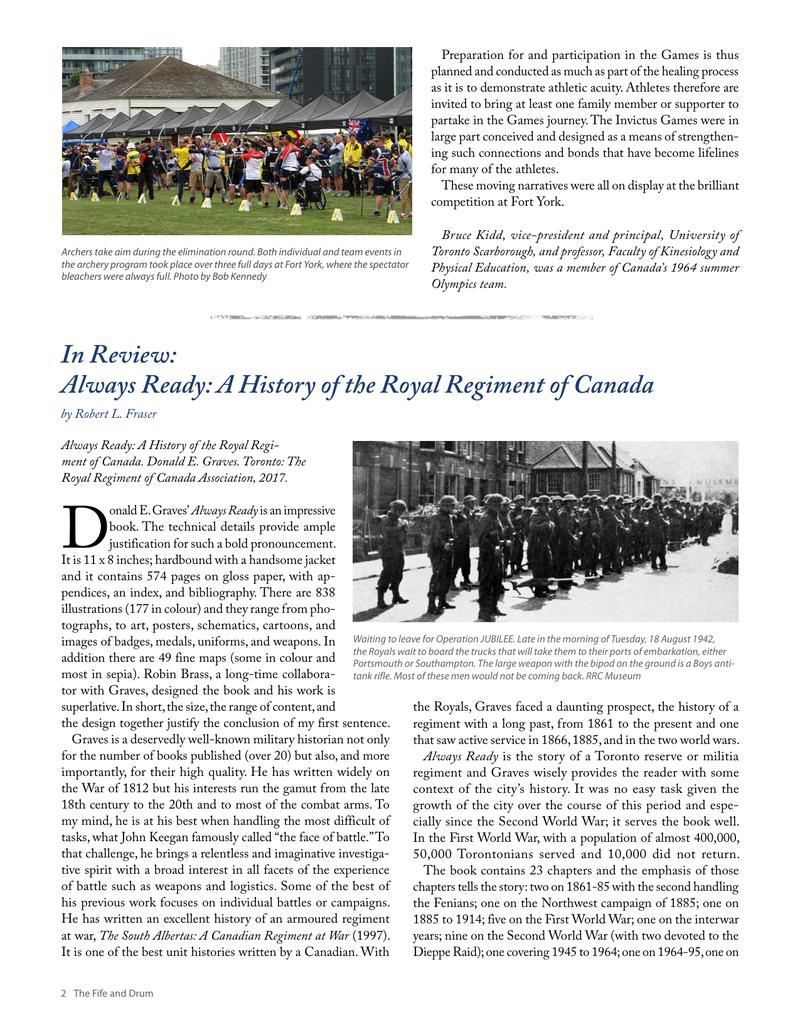
Donald E. Graves’ Always Ready is an impressive book. The technical details provide ample justification for such a bold pronouncement. It is 11 x 8 inches; hardbound with a handsome jacket and it contains 574 pages on gloss paper, with appendices, an index, and bibliography. There are 838 illustrations (177 in colour) and they range from photographs, to art, posters, schematics, cartoons, and images of badges, medals, uniforms, and weapons. In addition there are 49 fine maps (some in colour and most in sepia). Robin Brass, a long-time collaborator with Graves, designed the book and his work is superlative. In short, the size, the range of content, and the design together justify the conclusion of my first sentence.
Graves is a deservedly well-known military historian not only for the number of books published (over 20) but also, and more importantly, for their high quality. He has written widely on the War of 1812 but his interests run the gamut from the late 18th century to the 20th and to most of the combat arms. To my mind, he is at his best when handling the most difficult of tasks, what John Keegan famously called “the face of battle.” To that challenge, he brings a relentless and imaginative investigative spirit with a broad interest in all facets of the experience of battle such as weapons and logistics. Some of the best of his previous work focuses on individual battles or campaigns. He has written an excellent history of an armoured regiment at war, The South Albertas: A Canadian Regiment at War (1997). It is one of the best unit histories written by a Canadian. With the Royals, Graves faced a daunting prospect, the history of a regiment with a long past, from 1861 to the present and one that saw active service in 1866, 1885, and in the two world wars.
Always Ready is the story of a Toronto reserve or militia regiment and Graves wisely provides the reader with some context of the city’s history. It was no easy task given the growth of the city over the course of this period and especially since the Second World War; it serves the book well. In the First World War, with a population of almost 400,000, 50,000 Torontonians served and 10,000 did not return.
The book contains 23 chapters and the emphasis of those chapters tells the story: two on 1861-85 with the second handling the Fenians; one on the Northwest campaign of 1885; one on 1885 to 1914; five on the First World War; one on the interwar years; nine on the Second World War (with two devoted to the Dieppe Raid); one covering 1945 to 1964; one on 1964-95, one on 1995-2012 (including Afghanistan), and one on the 21st century.
The title page of the book contains a long, and appropriate, quote from Lord Wavell on infantry and battles/wars. It gives the reader an immediate and vivid appreciation of Graves’s understanding of his task and what is important to it. Alan Earp, a Second War veteran with the Argyll and Sutherland Highlanders and an academic, once described a battalion’s war years as its “real history.” He was, to be sure, mindful of the peacetime history of militia units and the continuous struggle of the officer and NCO cadres to hold them together given the vicissitudes of changes to government policy, the ebb and flow (mainly the ebb) of government funding, and the swings in popular attitudes to the military and the profession of arms.
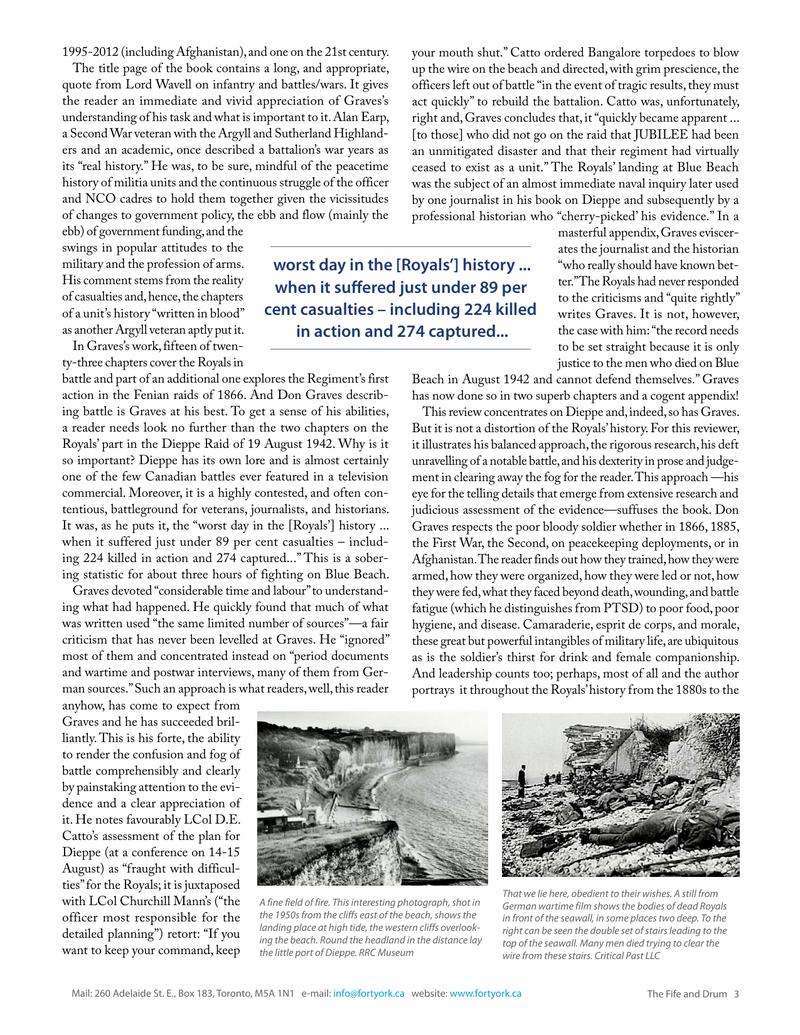
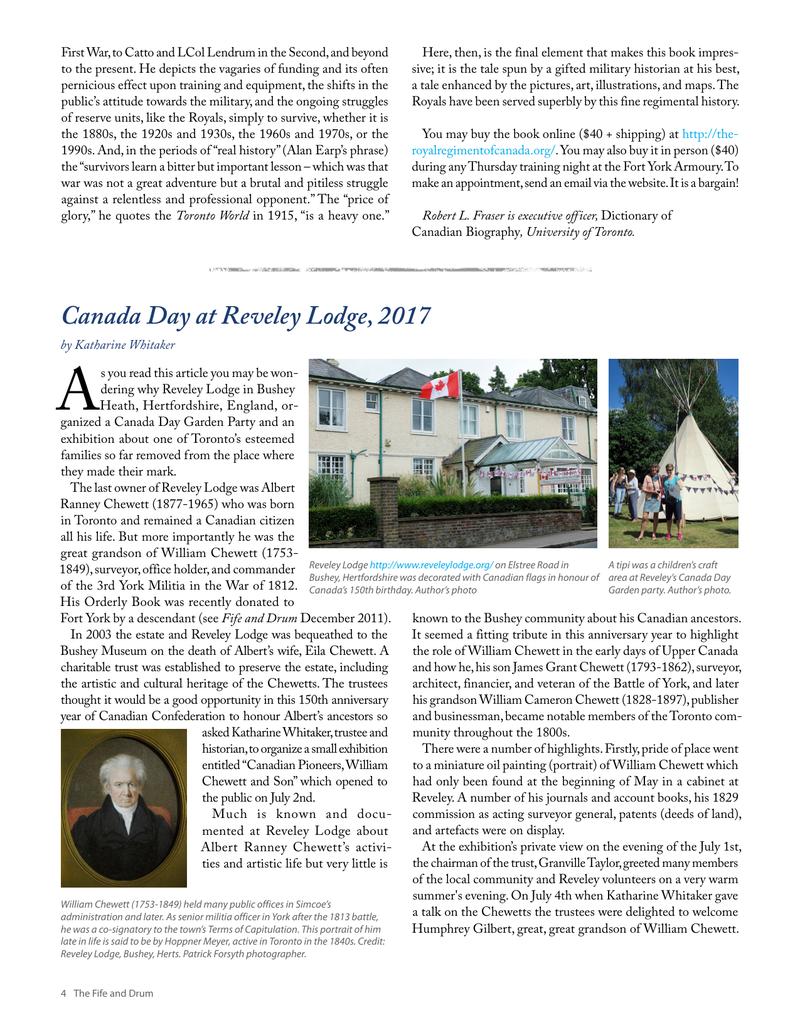
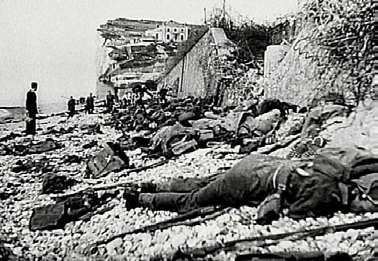
His comment stems from the reality of casualties and, hence, the chapters of a unit’s history “written in blood” in action and as another Argyll veteran aptly put it. In Graves’s work, fifteen of twenty-three chapters cover the Royals in battle and part of an additional one explores the Regiment’s first action in the Fenian raids of 1866. And Don Graves describing battle is Graves at his best. To get a sense of his abilities, a reader needs look no further than the two chapters on the Royals’ part in the Dieppe Raid of 19 August 1942. Why is it so important? Dieppe has its own lore and is almost certainly one of the few Canadian battles ever featured in a television commercial. Moreover, it is a highly contested, and often contentious, battleground for veterans, journalists, and historians. It was, as he puts it, the “worst day in the [Royals’] history … when it suffered just under 89 per cent casualties – including 224 killed in action and 274 captured…” This is a sobering statistic for about three hours of fighting on Blue Beach.
worst day in the [Royals’] history … when it suffered just under 89 per cent casualties – including 224 killed in action and 274 captured…
Graves devoted “considerable time and labour” to understanding what had happened. He quickly found that much of what was written used “the same limited number of sources”—a fair criticism that has never been levelled at Graves. He “ignored” most of them and concentrated instead on “period documents and wartime and postwar interviews, many of them from German sources.” Such an approach is what readers, well, this reader anyhow, has come to expect from Graves and he has succeeded brilliantly. This is his forte, the ability to render the confusion and fog of battle comprehensibly and clearly by painstaking attention to the evidence and a clear appreciation of it. He notes favourably LCol D.E. Catto’s assessment of the plan for Dieppe (at a conference on 14-15 August) as “fraught with difficulties” for the Royals; it is juxtaposed with LCol Churchill Mann’s (“the officer most responsible for the detailed planning”) retort: “If you want to keep your command, keep your mouth shut.” Catto ordered Bangalore torpedoes to blow up the wire on the beach and directed, with grim prescience, the officers left out of battle “in the event of tragic results, they must act quickly” to rebuild the battalion. Catto was, unfortunately, right and, Graves concludes that, it “quickly became apparent … [to those] who did not go on the raid that JUBILEE had been an unmitigated disaster and that their regiment had virtually ceased to exist as a unit.” The Royals’ landing at Blue Beach was the subject of an almost immediate naval inquiry later used by one journalist in his book on Dieppe and subsequently by a professional historian who “cherry-picked’ his evidence.” In a masterful appendix, Graves eviscerates the journalist and the historian “who really should have known better.” The Royals had never responded to the criticisms and “quite rightly” writes Graves. It is not, however, the case with him: “the record needs to be set straight because it is only justice to the men who died on Blue Beach in August 1942 and cannot defend themselves.” Graves has now done so in two superb chapters and a cogent appendix!

This review underscores on Dieppe and, indeed, so has Graves. But it is not a distortion of the Royals’ history. For this reviewer, it illustrates his balanced approach, the rigorous research, his deft unravelling of a notable battle, and his dexterity in prose and judgement in clearing away the fog for the reader. This approach—his eye for the telling details that emerge from extensive research and judicious assessment of the evidence—suffuses the book. Don Graves respects the poor bloody soldier whether in 1866, 1885, the First War, the Second, on peacekeeping deployments, or in Afghanistan. The reader finds out how they trained, how they were armed, how they were organized, how they were led or not, how they were fed, what they faced beyond death, wounding, and battle fatigue (which he distinguishes from PTSD) to poor food, poor hygiene, and disease. Camaraderie, esprit de corps, and morale, these great but powerful intangibles of military life, are ubiquitous as is the soldier’s thirst for drink and female companionship. And leadership counts too; perhaps, most of all and the author portrays it throughout the Royals’ history from the 1880s to the First War, to Catto and LCol Lendrum in the Second, and beyond to the present. It depicts an honour and its costs that all too often pernicious effect upon training and equipment, the shifts in the public’s attitude towards the military, and the never-ending struggles of reserve units, like the Royals, simply to survive, whether it is the 1880s, the 1920s and 1930s, the 1960s and 1970s, or the 1990s. And, in the periods of “real history” (Alan Earp’s phrase) the “survivors learn a bitter but important lesson – which was that war was not a great adventure but a brutal and pitiless struggle against a relentless and professional opponent.” The “price of glory,” he quotes the Toronto World in 1915, “is a heavy one.”
Here, then, is the final element that makes this book impressive: it is the tale spun by a gifted military historian at his best, a tale enhanced by the pictures, art, illustrations, and maps. The Royals have been served superbly by this fine regimental history.
You may buy the book online ($40 + shipping) at http://the-royalregimentofcanada.org/. You may also buy it in person ($40) during any Thursday training night at the Fort York Armoury. To make an appointment, send an email via the website. It is a bargain!
Original printed pages