To feline lovers, René Chartrand is the “Catman of Parliament Hill”—a man who spent years tending to the needs of a recently-dismantled feral colony in Ottawa. To others, Chartrand was chief curator for the National Historic Sites Branch of Parks Canada, his employer for nearly three decades. During that time, and in his current role as freelance writer and historical consultant, he has authored nearly one hundred books and monographs on military history and material culture.
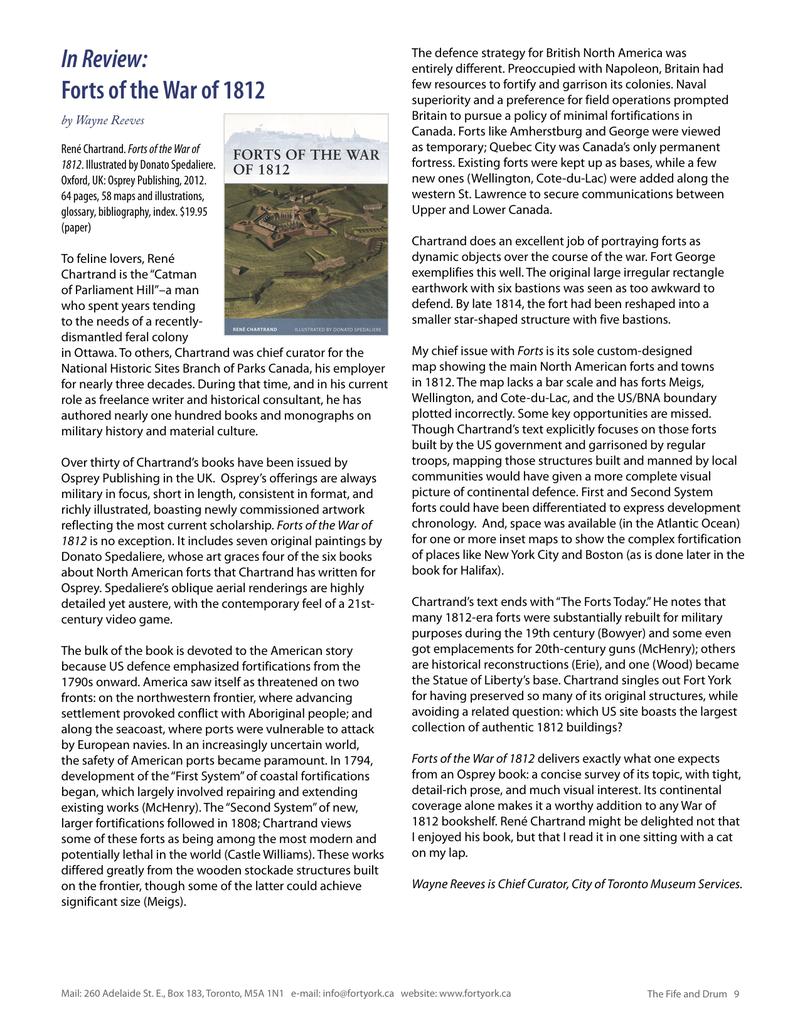
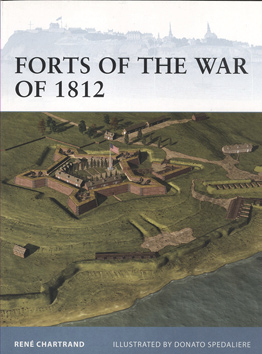
Over thirty of Chartrand’s books have been issued by Osprey Publishing in the UK. Osprey’s offerings are always military in focus, short in length, consistent in format, and richly illustrated, boasting newly commissioned artwork reflecting the most current scholarship. Forts of the War of 1812 is no exception. It includes seven original paintings by Donato Spedaliere, whose art graces four of the six books about North American forts that Chartrand has written for Osprey. Spedaliere’s oblique aerial renderings are highly detailed yet austere, with the contemporary feel of a 21st-century video game.
The bulk of the book is devoted to the American story because US defence emphasized fortifications from the 1790s onward. America saw itself as threatened on two fronts: on the northwestern frontier, where advancing settlement provoked conflict with Aboriginal people; and along the seacoast, where ports were vulnerable to attack by European navies. In an increasingly uncertain world, the safety of American ports became paramount. In 1794, development of the “First System” of coastal fortifications began, which largely involved repairing and extending existing works (McHenry). The “Second System” of new, larger fortifications followed in 1808; Chartrand views some of these forts as being among the most modern and potentially lethal in the world (Castle Williams). These works differed greatly from the wooden stockade structures built on the frontier, though some of the latter could achieve significant size (Meigs).
The defence strategy for British North America was entirely different. Preoccupied with Napoleon, Britain had few resources to fortify and garrison its colonies. Naval superiority and a preference for field operations prompted Britain to pursue a policy of minimal fortifications in Canada. Forts like Amherstburg and George were viewed as temporary; Quebec City was Canada’s only permanent fortress. Existing forts were kept up as bases, while a few new ones (Wellington, Cote-du-Lac) were added along the western St. Lawrence to secure communications between Upper and Lower Canada.
Chartrand does an excellent job of portraying forts as dynamic objects over the course of the war. Fort George exemplifies this well. The original large irregular rectangle earthwork with six bastions was seen as too awkward to defend. By late 1814, the fort had been reshaped into a smaller star-shaped structure with five bastions.
My chief issue with Forts is its sole custom-designed map showing the main North American forts and towns in 1812. The map lacks a bar scale and has forts Meigs, Wellington, and Cote-du-Lac, and the US/BNA boundary plotted incorrectly. Some key opportunities are missed. Though Chartrand’s text explicitly focuses on those forts built by the US government and garrisoned by regular troops, mapping those structures built and manned by local communities would have given a more complete visual picture of continental defence. First and Second System forts could have been differentiated to express development chronology. And, space was available (in the Atlantic Ocean) for one or more inset maps to show the complex fortification of places like New York City and Boston (as is done later in the book for Halifax).
Chartrand’s text ends with “The Forts Today.” He notes that many 1812-era forts were substantially rebuilt for military purposes during the 19th century (Bowyer) and some even got emplacements for 20th-century guns (McHenry); others are historical reconstructions (Erie), and one (Wood) became the Statue of Liberty’s base. Chartrand singles out Fort York for having preserved so many of its original structures, while avoiding a related question: which US site boasts the largest collection of authentic 1812 buildings?
Forts of the War of 1812 delivers exactly what one expects from an Osprey book: a concise survey of its topic, with tight, detail-rich prose, and much visual interest. Its continental coverage alone makes it a worthy addition to any War of 1812 bookshelf. René Chartrand might be delighted not that I enjoyed his book, but that I read it in one sitting with a cat on my lap.
Original printed pages