John Boyd (1865-1941) was an amateur photographer who had the good fortune to work at a job that allowed him to travel all over Ontario and take pictures of his favourite subjects: locomotives, sailing and steamships, natural features in the countryside, social conditions, and the military. Born in Ireland, he and his family immigrated to Canada when he was a child. He studied at Parkdale Collegiate in Toronto’s west end but left at the age of fifteen for a position as a messenger with the Grand Trunk Railway’s Freight Office. Promoted in 1894 to Special Travelling Agent, in 1899 he became the Grand Trunk Agent at Sarnia where he lived until 1912 when he returned to Toronto. Boyd continued in the employ of the GTR until 1918 when he switched to the Canadian National Railway as a superintendent in the Weighing Department. He stayed with the CNR until his retirement in 1931, having spent fifty-one years working for the railways.
Boyd became interested in photography in 1888 and started to record scenes at home and in the places he travelled on railway business, such as Ottawa, Kingston, Muskoka, Peterborough, Hamilton, London, Niagara Falls, Bracebridge, and North Bay, among many other towns. Also interested in the technical aspects of photography, Boyd built his first camera himself and later corresponded often with George Eastman of Kodak. He published articles on new techniques and was one of the first Canadian photographers to use Dufaycolour film in the 1930s. His photographs of events such as the burning of the Canadian Parliament Buildings in 1916, and royal visits, were widely published in newspapers in Canada and the United States. However he was never a staff photographer, unlike his son John H. Boyd (1898-1971) who was the staff photo-journalist for The Globe and Mail from 1927 to 1964.
With his vast range of interests the senior Boyd was a prolific photographer whose work can be found in at least three collections: Library and Archives Canada (28,959 photographs), the Archives of Ontario (4380 photographs), and the City of Toronto Archives (2422 photographs and four scrapbooks). Although his work is endlessly fascinating one specific photo album held at the City of Toronto Archives is currently of particular interest.
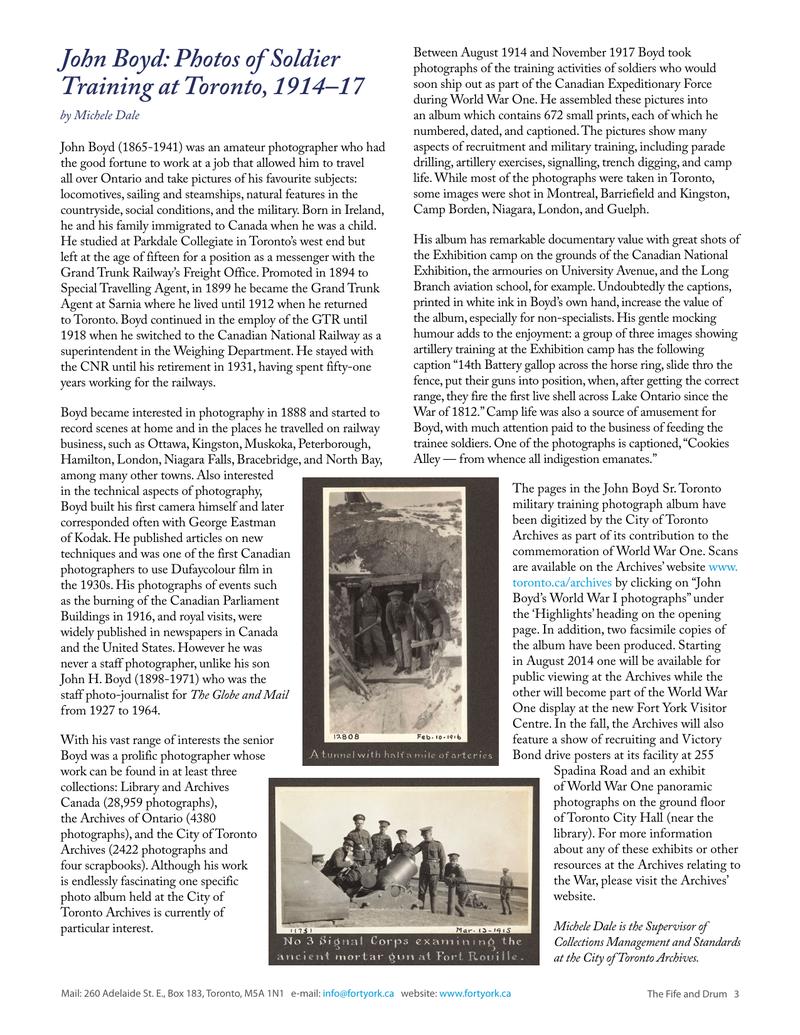
Between August 1914 and November 1917 Boyd took photographs of the training activities of soldiers who would soon ship out as part of the Canadian Expeditionary Force during World War One. He assembled these pictures into an album which contains 672 small prints, each of which he numbered, dated, and captioned. The pictures show many aspects of recruitment and military training, including parade drilling, artillery exercises, signalling, trench digging, and camp life. While most of the photographs were taken in Toronto, some images were shot in Montreal, Barriefield and Kingston, Camp Borden, Niagara, London, and Guelph.
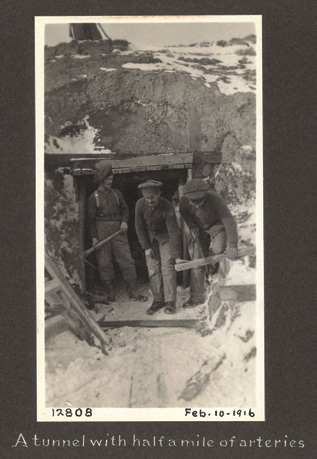
His album has remarkable documentary value with great shots of the Exhibition camp on the grounds of the Canadian National Exhibition, the armouries on University Avenue, and the Long Branch aviation school, for example. Undoubtedly the captions, printed in white ink in Boyd’s own hand, increase the value of the album, especially for non-specialists. His gentle mocking humour adds to the enjoyment: a group of three images showing artillery training at the Exhibition camp has the following caption “14th Battery gallop across the horse ring, slide thro the fence, put their guns into position, when, after getting the correct range, they fire the first live shell across Lake Ontario since the War of 1812.” Camp life was also a source of amusement for Boyd, with much attention paid to the business of feeding the trainee soldiers. One of the photographs is captioned, “Cookies Alley — from whence all indigestion emanates.”

The pages in the John Boyd Sr. Toronto military training photograph album have been digitized by the City of Toronto Archives as part of its contribution to the commemoration of World War One. Scans are available on the Archives’ website www.toronto.ca/archives by clicking on “John Boyd’s World War I photographs” under the ‘Highlights’ heading on the opening page. In addition, two facsimile copies of the album have been produced. Starting in August 2014 one will be available for public viewing at the Archives while the other will become part of the World War One display at the new Fort York Visitor Centre. In the fall, the Archives will also feature a show of recruiting and Victory Bond drive posters at its facility at 255 Spadina Road and an exhibit of World War One panoramic photographs on the ground floor of Toronto City Hall (near the library). For more information about any of these exhibits or other resources at the Archives relating to the War, please visit the Archives’ website.
Original printed pages