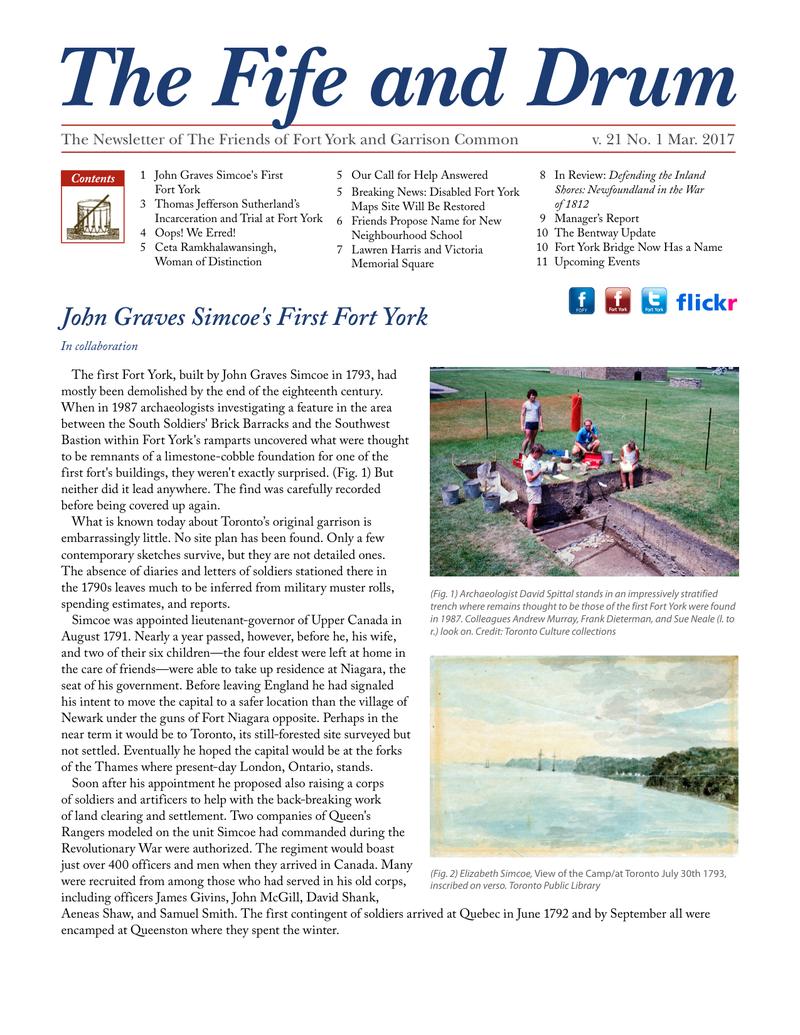
The first Fort York, built by John Graves Simcoe in 1793, had mostly been demolished by the end of the eighteenth century. When in 1987 archaeologists investigating a feature in the area between the South Soldiers’ Brick Barracks and the Southwest Bastion within Fort York’s ramparts uncovered what were thought to be remnants of a limestone-cobble foundation for one of the first fort’s buildings, they weren’t exactly surprised. (Fig. 1) But neither did it lead anywhere. The find was carefully recorded before being covered up again.

What is known today about Toronto’s original garrison is embarrassingly little. No site plan has been found. Only a few contemporary sketches survive, but they are not detailed ones. The absence of diaries and letters of soldiers stationed there in the 1790s leaves much to be inferred from military muster rolls, spending estimates, and reports.
Simcoe was appointed lieutenant-governor of Upper Canada in August 1791. Nearly a year passed, however, before he, his wife, and two of their six children—the four eldest were left at home in the care of friends—were able to take up residence at Niagara, the seat of his government. Before leaving England he had signaled his intent to move the capital to a safer location than the village of Newark under the guns of Fort Niagara opposite. Perhaps in the near term it would be to Toronto, its still-forested site surveyed but not settled. Eventually he hoped the capital would be at the forks of the Thames where present-day London, Ontario, stands.
Soon after his appointment he proposed also raising a corps of soldiers and artificers to help with the back-breaking work of land clearing and settlement. Two companies of Queen’s Rangers modeled on the unit Simcoe had commanded during the Revolutionary War were authorized. The regiment would boast just over 400 officers and men when they arrived in Canada. Many were recruited from among those who had served in his old corps, including officers James Givins, John McGill, David Shank, Aeneas Shaw, and Samuel Smith. The first contingent of soldiers arrived at Quebec in June 1792 and by September all were encamped at Queenston where they spent the winter.

Early the following spring, Simcoe and seven of his officers reconnoitered the site and harbour of Toronto. Returning to Niagara eleven days later the governor was determined to begin settlement at the new seat of government immediately. By 1 July 1793 Capt. Samuel Smith’s company was at Toronto clearing land for the garrison and town, and building roads in the vicinity. Housed in tents on the site of today’s Fort York, they were joined by Capt. David Shank’s company a few weeks later. The Rangers’ Monthly Returns show that regimental ‘Head Quarters’ and the whole corps had moved to York by 1 August.
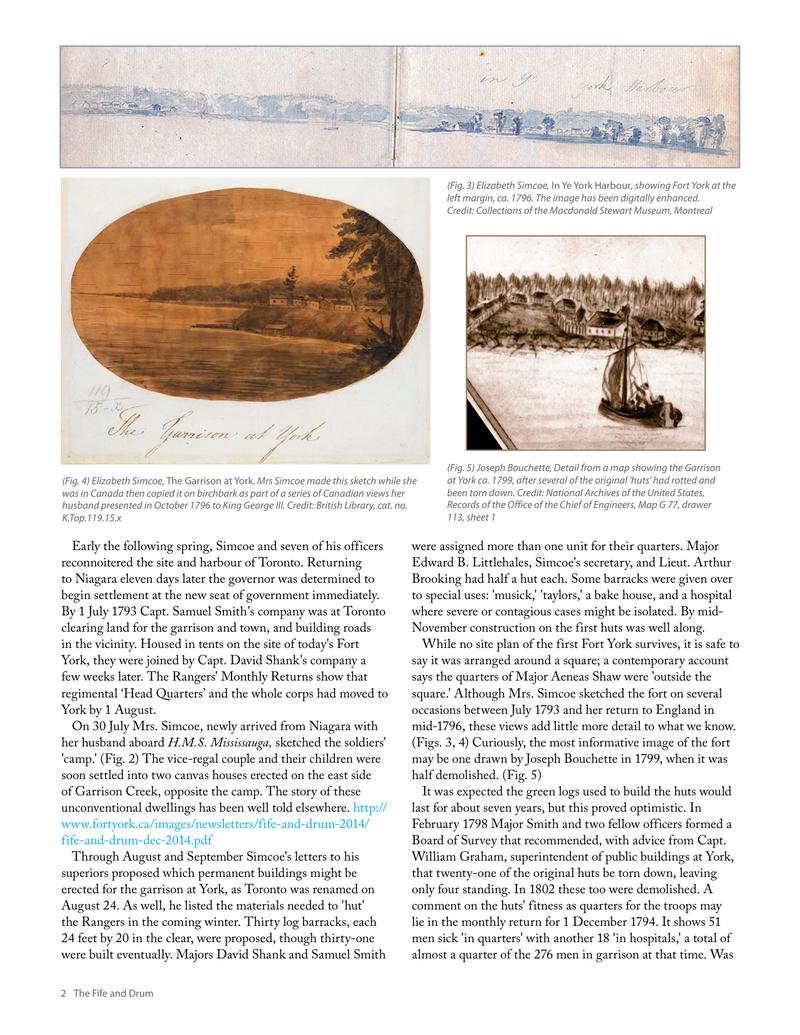
On 30 July Mrs. Simcoe, newly arrived from Niagara with her husband aboard H.M.S. Mississauga, sketched the soldiers’ ‘camp.’ (Fig. 2) The vice-regal couple and their children were soon settled into two canvas houses erected on the east side of Garrison Creek, opposite the camp. The story of these unconventional dwellings has been well told elsewhere. http://www.fortyork.ca/images/newsletters/fife-and-drum-2014/fife-and-drum-dec-2014.pdf
Through August and September Simcoe’s letters to his superiors proposed which permanent buildings might be erected for the garrison at York, as Toronto was renamed on August 24. As well, he listed the materials needed to ‘hut’ the Rangers in the coming winter. Thirty log barracks, each 24 feet by 20 in the clear, were proposed, though thirty-one were built eventually. Majors David Shank and Samuel Smith were assigned more than one unit for their quarters. Major Edward B. Littlehales, Simcoe’s secretary, and Lieut. Arthur Brooking had half a hut each. Some barracks were given over to special uses: ‘musick,’ ‘taylors,’ a bake house, and a hospital where severe or contagious cases might be isolated. By mid-November construction on the first huts was well along.

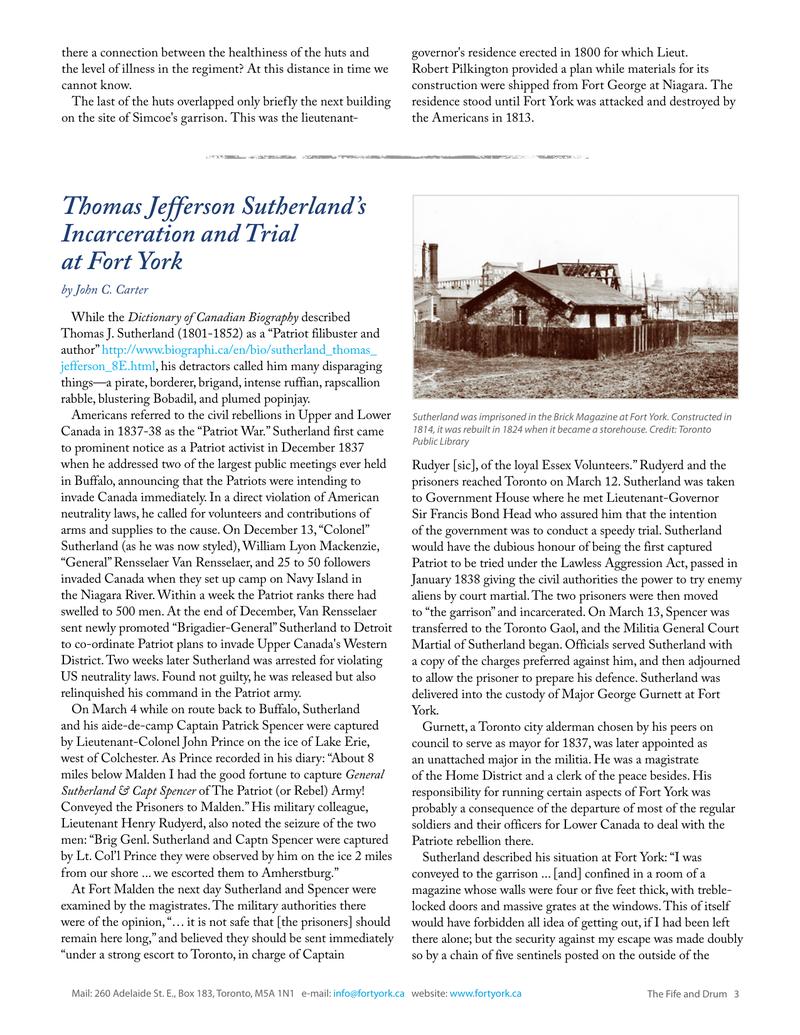
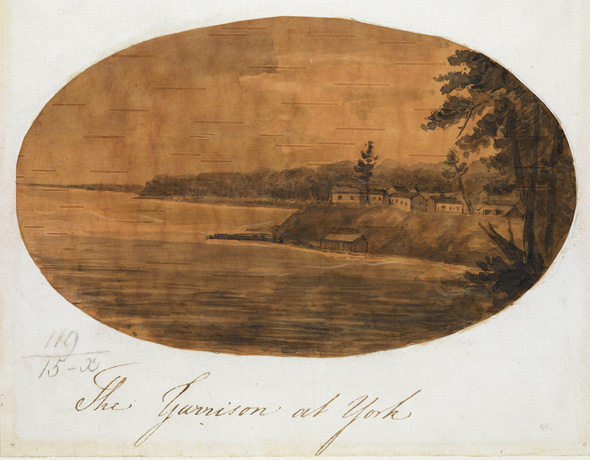
While no site plan of the first Fort York survives, it is safe to say it was arranged around a square; a contemporary account says the quarters of Major Aeneas Shaw were ‘outside the square.’ Although Mrs. Simcoe sketched the fort on several occasions between July 1793 and her return to England in mid-1796, these views add little more detail to what we know. (Figs. 3, 4) Curiously, the most informative image of the fort may be one drawn by Joseph Bouchette in 1799, when it was half demolished. (Fig. 5)
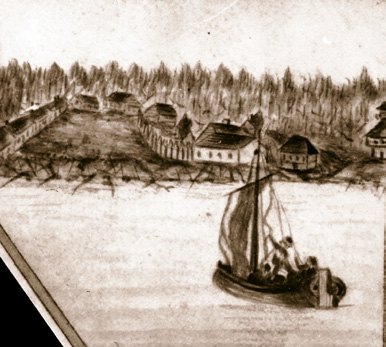
It was expected the green logs used to build the huts would last for about seven years, but this proved optimistic. In February 1798 Major Smith and two fellow officers formed a Board of Survey that recommended, with advice from Capt. William Graham, superintendent of public buildings at York, that twenty-one of the original huts be torn down, leaving only four standing. In 1802 these too were demolished. A comment on the huts’ fitness as quarters for the troops may lie in the monthly return for 1 December 1794. It shows 51 men sick ‘in quarters’ with another 18 ‘in hospitals,’ a total of almost a quarter of the 276 men in garrison at that time. Was there a connection between the healthiness of the huts and the level of illness in the regiment? At this distance in time we cannot know.
The last of the huts overlapped only briefly the next building on the site of Simcoe’s garrison. This was the lieutenant-governor’s residence erected in 1800 for which Lieut. Robert Pilkington provided a plan while materials for its construction were shipped from Fort George at Niagara. The residence stood until Fort York was attacked and destroyed by the Americans in 1813.
Original printed pages