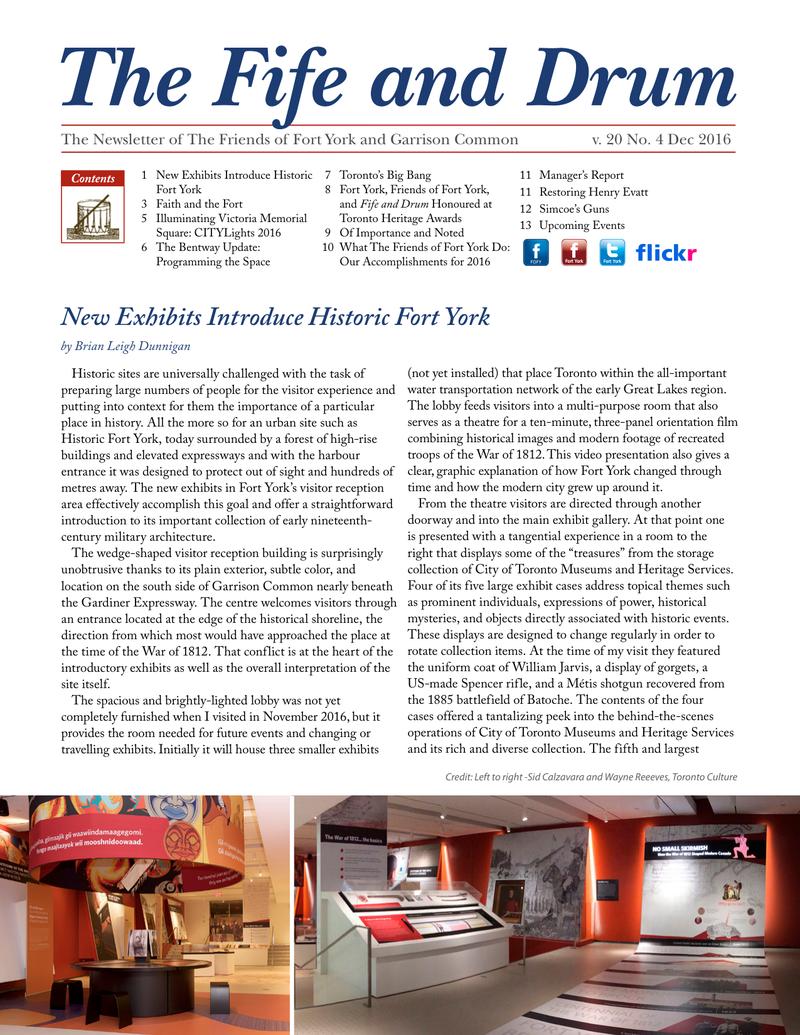
Historic sites are universally challenged with the task of preparing large numbers of people for the visitor experience and putting into context for them the importance of a particular place in history. All the more so for an urban site such as Historic Fort York, today surrounded by a forest of high-rise buildings and elevated expressways and with the harbour entrance it was designed to protect out of sight and hundreds of metres away. The new exhibits in Fort York’s visitor reception area effectively accomplish this goal and offer a straightforward introduction to its important collection of early nineteenth-century military architecture.
The wedge-shaped visitor reception building is surprisingly unobtrusive thanks to its plain exterior, subtle color, and location on the south side of Garrison Common nearly beneath the Gardiner Expressway. The centre welcomes visitors through an entrance located at the edge of the historical shoreline, the direction from which most would have approached the place at the time of the War of 1812. That conflict is at the heart of the introductory exhibits as well as the overall interpretation of the site itself.
The spacious and brightly-lighted lobby was not yet completely furnished when I visited in November 2016, but it provides the room needed for future events and changing or travelling exhibits. Initially it will house three smaller exhibits (not yet installed) that place Toronto within the all-important water transportation network of the early Great Lakes region. The lobby feeds visitors into a multi-purpose room that also serves as a theatre for a ten-minute, three-panel orientation film combining historical images and modern footage of recreated troops of the War of 1812. This video presentation also gives a clear, graphic explanation of how Fort York changed through time and how the modern city grew up around it.

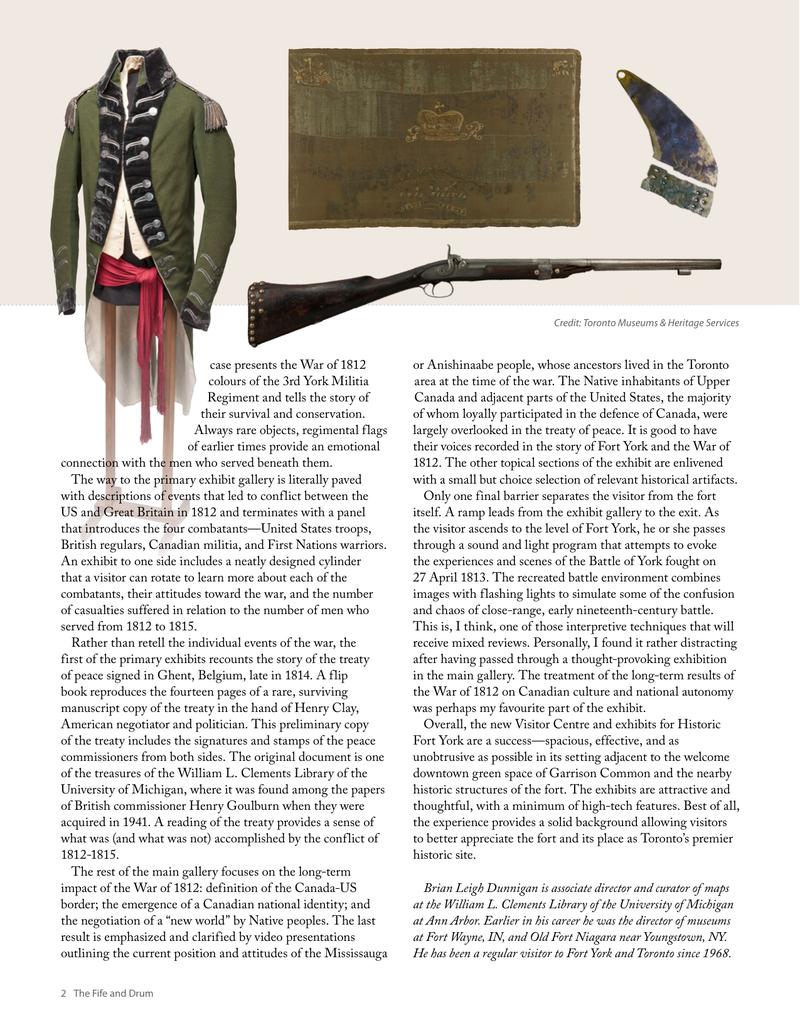
From the theatre visitors are directed through another doorway and into the main exhibit gallery. At that point one is presented with a tangential experience in a room to the right that displays some of the “treasures” from the storage collection of City of Toronto Museums and Heritage Services. Four of its five large exhibit cases address topical themes such as prominent individuals, expressions of power, historical mysteries, and objects directly associated with historic events. These displays are designed to change regularly in order to rotate collection items. At the time of my visit they featured the uniform coat of William Jarvis, a display of gorgets, a US-made Spencer rifle, and a Métis shotgun recovered from the 1885 battlefield of Batoche. The contents of the four cases offered a tantalizing peek into the behind-the-scenes operations of City of Toronto Museums and Heritage Services and its rich and diverse collection.

The fifth and largest case presents the War of 1812 colours of the 3rd York Militia Regiment and tells the story of their survival and conservation. Always rare objects, regimental flags of earlier times provide an emotional connection with the men who served beneath them.
The way to the primary exhibit gallery is literally paved with descriptions of events that led to conflict between the US and Great Britain in 1812 and terminates with a panel that introduces the four combatants—United States troops, British regulars, Canadian militia, and First Nations warriors. An exhibit to one side includes a neatly designed cylinder that a visitor can rotate to learn more about each of the combatants, their attitudes toward the war, and the number of casualties suffered in relation to the number of men who served from 1812 to 1815.
Rather than retell the individual events of the war, the first of the primary exhibits recounts the story of the treaty of peace signed in Ghent, Belgium, late in 1814. A flip book reproduces the fourteen pages of a rare, surviving manuscript copy of the treaty in the hand of Henry Clay, American negotiator and politician. This preliminary copy of the treaty includes the signatures and stamps of the peace commissioners from both sides. The original document is one of the treasures of the William L. Clements Library of the University of Michigan, where it was found among the papers of British commissioner Henry Goulburn when they were acquired in 1941. A reading of the treaty provides a sense of what was (and what was not) accomplished by the conflict of 1812-1815.
The rest of the main gallery focuses on the long-term impact of the War of 1812: definition of the Canada-US border; the emergence of a Canadian national identity; and the negotiation of a “new world” by Native peoples. The last result is emphasized and clarified by video presentations outlining the current position and attitudes of the Mississauga or Anishinaabe people, whose ancestors lived in the Toronto area at the time of the war. The Native inhabitants of Upper Canada and adjacent parts of the United States, the majority of whom loyally participated in the defence of Canada, were largely overlooked in the treaty of peace. It is good to have their voices recorded in the story of Fort York and the War of 1812. The other topical sections of the exhibit are enlivened with a small but choice selection of relevant historical artifacts.
Only one final barrier separates the visitor from the fort itself. A ramp leads from the exhibit gallery to the exit. As the visitor ascends to the level of Fort York, he or she passes through a sound and light program that attempts to evoke the experiences and scenes of the Battle of York fought on 27 April 1813. The recreated battle environment combines images with flashing lights to simulate some of the confusion and chaos of close-range, early nineteenth-century battle. This is, I think, one of those interpretive techniques that will receive mixed reviews. Personally, I found it rather distracting after having passed through a thought-provoking exhibition in the main gallery. The treatment of the long-term results of the War of 1812 on Canadian culture and national autonomy was perhaps my favourite part of the exhibit.
Overall, the new Visitor Centre and exhibits for Historic Fort York are a success—spacious, effective, and as unobtrusive as possible in its setting adjacent to the welcome downtown green space of Garrison Common and the nearby historic structures of the fort. The exhibits are attractive and thoughtful, with a minimum of high-tech features. Best of all, the experience provides a solid background allowing visitors to better appreciate the fort and its place as Toronto’s premier historic site.
Original printed pages