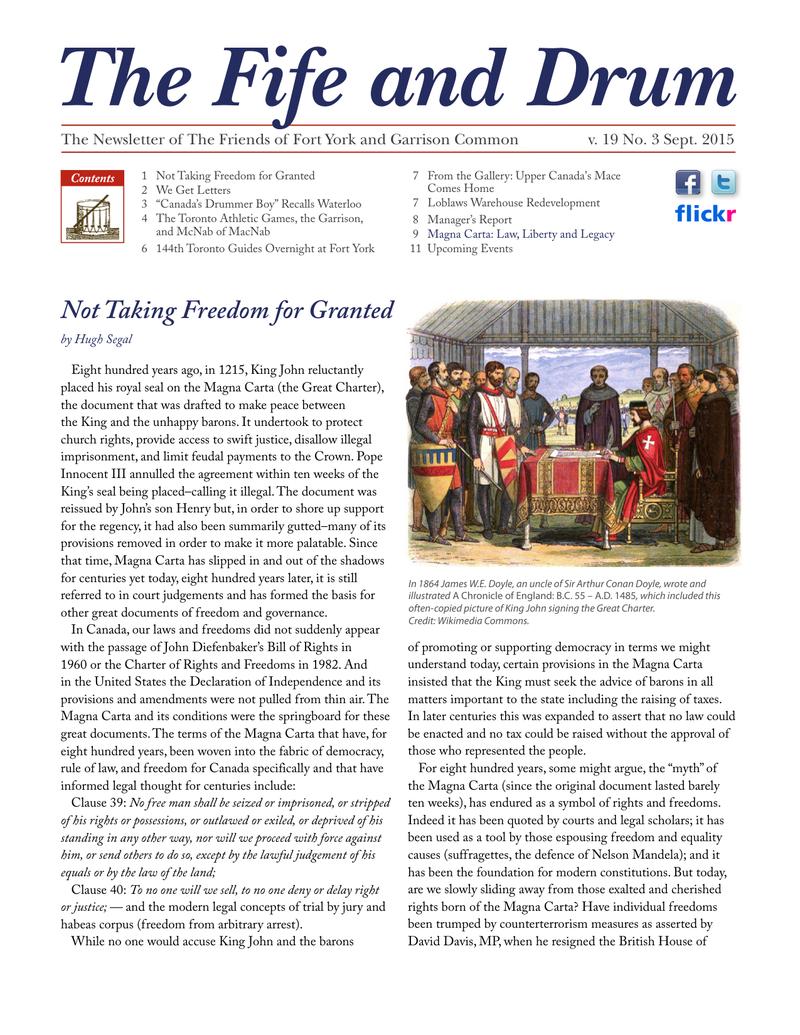
Eight hundred years ago, in 1215, King John reluctantly placed his royal seal on the Magna Carta (the Great Charter), the document that was drafted to make peace between the King and the unhappy barons. It undertook to protect church rights, provide access to swift justice, disallow illegal imprisonment, and limit feudal payments to the Crown. Pope Innocent III annulled the agreement within ten weeks of the King’s seal being placed–calling it illegal. The document was reissued by John’s son Henry but, in order to shore up support for the regency, it had also been summarily gutted–many of its provisions removed in order to make it more palatable. Since that time, Magna Carta has slipped in and out of the shadows for centuries yet today, eight hundred years later, it is still referred to in court judgements and has formed the basis for other great documents of freedom and governance.

In Canada, our laws and freedoms did not suddenly appear with the passage of John Diefenbaker’s Bill of Rights in 1960 or the Charter of Rights and Freedoms in 1982. And in the United States the Declaration of Independence and its provisions and amendments were not pulled from thin air. The Magna Carta and its conditions were the springboard for these great documents. The terms of the Magna Carta that have, for eight hundred years, been woven into the fabric of democracy, rule of law, and freedom for Canada specifically and that have informed legal thought for centuries include:
Clause 39: No free man shall be seized or imprisoned, or stripped of his rights or possessions, or outlawed or exiled, or deprived of his standing in any other way, nor will we proceed with force against him, or send others to do so, except by the lawful judgement of his equals or by the law of the land;
Clause 40: To no one will we sell, to no one deny or delay right or justice; — and the modern legal concepts of trial by jury and habeas corpus (freedom from arbitrary arrest).
While no one would accuse King John and the barons of promoting or supporting democracy in terms we might understand today, certain provisions in the Magna Carta insisted that the King must seek the advice of barons in all matters important to the state including the raising of taxes. In later centuries this was expanded to assert that no law could be enacted and no tax could be raised without the approval of those who represented the people.
For eight hundred years, some might argue, the “myth” of the Magna Carta (since the original document lasted barely ten weeks), has endured as a symbol of rights and freedoms. Indeed it has been quoted by courts and legal scholars; it has been used as a tool by those espousing freedom and equality causes (suffragettes, the defence of Nelson Mandela); and it has been the foundation for modern constitutions. But today, are we slowly sliding away from those exalted and cherished rights born of the Magna Carta? Have individual freedoms been trumped by counterterrorism measures as asserted by David Davis, MP, when he resigned the British House of
Original printed pages