

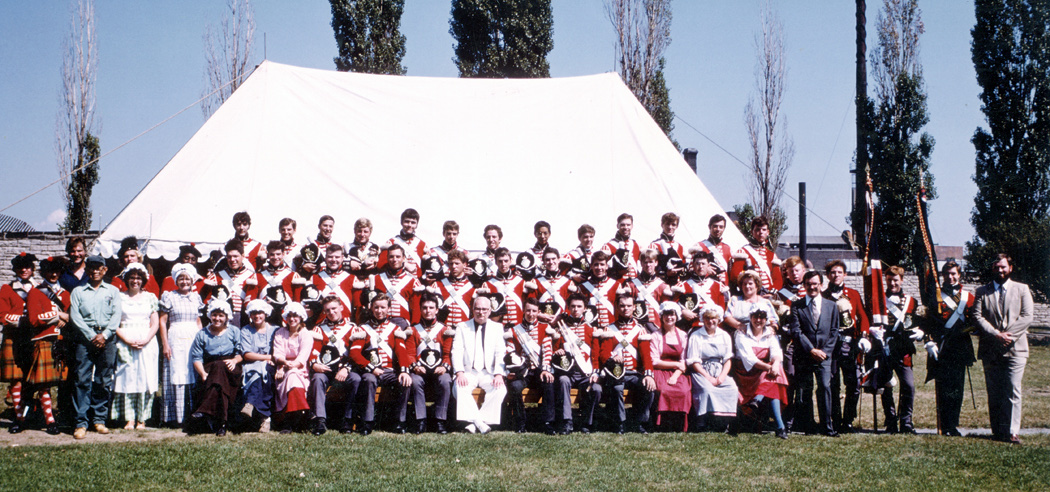
The history of the Fort York Guard extends over several decades and through various incarnations. A full narrative could fill volumes since its stories are as diverse as the hundreds of members included in its ranks. I had the privilege of being with ‘The Guard’ from 1980-85 when it mustered its highest numbers and boasted a very multidisciplinary staff.
In use from the 1950s, the title ‘Fort York Guard’ was given until 1999 to the combined interpretive/animation staff of Fort York, comprising both full and part-time employees. Since 1999, the name has been adopted by the summer animation squad and drums that field at Fort York annually, courtesy of the tireless fundraising efforts of the Friends of Fort York.
The Guard’s lineage can be traced back to the fort’s opening as a public museum in 1934 when serving members of the Queen’s (York) Rangers paraded as a commemorative unit of the Queen’s Rangers c.1793. Period photos show uniforms that were poor replicas based largely on erroneous 20th century understanding of 19th century military garb. Nonetheless, it is widely accepted that this small corps was the genesis for costumed animation at the fort, and the first Canadian military re-enactment unit. The Ranger section was supported by a small group of the Royal Regiment of Canada who donned equally spurious uniforms intended to replicate those of the Incorporated Militia of Upper Canada. Though neither section was considered official fort staff, they did demonstrate the public’s appreciation for commemorative pageantry at the fort.
Beyond this 1934 appearance of the recreated Queen’s Rangers, several watershed periods in the evolution of ‘The Guard’ cemented it in the annals of Toronto history.
In 1952, Toronto City Council made the Toronto Civic Historical Committee (forerunner of the Toronto Historical Board) responsible for the administration and operation of Fort York. Under the supervision of the THB’s first director, Brigadier-General John A. McGinnis, four senior high school students were hired in the summer of 1953 to act as site guides. In true military fashion, they were dressed in a shirt and tie with a green blazer, grey flannel trousers, and a green beret. They also carried a malacca stick suitable for pointing out details in displays and room settings! Green was considered the signature colour for Fort York and was likely chosen as a nod to the official colour of the Queen’s (York) Rangers, the Canadian Army reserve regiment which McGinnis went on to command from 1954-58.
However, the true birth of the Fort York Guard as costumed interpreter/animator staff occurred in 1955 when four young men donned a ’50s interpretation of the famous red coatee and grey trousers of Upper Canada’s Incorporated Militia from the War of 1812. In detail, the uniforms were dodgy at best, but they passed the ‘all-important five-yard test’ for authenticity. The uniforms were featured only during demonstrations and the green blazer and grey flannels were worn when ‘guiding’ into the late ’50s. As a squad, the Guard remained relatively small until 1957 when it doubled to eight members.
By the early 1960s, museum projects across Canada began to receive extended funding for exhibits, events, and restorations in anticipation of the 1967 Canadian centennial year celebrations. This nation-wide interest in history brought change to Fort York and the Guard was a beneficiary. A few years earlier, in 1960, the Toronto Historical Board (THB) had been established by an act of City Council, replacing the old Toronto Civic Historical Committee. This highlighted the importance of heritage in Toronto and, as a result, the status of the Fort York Guard was elevated as its members took on an additional role as civic ceremonial emissaries. The Guard grew to the point that it was able to field twenty members in a week-long route march that led from Fort George at Niagara-on-the-Lake to Toronto for the opening of the 1967 Canadian National Exhibition. Along the way, the Guard performed tactical demonstrations at various towns and community events.
Between 1967 and 1969, when the Guard had established itself as the premier attraction at Fort York, it was determined that additional, large-scale events were needed to showcase its military entertainment value and draw revenue. Music was added as were artillery demonstrations using the site’s large garrison guns and a small iron 1-pounder mounted on a diminutive field carriage. Over the next few years the fort enhanced its famous Fort York Festival on Victoria Day weekend; Simcoe Day on August civic holiday weekend; and William J. Stewart Trophy Day in mid/late August. (The Stewart Trophy, named for a major supporter of Fort York who served as mayor during the restoration, recognized ‘Outstanding Guardsman’ and awarded promotional rank certificates to other members). All of these days featured large scale tactical demonstrations, activities that were publicized and covered widely in the local media.
As a result of these popular public events, demand for the Fort York Guard escalated across the city and beyond. By 1970, the Guard had become a ‘must-see’ attraction in Toronto and the rest of the province, along with similar presentations at sites such as Fort Henry in Kingston.
In 1973, the Guard expanded once again to support the centennial of the RCMP. A special 16-man detachment of the North West Mounted Police (NWMP) c.1873 was formed with financial support from the RCMP and David Macdonald Stewart. The unit trained and paraded at Fort York with serving members of Canada’s national police. Soon after, in 1974, a 12-man section of the Guard was sent to Los Angeles on behalf of the Ministry of Tourism to promote Canada as a travel destination.
In what was perhaps the most important decision taken about the appearance of the Fort York Guard, plans were approved in 1977 to move the Guard away from a generic 1812 militia unit to the recreated Grenadier Company of the 8th (King’s) Regiment c.1813. The Grenadier Company, of course, had distinguished itself during the Battle of York on 27 April 1813 and the decision to commemorate the unit was greeted with great enthusiasm. Since none of this was taken lightly, permission to field as the 8th was sought and granted by Britain’s Ministry of Defence and the King’s Regiment.
As a result, new and more authentic woollen uniforms and equipment were completed for issue in 1978, courtesy of a $12,000 donation from the Royal Insurance Company of Canada combined with a matching grant from Wintario lottery – all facilitated by THB board member Lieutenant-Colonel Norman Wright, a retired executive vice-president of the Royal Insurance Company of Canada. (The fact that Royal Insurance was headquartered in Liverpool, home to the King’s Regiment, undoubtedly helped move the paperwork along!) Lieutenant-Colonel Wright worked tirelessly to promote the Fort York Guard to the business community and beyond. As a result, the Guard soon found itself at every major event across the city and began making annual trips to US sites such as Fort Wayne, Indiana.
Full and part-time Guard staff took the responsibility of representing the 8th very seriously. Cleanliness, deportment, and period grooming were paramount so the Guard turned itself out in ‘Class A’ condition always. Skill-at-arms, drill, and field evolutions were practiced daily from early May until Labour Day to the point where it would have rivalled its War of 1812 predecessors.
Read about the expansion of the Guard in the 1980s in the next issue of The Fife and Drum.
Original printed pages


