↗ View this article in the original PDF newsletter
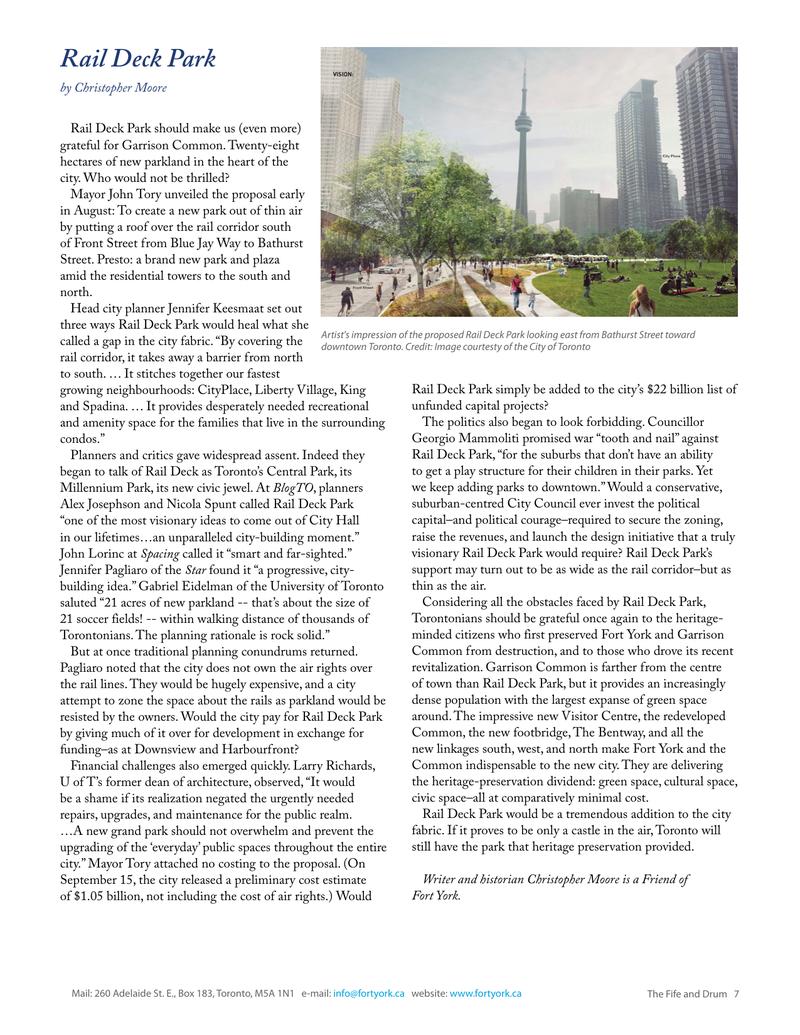
Rail Deck Park should make us (even more) grateful for Garrison Common. Twenty-eight hectares of new parkland in the heart of the city. Who would not be thrilled? Mayor John Tory unveiled the proposal early in August: To create a new park out of thin air by putting a roof over the rail corridor south of Front Street from Blue Jay Way to Bathurst Street. Presto: a brand new park and plaza amid the residential towers to the south and north. Head city planner Jennifer Keesmaat set out three ways Rail Deck Park would heal what she Artist’s impression of called a gap in the city fabric. “By covering the downtown Toronto. rail corridor, it takes away a barrier from north to south. … It stitches together our fastest growing neighbourhoods: CityPlace, Liberty Village, King and Spadina. … It provides desperately needed recreational and amenity space for the families that live in the surrounding condos.” Planners and critics gave widespread assent. Indeed they began to talk of Rail Deck as Toronto’s Central Park, its Millennium Park, its new civic jewel. At BlogTO, planners Alex Josephson and Nicola Spunt called Rail Deck Park “one of the most visionary ideas to come out of City Hall in our lifetimes…an unparalleled city-building moment.” John Lorinc at Spacing called it “smart and far-sighted.” Jennifer Pagliaro of the Star found it “a progressive, citybuilding idea.” Gabriel Eidelman of the University of Toronto saluted “21 acres of new parkland — that’s about the size of 21 soccer fields! — within walking distance of thousands of Torontonians. The planning rationale is rock solid.” But at once traditional planning conundrums returned. Pagliaro noted that the city does not own the air rights over the rail lines. They would be hugely expensive, and a city attempt to zone the space about the rails as parkland would be resisted by the owners. Would the city pay for Rail Deck Park by giving much of it over for development in exchange for funding–as at Downsview and Harbourfront? Financial challenges also emerged quickly. Larry Richards, U of T’s former dean of architecture, observed, “It would be a shame if its realization negated the urgently needed repairs, upgrades, and maintenance for the public realm. …A new grand park should not overwhelm and prevent the upgrading of the ‘everyday’ public spaces throughout the entire city.” Mayor Tory attached no costing to the proposal. (On September 15, the city released a preliminary cost estimate of $1.05 billion, not including the cost of air rights.) Would
the proposed Rail Deck Park looking east from Bathurst Street toward Credit: Image courtesty of the City of Toronto Rail Deck Park simply be added to the city’s $22 billion list of unfunded capital projects? The politics also began to look forbidding. Councillor Georgio Mammoliti promised war “tooth and nail” against Rail Deck Park, “for the suburbs that don’t have an ability to get a play structure for their children in their parks. Yet we keep adding parks to downtown.” Would a conservative, suburban-centred City Council ever invest the political capital–and political courage–required to secure the zoning, raise the revenues, and launch the design initiative that a truly visionary Rail Deck Park would require? Rail Deck Park’s support may turn out to be as wide as the rail corridor –but as thin as the air. Considering all the obstacles faced by Rail Deck Park, Torontonians should be grateful once again to the heritageminded citizens who first preserved Fort York and Garrison Common from destruction, and to those who drove its recent revitalization. Garrison Common is farther from the centre of town than Rail Deck Park, but it provides an increasingly dense population with the largest expanse of green space around. The impressive new Visitor Centre, the redeveloped Common, the new footbridge, The Bentway, and all the new linkages south, west, and north make Fort York and the Common indispensable to the new city. They are delivering the heritage-preservation dividend: green space, cultural space, civic space–all at comparatively minimal cost. Rail Deck Park would be a tremendous addition to the city fabric. If it proves to be only a castle in the air, Toronto will still have the park that heritage preservation provided.
Original printed pages