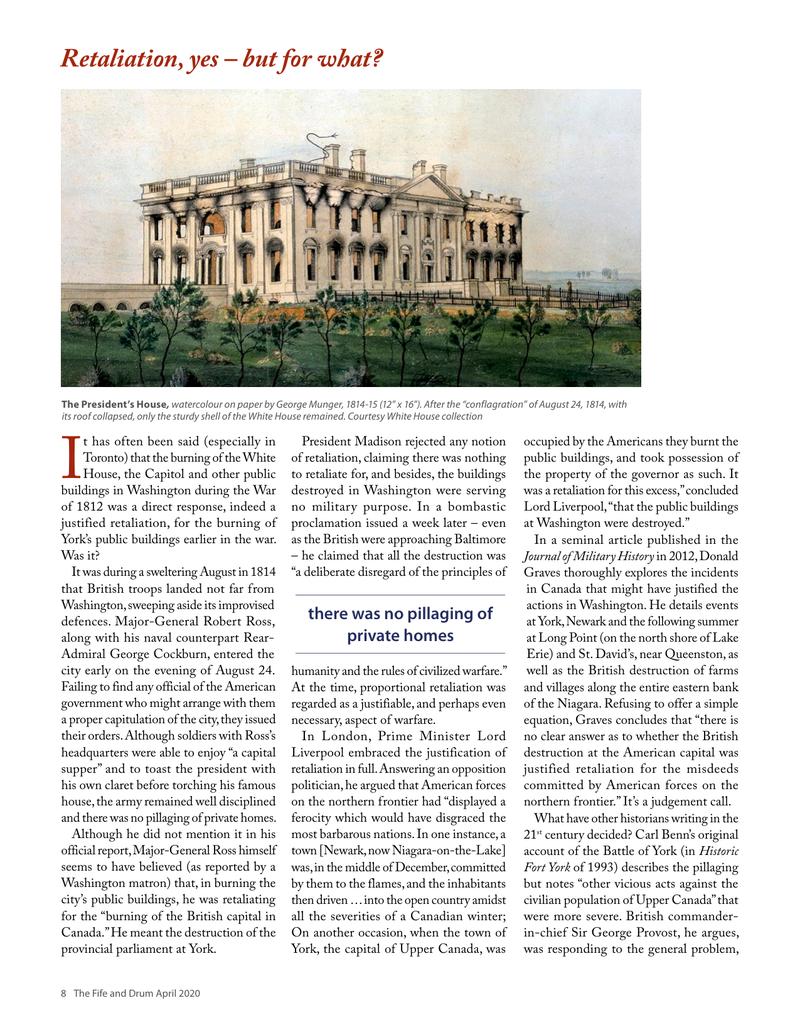
It has often been said (especially in Toronto) that the burning of the White House, the Capitol and other public buildings in Washington during the War of 1812 was a direct response, indeed a justified retaliation, for the burning of York’s public buildings earlier in the war. Was it?
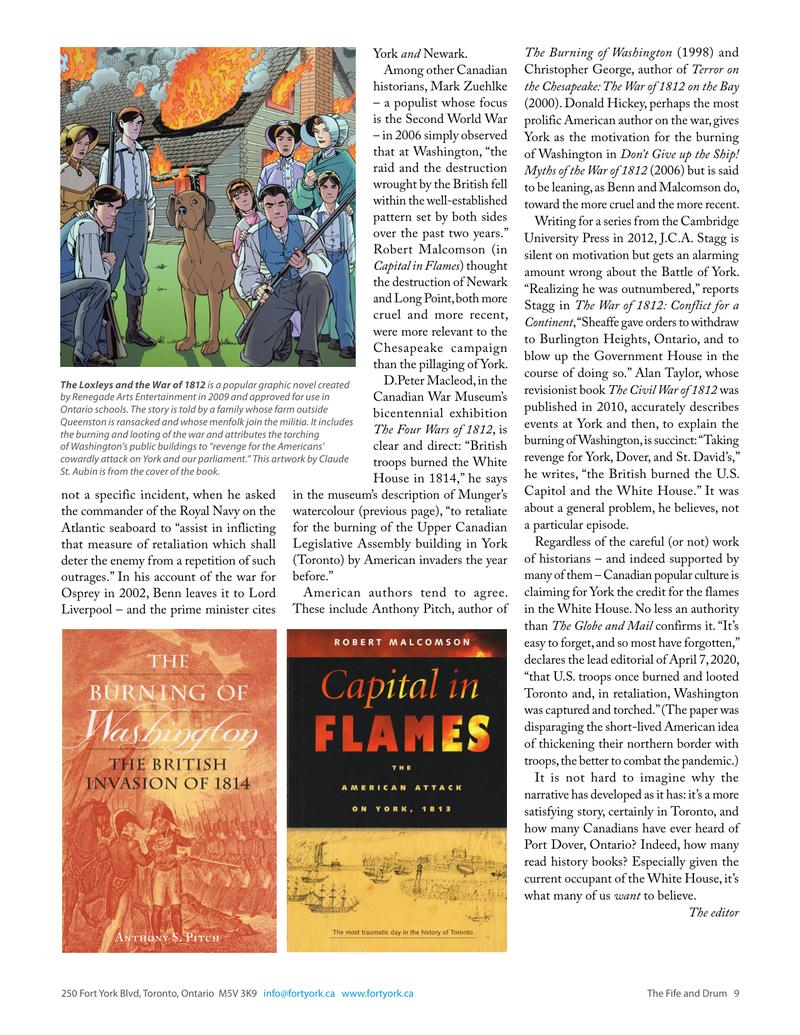
It was during a sweltering August in 1814 that British troops landed not far from Washington, sweeping aside its improvised defences. Major-General Robert Ross, along with his naval counterpart Rear-Admiral George Cockburn, entered the city early on the evening of August 24. Failing to find any official of the American government who might arrange with them a proper capitulation of the city, they issued their orders. Although soldiers with Ross’s headquarters were able to enjoy “a capital supper” and to toast the president with his own claret before torching his famous house, the army remained well disciplined and there was no pillaging of private homes. Although he did not mention it in his official report, Major-General Ross himself seems to have believed (as reported by a Washington matron) that, in burning the city’s public buildings, he was retaliating for the “burning of the British capital in Canada.” He meant the destruction of the provincial parliament at York.
President Madison rejected any notion of retaliation, claiming there was nothing to retaliate for, and besides, the buildings destroyed in Washington were serving no military purpose. In a bombastic proclamation issued a week later – even as the British were approaching Baltimore – he claimed that all the destruction was “a deliberate disregard of the principles of humanity and the rules of civilized warfare.”
there was no pillaging of private homes
At the time, proportional retaliation was regarded as a justifiable, and perhaps even necessary, aspect of warfare.
In London, Prime Minister Lord Liverpool embraced the justification of retaliation in full. Answering an opposition politician, he argued that American forces on the northern frontier had “displayed a ferocity which would have disgraced the most barbarous nations. In one instance, a town [Newark, now Niagara-on-the-Lake] was, in the middle of December, committed by them to the flames, and the inhabitants then driven … into the open country amidst all the severities of a Canadian winter; On another occasion, when the town of York, the capital of Upper Canada, was occupied by the Americans they burnt the public buildings, and took possession of the property of the governor as such. It was a retaliation for this excess,” concluded Lord Liverpool, “that the public buildings at Washington were destroyed.”
In a seminal article published in the Journal of Military History in 2012, Donald Graves thoroughly explores the incidents in Canada that might have justified the actions in Washington. He details events at York, Newark and the following summer at Long Point (on the north shore of Lake Erie) and St. David’s, near Queenston, as well as the British destruction of farms and villages along the entire eastern bank of the Niagara. Refusing to offer a simple equation, Graves concludes that “there is no clear answer as to whether the British destruction at the American capital was justified retaliation for the misdeeds committed by American forces on the northern frontier.” It’s a judgement call.
What have other historians writing in the 21st century decided? Carl Benn’s original account of the Battle of York (in Historic Fort York of 1993) describes the pillaging but notes “other vicious acts against the civilian population of Upper Canada” that were more severe. British commander-in-chief Sir George Provost, he argues, was responding to the general problem, not a specific incident, when he asked the commander of the Royal Navy on the Atlantic seaboard to “assist in inflicting that measure of retaliation which shall deter the enemy from a repetition of such outrages.” In his account of the war for Osprey in 2002, Benn leaves it to Lord Liverpool – and the prime minister cites York and Newark.
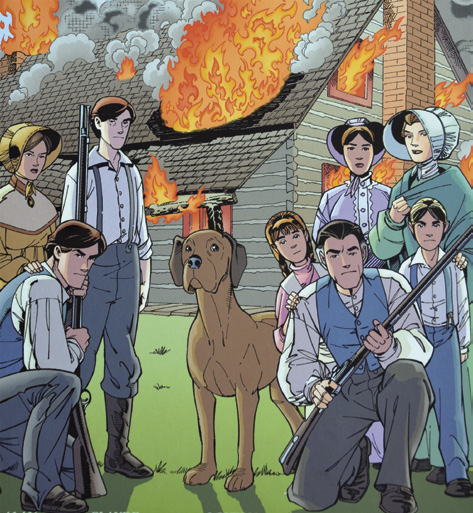
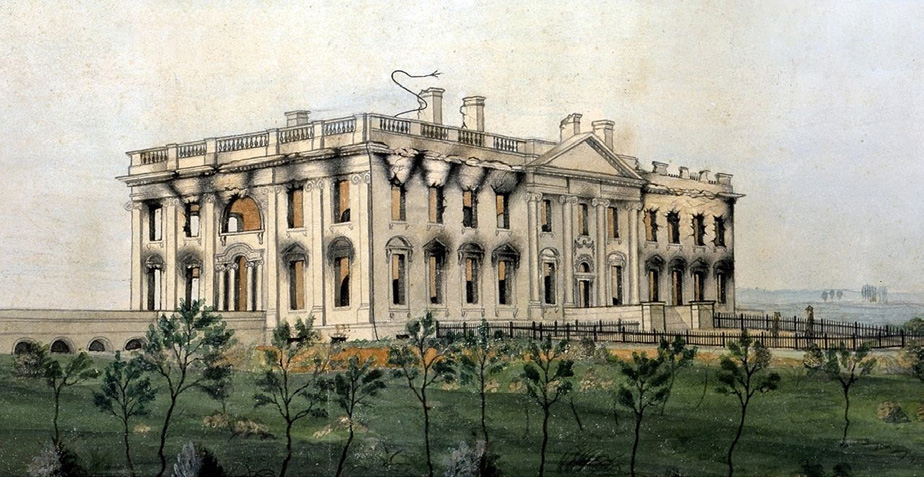
Among other Canadian historians, Mark Zuehlke – a populist whose focus is the Second World War – in 2006 simply observed that at Washington, “the raid and the destruction wrought by the British fell within the well-established parameters set by both sides over the past two years.” Robert Malcomson (in Capital in Flames) thought the destruction of Newark and Long Point, both more cruel and more recent, were more relevant to the Chesapeake campaign than the pillaging of York.
D’Arcy Macleod, in the Canadian War Museum’s bicentennial exhibition The Four Wars of 1812, is clear and direct: “British troops burned the White House in 1814,” he says in the museum description of Munger’s watercolour (previous page), “to retaliate for the burning of the Upper Canadian Legislative Assembly building in York (Toronto) by American invaders the year before.”
American authors tend to agree. These include Anthony Pitch, author of The Burning of Washington (1998) and Christopher George, author of Terror on the Chesapeake: The War of 1812 on the Bay (2000). Donald Hickey, perhaps the most prolific American author on the war, gives York as the motivation for the burning of Washington in Don’t Give up the Ship! Myths of the War of 1812 (2006) but is said to be leaning, as Benn and Malcomson do, toward the more cruel and the more recent.
Writing for a series from the Cambridge University Press in 2012, J.C.A. Stagg is silent on motivation but gets an alarming amount wrong about the Battle of York. “Realizing he was outnumbered,” reports Stagg in The War of 1812: Conflict for a Continent, “Sheaffe gave orders to withdraw to Burlington Heights, Ontario, and to blow up the Government House in the course of doing so.” Alan Taylor, whose revisionist book The Civil War of 1812 was published in 2010, accurately describes events at York and then, to explain the burning of Washington, is succinct: “Taking revenge for York, Dover, and St. David’s,” he writes, “the British burned the U.S. Capitol and the White House.” It was about a general problem, he believes, not a particular episode.
Regardless of the careful (or not) work of historians – and indeed supported by many of them – Canadian popular culture is claiming for York the credit for the flames in the White House. No less an authority than The Globe and Mail confirms it: “It’s easy to forget, and so most have forgotten,” declares the lead editorial of April 7, 2020, “that U.S. troops once burned and looted Toronto and, in retaliation, Washington was captured and torched.” (The paper was disparaging the short-lived American idea of thickening their northern border with troops, the better to combat the pandemic.)
It is not hard to imagine why the narrative has developed as it has: it’s a more satisfying story, certainly in Toronto, and how many Canadians have ever heard of Port Dover, Ontario? Indeed, how many read history books? Especially given the current occupant of the White House, it’s what many of us want to believe.
Original printed pages