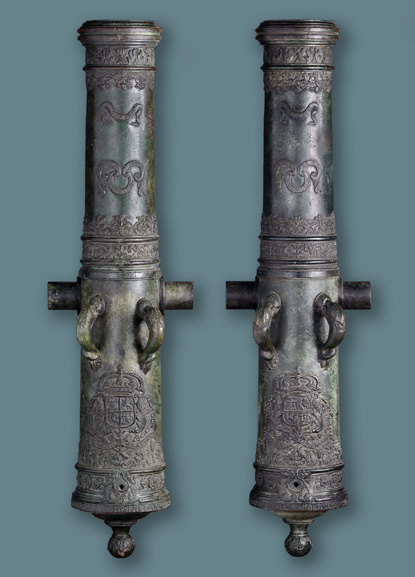
A few months ago Robert Hamilton, an alert reader of The Fife & Drum, sent us a link to a forthcoming sale in New York City. The objects on offer from Peter Finer, a noted arms and armour dealer based in London, UK, were a pair of bronze cannon once owned by John Graves Simcoe. Cast in Seville (Spain) in 1747 they were taken by the British as trophies-of-war from a revolutionary garrison on Santo Domingo (now Haiti) in 1793. Gifted by King George III to Simcoe in 1798 following the latter’s brief command of British forces on Haiti following his departure from Upper Canada the cannons were proudly on display at the Simcoes’ estate, Wolford Lodge, until its demolition in 1923.
But this wasn’t my first encounter with these guns. I had noticed them when they appeared in 2005 as lot 129 in a Christie’s (London) Antique Arms and Armour sale: “A very fine pair of Spanish bronze cannon by Mathias Solano. Royal Gun Foundry, Seville.” They were being sold by the Mole Valley District Council (Dorking, Surrey, UK) who’d owned them since 1940 when they were donated by Herbert Reeves, who in turn had purchased them from the sale of the Wolford Estate in 1922. Christie’s lot 129 was expected to fetch between £30,000 and £40,000; the hammer came down at £90,000. Needless to say, we did not bid.
Nor would we twenty years later. Any time the expression ‘price on request’ is employed it usually translates to astonishingly expensive, and I expect these guns would be. But that’s not the reason we wouldn’t bid for Simcoe’s Spanish cannons. The real reason is sound collecting practice. They have little to nothing to do with his time in Upper Canada, and therefore, fall outside our collecting mandate. (We actually do turn down much more than we acquire for just this reason.) But, to be honest, I probably would think long and hard for a reason to take them if they were on offer as a gift–it’s just very difficult to justify spending hundreds of thousands of dollars on something, however splendid, with little research or exhibition potential.
Also we don’t have hundreds of thousands of unrestricted acquisition dollars just sitting around. What we do have is a small, but growing, fund managed by the Fort York Foundation that we can draw upon to acquire objects or undertake special conservation projects that would normally be beyond our ability to fund.
To donate to the fort’s Acquisition Fund, please click here: http://www.fortyorkfoundation.ca/acquisition-fund/
Original printed pages