Historic site museums regularly face pressures to generate revenue beyond the income they derive from admissions, gift shop sales and other standard sources. One common response is to rent space for social events, film shoots and comparable activities. Often the grounds and some buildings are sturdy enough to withstand the associated wear, but period rooms that use artefacts to recreate interiors from the past are not, because those exhibits simply are too fragile. Thus, non-museum activities in period rooms present unjustifiable dangers to heritage resources that are supposed to be preserved for the public benefit.
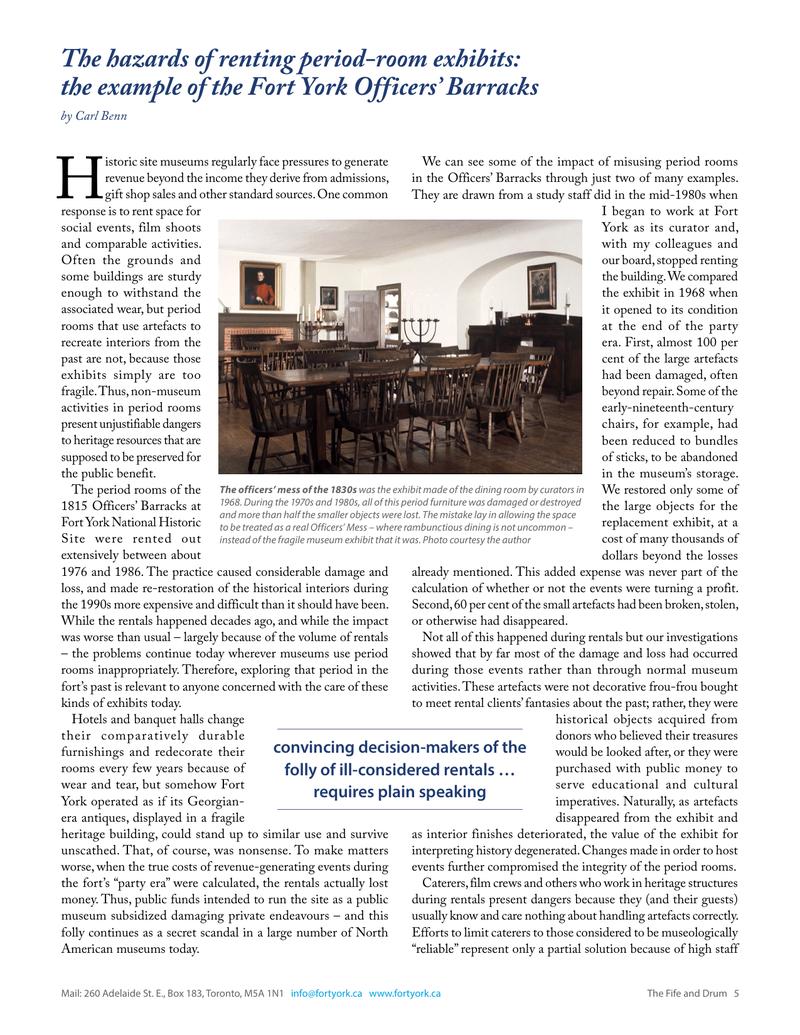
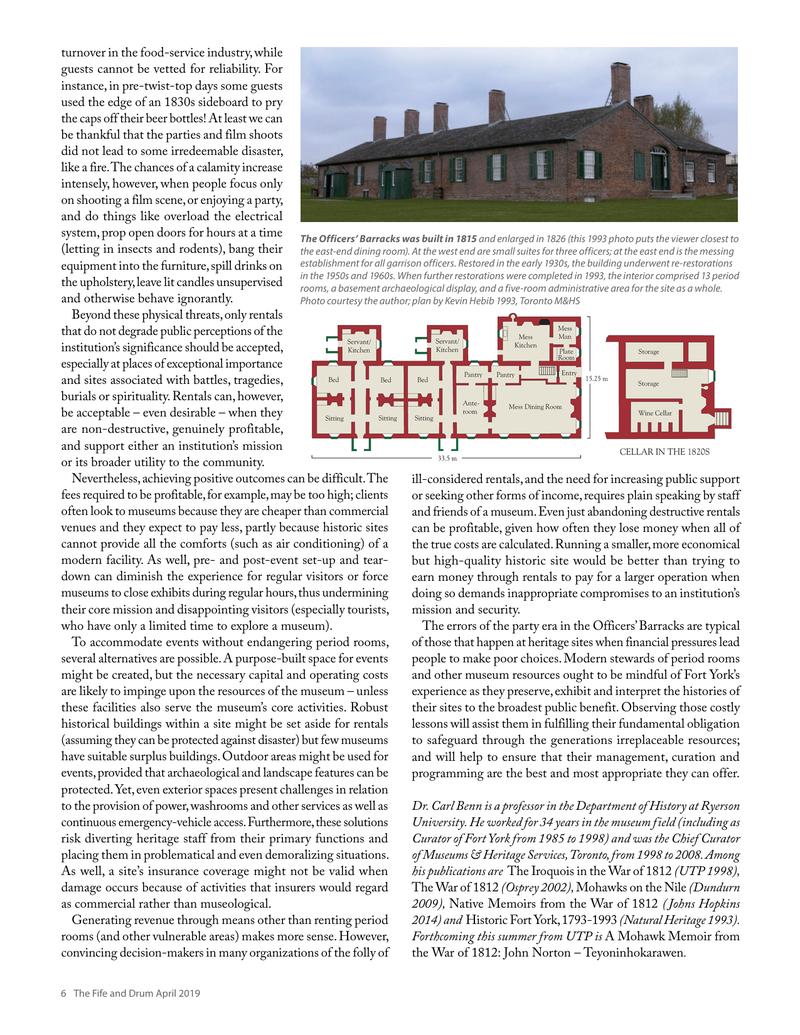
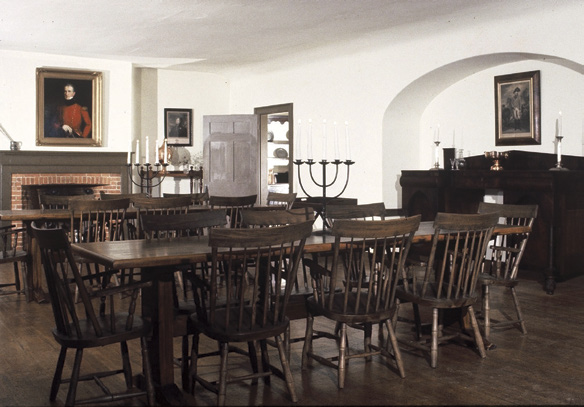
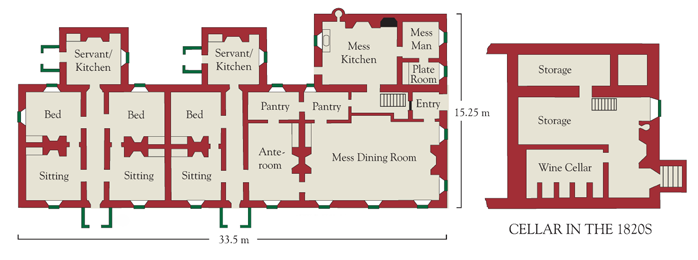
The period rooms of the 1815 Officers’ Barracks at Fort York National Historic Site were rented out extensively between about 1976 and 1986. The practice caused considerable damage and loss, and made re-restoration of the historical interiors during the 1990s more expensive and difficult than it should have been. While the rentals happened decades ago, and while the impact was worse than usual – largely because of the volume of rentals – the problems continue today wherever museums use period rooms inappropriately. Therefore, exploring that period in the fort’s past is relevant to anyone concerned with the care of these kinds of exhibits today.
Hotels and banquet halls change their comparatively durable furnishings and redecorate their rooms every few years because of wear and tear, but somehow Fort York operated as if its Georgian-era antiques, displayed in a fragile heritage building, could stand up to similar use and survive unscathed. That, of course, was nonsense. To make matters worse, when the true costs of revenue-generating events during the fort’s “party era” were calculated, the rentals actually lost money. Thus, public funds intended to run the site as a public museum subsidized damaging private endeavours – and this folly continues as a secret scandal in a large number of North American museums today.
We can see some of the impact of misusing period rooms in the Officers’ Barracks through just two of many examples. They are drawn from a study staff did in the mid-1980s when I began to work at Fort York as its curator and, with my colleagues and our board, stopped renting the building. We compared the exhibit in 1968 when it opened to its condition at the end of the party era. First, almost 100 per cent of the large artefacts had been damaged, often beyond repair. Some of the early-nineteenth-century chairs, for example, had been reduced to bundles of sticks, to be abandoned in the museum’s storage. We restored only some of the large objects for the replacement exhibit, at a cost of many thousands of dollars beyond the losses already mentioned. This added expense was never part of the calculation of whether or not the events were turning a profit. Second, 60 per cent of the small artefacts had been broken, stolen, or otherwise had disappeared.
Not all of this happened during rentals but our investigations showed that by far most of the damage and loss had occurred during those events rather than through normal museum activities. These artefacts were not decorative frou-frou bought to meet rental clients’ fantasies about the past; rather, they were historical objects acquired from donors who believed their treasures would be looked after, or they were purchased with public money to serve educational and cultural imperatives. Naturally, as artefacts disappeared from the exhibit and as interior finishes deteriorated, the value of the exhibit for interpreting history degenerated. Changes made in order to host events further compromised the integrity of the period rooms. Caterers, film crews and others who work in heritage structures during rentals present dangers because they (and their guests) usually know and care nothing about handling artefacts correctly. Efforts to limit caterers to those considered to be museologically “reliable” represent only a partial solution because of high staff
convincing decision-makers of the folly of ill-considered rentals … requires plain speaking
turnover in the food-service industry, while guests cannot be vetted for reliability. For instance, in pre-twist-top days some guests used the edge of an 1830s sideboard to pry the caps off their beer bottles! At least we can be thankful that the parties and film shoots did not lead to some irredeemable disaster, like a fire. The chances of a calamity increase intensely, however, when people focus only on shooting a film scene, or enjoying a party, and do things like overload the electrical system, prop open doors for hours at a time (letting in insects and rodents), bang their equipment into the furniture, spill drinks on the upholstery, leave lit candles unsupervised and otherwise behave ignorantly.
Beyond these physical threats, only rentals that do not degrade public perceptions of the institution’s significance should be accepted, especially at places of exceptional importance and sites associated with battles, tragedies, burials or spirituality. Rentals can, however, be acceptable – even desirable – when they are non-destructive, genuinely profitable, and support either an institution’s mission or its broader utility to the community.
Nevertheless, achieving positive outcomes can be difficult. The fees required to be profitable, for example, may be too high; clients often look to museums because they are cheaper than commercial venues and they expect to pay less, partly because historic sites cannot provide all the comforts (such as air conditioning) of a modern facility. As well, pre- and post-event set-up and tear-down can diminish the experience for regular visitors or force museums to close exhibits during regular hours, thus undermining their core mission and disappointing visitors (especially tourists, who have only a limited time to explore a museum).
To accommodate events without endangering period rooms, several alternatives are possible. A purpose-built space for events might be created, but the necessary capital and operating costs are likely to impinge upon the resources of the museum – unless these facilities also serve the museum’s core activities. Robust historical buildings within a site might be set aside for rentals (assuming they can be protected against disaster) but few museums have suitable surplus buildings. Outdoor areas might be used for events, provided that archaeological and landscape features can be protected. Yet, even exterior spaces present challenges in relation to the provision of power, washrooms and other services as well as continuous emergency-vehicle access. Furthermore, these solutions risk diverting heritage staff from their primary functions and placing them in problematical and even demoralizing situations. As well, a site’s insurance coverage might not be valid when damage occurs because of activities that insurers would regard as commercial rather than museological.
Generating revenue through means other than renting period rooms (and other vulnerable areas) makes more sense. However, convincing decision-makers in many organizations of the folly of ill-considered rentals, and the need for increasing public support or seeking other forms of income, requires plain speaking by staff and friends of a museum. Even just abandoning destructive rentals can be profitable, given how often they lose money when all of the true costs are calculated. Running a smaller, more economical but high-quality historic site would be better than trying to earn money through rentals to pay for a larger operation when doing so demands inappropriate compromises to an institution’s mission and security.
The errors of the party era in the Officers’ Barracks are typical of those that happen at heritage sites when financial pressures lead people to make poor choices. Modern stewards of period rooms and other museum resources ought to be mindful of Fort York’s experience as they preserve, exhibit and interpret the histories of their sites to the broadest public benefit. Observing those costly lessons will assist them in fulfilling their fundamental obligation to safeguard through the generations irreplaceable resources; and will help to ensure that their management, curation and programming are the best and most appropriate they can offer.
Original printed pages