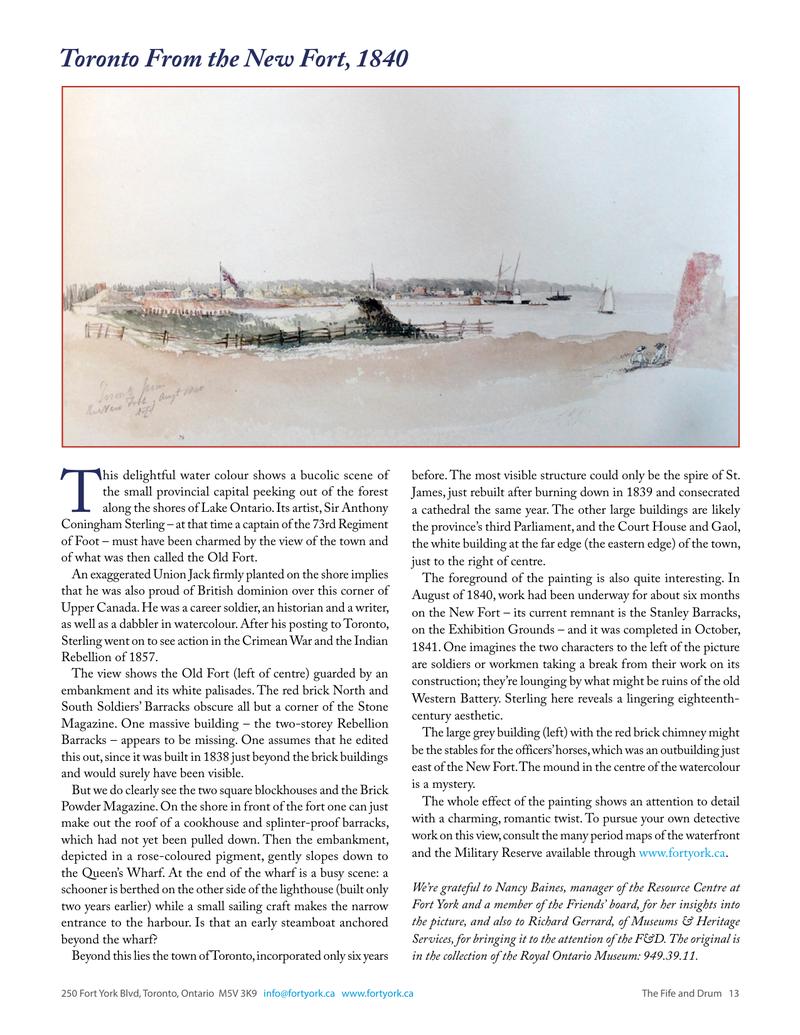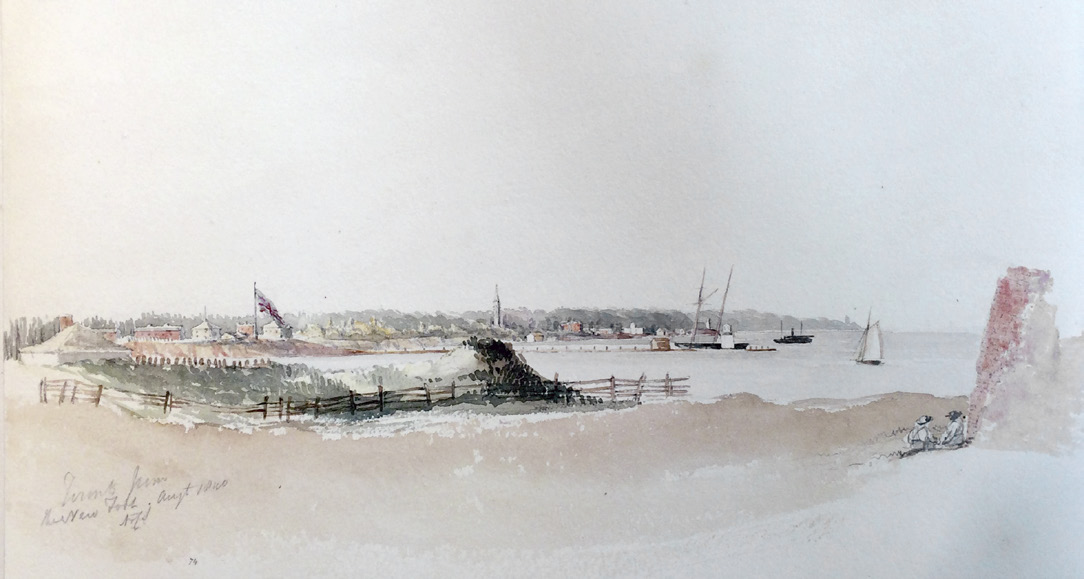
This delightful water colour shows a bucolic scene of the small provincial capital peeking out of the forest along the shores of Lake Ontario. Its artist, Sir Anthony Coningham Sterling – at that time a captain of the 73rd Regiment of Foot – must have been charmed by the view of the town and of what was then called the Old Fort.
An exaggerated Union Jack firmly planted on the shore implies that he was also proud of British dominion over this corner of Upper Canada. He was a career soldier, an historian and a writer, as well as a dabbler in watercolour. After his posting to Toronto, Sterling went on to see action in the Crimean War and the Indian Rebellion of 1857.
The view shows the Old Fort (left of centre) guarded by an embankment and its white palisades. The red brick North and South Soldiers’ Barracks obscure all but a corner of the Stone Magazine. One massive building – the two-storey Rebellion Barracks – appears to be missing. One assumes that he edited this out, since it was built in 1838 just beyond the brick buildings and would surely have been visible.
But we do clearly see the two square blockhouses and the Brick Powder Magazine. On the shore in front of the fort one can just make out the roof of a cookhouse and splinter-proof barracks, which had not yet been pulled down. Then the embankment, depicted in a rose-coloured pigment, gently slopes down to the Queen’s Wharf. At the end of the wharf is a busy scene: a schooner is berthed on the other side of the lighthouse (built only two years earlier) while a small sailing craft makes the narrow entrance to the harbour. Is that an early steamboat anchored beyond the wharf?
Beyond this lies the town of Toronto, incorporated only six years before. The most visible structure could only be the spire of St. James, just rebuilt after burning down in 1839 and consecrated a cathedral the same year. The other large buildings are likely the province’s third Parliament, and the Court House and Gaol, the white building at the far edge (the eastern edge) of the town, just to the right of centre.
The foreground of the painting is also quite interesting. In August of 1840, work had been underway for about six months on the New Fort – its current remnant is the Stanley Barracks, on the Exhibition Grounds – and it was completed in October, 1841. One imagines the two characters to the left of the picture are soldiers or workmen taking a break from their work on its construction; they’re lounging by what might be ruins of the old Western Battery. Sterling here reveals a lingering eighteenth-century aesthetic.
The large grey building (left) with the red brick chimney might be the stables for the officers’ horses, which was an outbuilding just east of the New Fort. The mound in the centre of the watercolour is a mystery.
The whole effect of the painting shows an attention to detail with a charming, romantic twist. To pursue your own detective work on this view, consult the many period maps of the waterfront and the Military Reserve available through www.fortyork.ca.
Original printed pages