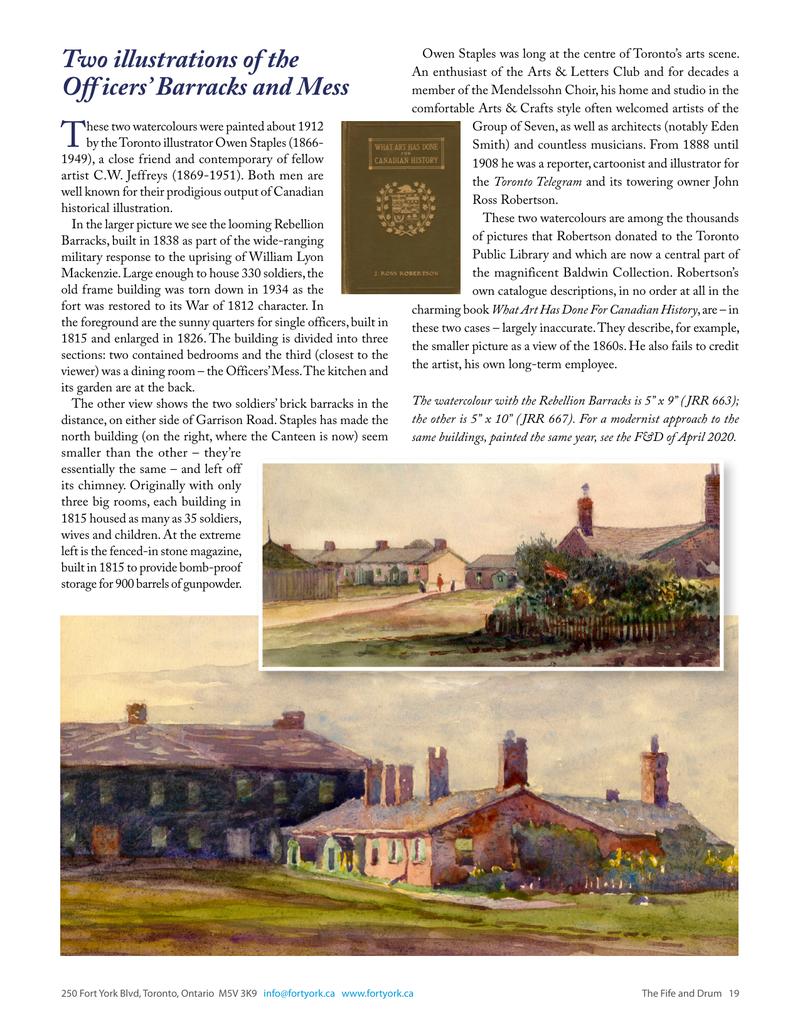
hese two watercolours were painted about 1912 T by the Toronto illustrator Owen Staples (18661949), a close friend and contemporary of fellow artist C.W. Jeffreys (1869-1951). Both men are well known for their prodigious output of Canadian historical illustration. In the larger picture we see the looming Rebellion Barracks, built in 1838 as part of the wide-ranging military response to the uprising of William Lyon Mackenzie. Large enough to house 330 soldiers, the old frame building was torn down in 1934 as the fort was restored to its War of 1812 character. In the foreground are the sunny quarters for single officers, built in 1815 and enlarged in 1826. The building is divided into three sections: two contained bedrooms and the third (closest to the viewer) was a dining room – the Officers’ Mess. The kitchen and its garden are at the back. The other view shows the two soldiers’ brick barracks in the distance, on either side of Garrison Road. Staples has made the north building (on the right, where the Canteen is now) seem smaller than the other – they’re essentially the same – and left off its chimney. Originally with only three big rooms, each building in 1815 housed as many as 35 soldiers, wives and children. At the extreme left is the fenced-in stone magazine, built in 1815 to provide bomb-proof storage for 900 barrels of gunpowder.
Owen Staples was long at the centre of Toronto’s arts scene. An enthusiast of the Arts & Letters Club and for decades a member of the Mendelssohn Choir, his home and studio in the comfortable Arts & Crafts style often welcomed artists of the Group of Seven, as well as architects (notably Eden Smith) and countless musicians. From 1888 until 1908 he was a reporter, cartoonist and illustrator for the Toronto Telegram and its towering owner John Ross Robertson. These two watercolours are among the thousands of pictures that Robertson donated to the Toronto Public Library and which are now a central part of the magnificent Baldwin Collection. Robertson’s own catalogue descriptions, in no order at all in the charming book What Art Has Done For Canadian History, are – in these two cases – largely inaccurate. They describe, for example, the smaller picture as a view of the 1860s. He also fails to credit the artist, his own long-term employee. The watercolour with the Rebellion Barracks is 5” x 9” (JRR 663); the other is 5” x 10” (JRR 667). For a modernist approach to the same buildings, painted the same year, see the F&D of April 2020.
Two illustrations of the Officers’ Barracks and Mess
Original printed pages