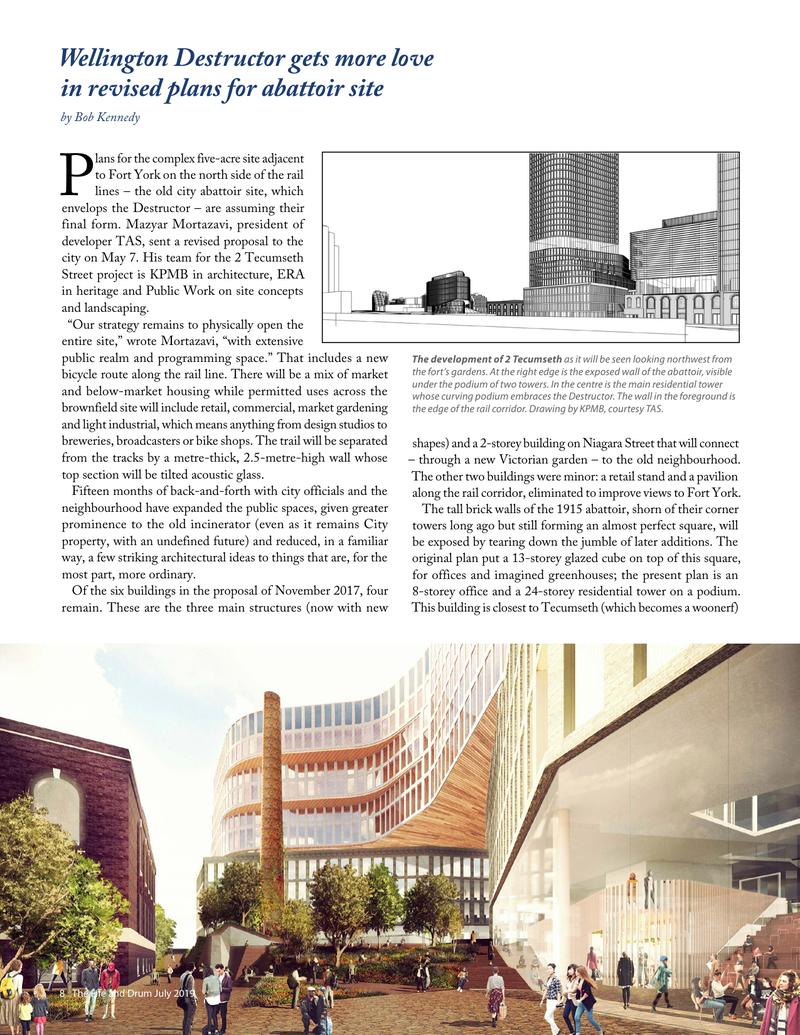
Plans for the complex five-acre site adjacent to Fort York on the north side of the rail lines – the old city abattoir site, which envelops the Destructor – are assuming their final form. Mazyar Mortazavi, president of developer TAS, sent a revised proposal to the city on May 7. His team for the 2 Tecumseth Street project is KPMB in architecture, ERA in heritage and Public Work on site concepts and landscaping.
“Our strategy remains to physically open the entire site,” wrote Mortazavi, “with extensive public realm and programming space.” That includes a new bicycle route along the rail line. There will be a mix of market and below-market housing while permitted uses across the brownfield site will include retail, commercial, market gardening and light industrial, which means anything from design studios to breweries, broadcasters or bike shops. The trail will be separated from the tracks by a metre-thick, 2.5-metre-high wall whose top section will be tilted acoustic glass.
Fifteen months of back-and-forth with city officials and the neighbourhood have expanded the public spaces, given greater prominence to the old incinerator (even as it remains City property, with an undefined future) and reduced, in a familiar way, a few striking architectural ideas to things that are, for the most part, more ordinary.
Of the six buildings in the proposal of November 2017, four remain. These are the three main structures (now with new shapes) and a 2-storey building on Niagara Street that will connect – through a new Victorian garden – to the old neighbourhood. The other two buildings were minor: a retail stand and a pavilion along the rail corridor, eliminated to improve views to Fort York.
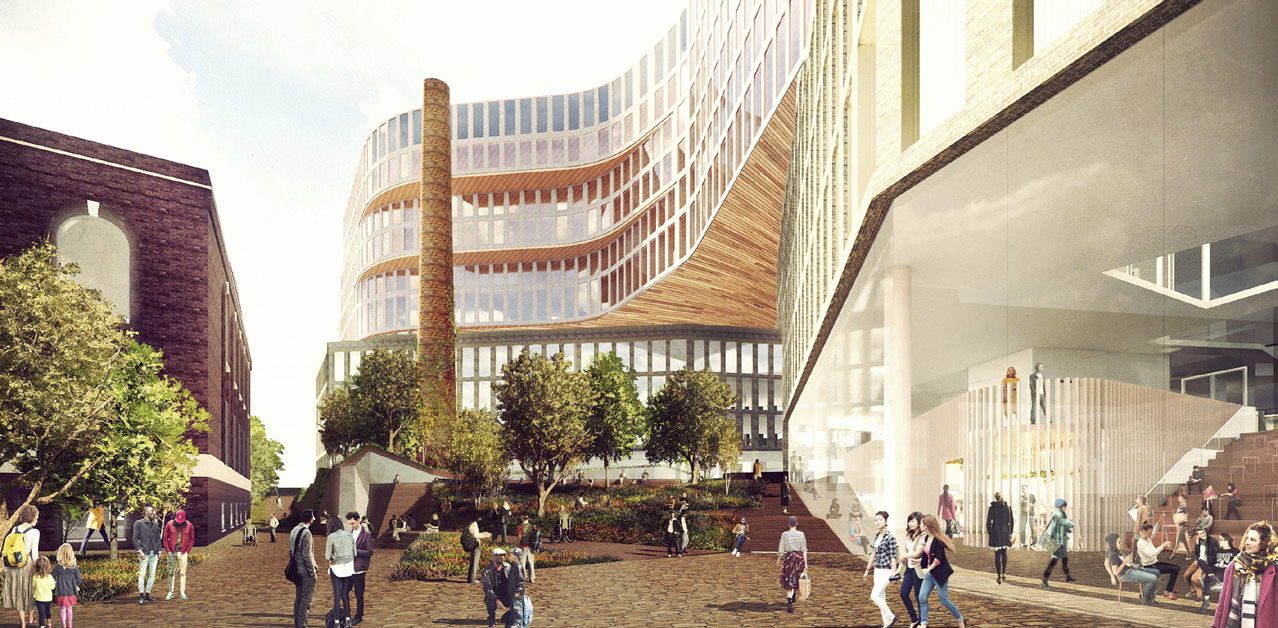
The tall brick walls of the 1915 abattoir, shorn of their corner towers long ago but still forming an almost perfect square, will be exposed by tearing down the jumble of later additions. The original plan put a 13-storey glazed cube on top of this square, for offices and imagined greenhouses; the present plan is an 8-storey office and a 24-storey residential tower on a podium. This building is closest to Tecumseth (which becomes a woonerf) and defines the main entrance to the project.
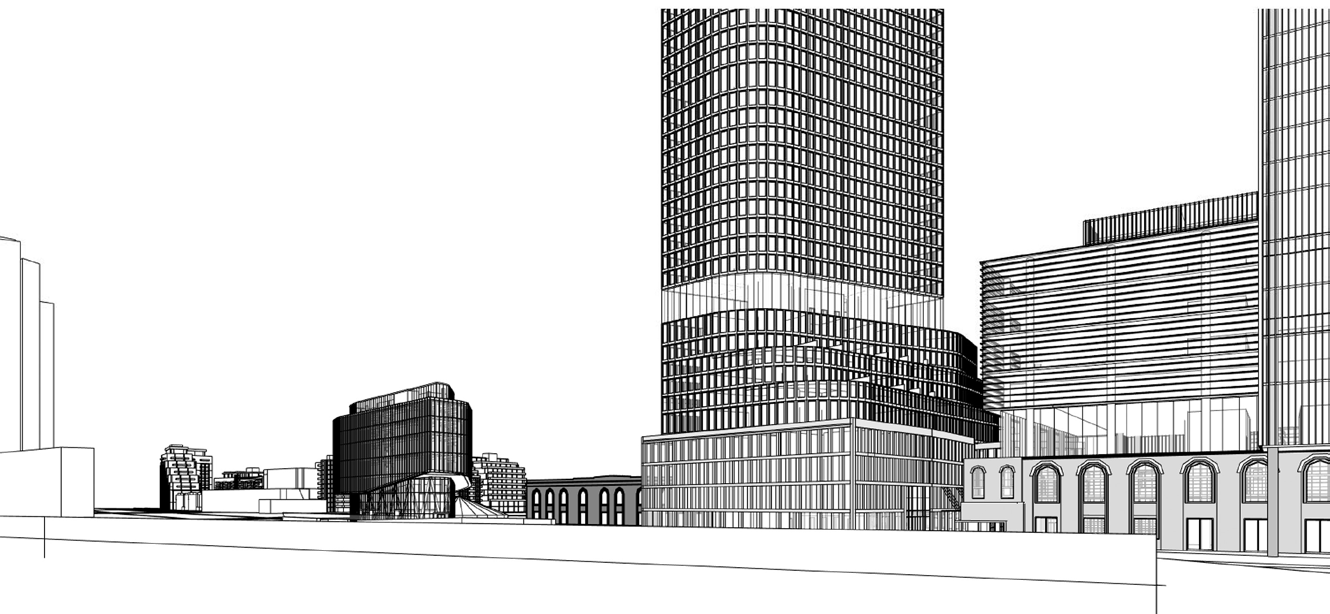
In the centre of the site, conceived as a plateau above the shadow of the Garrison Creek ravine, the main residential tower – originally a slender 38 storeys – has been reduced to 30 and given a shapely new podium (pictured). This provides, says Marc Ryan, principal of Public Work, “a new space on the plateau” that embraces the smoke stack and the textured walls of the Destructor, built in 1925. The terraced podium will also shelter the plaza, which faces south.
Ryan says the new shapes of the built form allowed him to reinforce Public Work’s initial concept, which was based on site porosity and the shadows of Garrison Creek. Now, there’s “a more distinctive series of public spaces of increasing scale” – from the garden on Niagara, to the open plaza mixing new and old, down to the spacious lowland of the imagined ravine. “The lowlands are where we amplify,” says Ryan, “the meaning of the topography and role of the former Garrison Creek.”
The third major building is at the west end of the site and aligned with the tracks. Sandwiched between a City works yard and the rail line, it has been redesigned from residential to office or industrial. It has also been lowered to 7 storeys from 15 and sculptured to reduce morning shadow on the green space beside it. Here, about a third of an acre (1189 m2) is being added by TAS to the adjacent South Stanley Park extension, created for the northern span of Garrison Crossing. The curves of the ramps here do more than just manage elevation. Expect to see “a sequence of views that unfold as you move” and that always, says Ryan, “will culminate in the broader founding landscape” of Toronto. By that he means the shadows of 12,000 years of landscape history, mingled with traces of industry and the growing city, all of it still within sight of the ancient creek that defined the place of Fort York.
Original printed pages