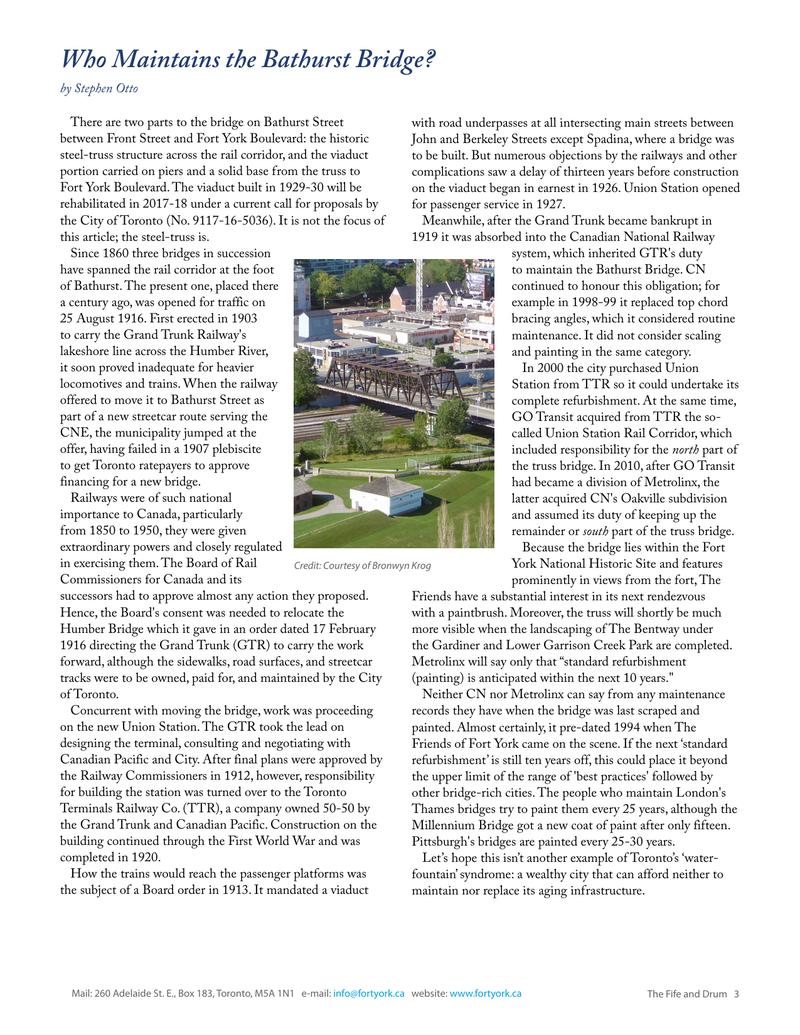
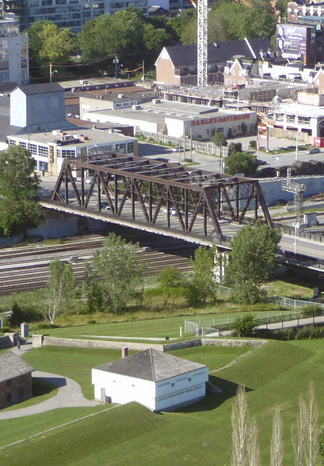
There are two parts to the bridge on Bathurst Street between Front Street and Fort York Boulevard: the historic steel-truss structure across the rail corridor, and the viaduct portion carried on piers and a solid base from the truss to Fort York Boulevard. The viaduct built in 1929-30 will be rehabilitated in 2017-18 under a current call for proposals by the City of Toronto (No. 9117-16-5036). It is not the focus of this article; the steel-truss is.
Since 1860 three bridges in succession have spanned the rail corridor at the foot of Bathurst. The present one, placed there a century ago, was opened for traffic on 25 August 1916. First erected in 1903 to carry the Grand Trunk Railway’s lakeshore line across the Humber River, it soon proved inadequate for heavier locomotives and trains. When the railway offered to move it to Bathurst Street as part of a new streetcar route serving the CNE, the municipality jumped at the offer, having failed in a 1907 plebiscite to get Toronto ratepayers to approve financing for a new bridge.
Railways were of such national importance to Canada, particularly from 1850 to 1950, they were given extraordinary powers and closely regulated in exercising them. The Board of Rail Commissioners for Canada and its successors had to approve almost any action they proposed. Hence, the Board’s consent was needed to relocate the Humber Bridge which it gave in an order dated 17 February 1916 directing the Grand Trunk (GTR) to carry the work forward, although the sidewalks, road surfaces, and streetcar tracks were to be owned, paid for, and maintained by the City of Toronto.
Concurrent with moving the bridge, work was proceeding on the new Union Station. The GTR took the lead on designing the terminal, consulting and negotiating with Canadian Pacific and City. After final plans were approved by the Railway Commissioners in 1912, however, responsibility for building the station was turned over to the Toronto Terminals Railway Co. (TTR), a company owned 50-50 by the Grand Trunk and Canadian Pacific. Construction on the building continued through the First World War and was completed in 1920.
How the trains would reach the passenger platforms was the subject of a Board order in 1913. It mandated a viaduct with road underpasses at all intersecting main streets between John and Berkeley Streets except Spadina, where a bridge was to be built. But numerous objections by the railways and other complications saw a delay of thirteen years before construction on the viaduct began in earnest in 1926. Union Station opened for passenger service in 1927.
Meanwhile, after the Grand Trunk became bankrupt in 1919 it was absorbed into the Canadian National Railway system, which inherited GTR’s duty to maintain the Bathurst Bridge. CN continued to honour this obligation; for example in 1998-99 it replaced top chord bracing angles, which it considered routine maintenance. It did not consider scaling and painting in the same category.
In 2000 the city purchased Union Station from TTR so it could undertake its complete refurbishment. At the same time, GO Transit acquired from TTR the so-called Union Station Rail Corridor, which included responsibility for the north part of the truss bridge. In 2010, after GO Transit had became a division of Metrolinx, the latter acquired CN’s Oakville subdivision and assumed its duty of keeping up the remainder or south part of the truss bridge.
Because the bridge lies within the Fort York National Historic Site and features prominently in views from the fort, The Friends have a substantial interest in its next rendezvous with a paintbrush. Moreover, the truss will shortly be much more visible when the landscaping of The Bentway under the Gardiner and Lower Garrison Creek Park are completed. Metrolinx will say only that “standard refurbishment (painting) is anticipated within the next 10 years.”
Neither CN nor Metrolinx can say from any maintenance records they have when the bridge was last scraped and painted. Almost certainly, it pre-dated 1994 when The Friends of Fort York came on the scene. If the next ‘standard refurbishment’ is still ten years off, this could place it beyond the upper limit of the range of ‘best practices’ followed by other bridge-rich cities. The people who maintain London’s Thames bridges try to paint them every 25 years, although the Millennium Bridge got a new coat of paint after only fifteen. Pittsburgh’s bridges are painted every 25-30 years.
Let’s hope this isn’t another example of Toronto’s ‘water-fountain’ syndrome: a wealthy city that can afford neither to maintain nor replace its aging infrastructure.
Original printed pages