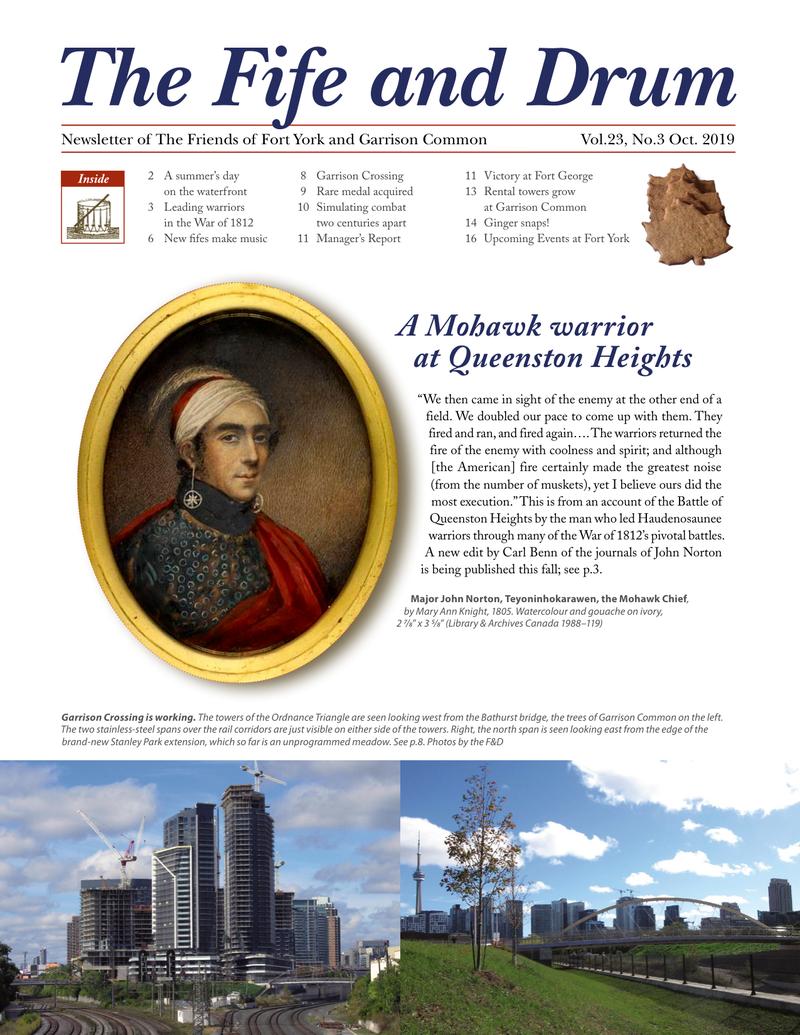
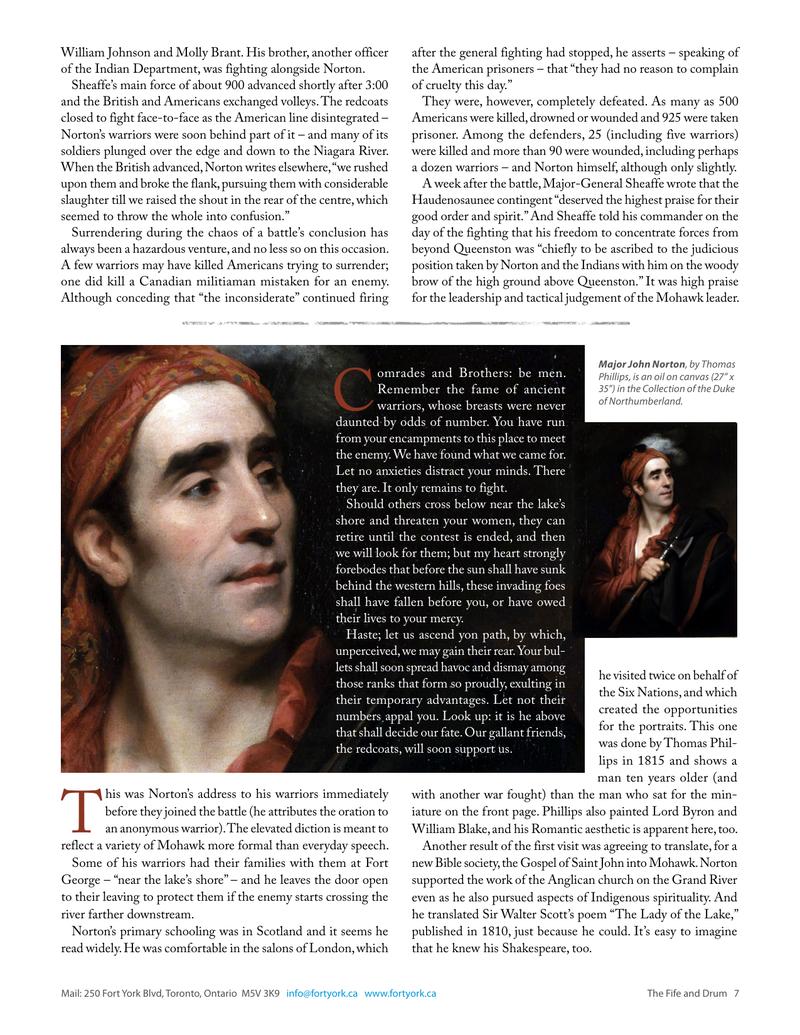
“We then came in sight of the enemy at the other end of a field. We doubled our pace to come up with them. They fired and ran, and fired again…. The warriors returned the fire of the enemy with coolness and spirit; and although [the American] fire certainly made the greatest noise (from the number of muskets), yet I believe ours did the most execution.” This is from an account of the Battle of Queenston Heights by the man who led Haudenosaunee warriors through many of the War of 1812’s pivotal battles. A new edit by Carl Benn of the journals of John Norton is being published this fall; see p.3.
William Johnson and Molly Brant. His brother, another officer of the Indian Department, was fighting alongside Norton.
Sheaffe’s main force of about 900 advanced shortly after 3:00 and the British and Americans exchanged volleys. The redcoats closed to fight face-to-face as the American line disintegrated – Norton’s warriors were soon behind part of it – and many of its soldiers plunged over the edge and down to the Niagara River. When the British advanced, Norton writes elsewhere, “we rushed upon them and broke the flank, pursuing them with considerable slaughter till we raised the shout in the rear of the centre, which seemed to throw the whole into confusion.”
Surrendering during the chaos of a battle’s conclusion has always been a hazardous venture, and no less so on this occasion. A few warriors may have killed Americans trying to surrender; one did kill a Canadian militiaman mistaken for an enemy. Although conceding that “the inconsiderate” continued firing after the general fighting had stopped, he asserts – speaking of the American prisoners – that “they had no reason to complain of cruelty this day.”
They were, however, completely defeated. As many as 500 Americans were killed, drowned or wounded and 925 were taken prisoner. Among the defenders, 25 (including five warriors) were killed and more than 90 were wounded, including perhaps a dozen warriors – and Norton himself, although only slightly.
A week after the battle, Major-General Sheaffe wrote that the Haudenosaunee contingent “deserved the highest praise for their good order and spirit.” And Sheaffe told his commander on the day of the fighting that his freedom to concentrate forces from beyond Queenston was “chiefly to be ascribed to the judicious position taken by Norton and the Indians with him on the woody brow of the high ground above Queenston.” It was high praise for the leadership and tactical judgement of the Mohawk leader.
Comrades and Brothers: be men. Remember the fame of ancient warriors, whose breasts were never daunted by odds of number. You have run from your encampments to this place to meet the enemy. We have found what we came for. Let no anxieties distract your minds. There they are. It only remains to fight. Should others cross below near the lake’s shore and threaten your women, they can retire until the contest is ended, and then we will look for them; but my heart strongly forebodes that before the sun shall have sunk behind the western hills, these invading foes shall have fallen before you, or have owed their lives to your mercy. Haste; let us ascend yon path, by which, unperceived, we may gain their rear. Your bullets shall soon spread havoc and dismay among those ranks that form so proudly, exulting in their temporary advantages. Let not their numbers appal you. Look up: it is he above that shall decide our fate. Our gallant friends, the redcoats, will soon support us.
This was Norton’s address to his warriors immediately before they joined the battle (he attributes the oration to an anonymous warrior). The elevated diction is meant to reflect a variety of Mohawk more formal than everyday speech. Some of his warriors had their families with them at Fort George – “near the lake’s shore” – and he leaves the door open to their leaving to protect them if the enemy starts crossing the river farther downstream.
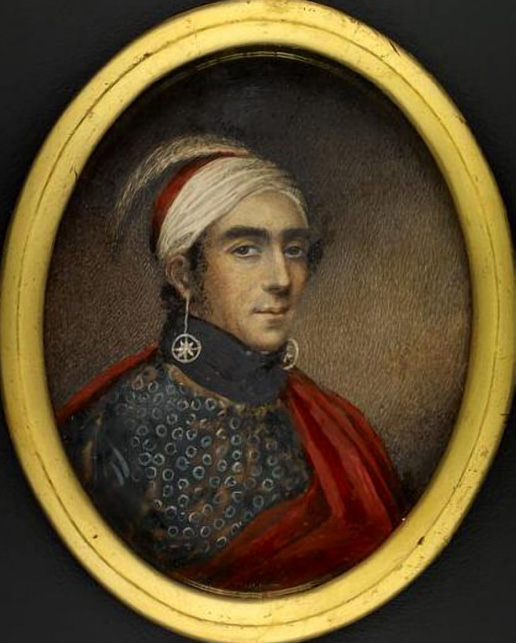
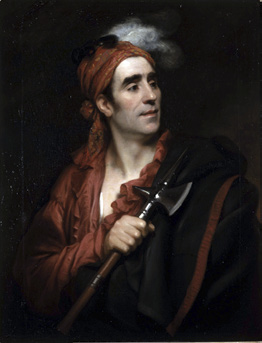
Norton’s primary schooling was in Scotland and it seems he read widely. He was comfortable in the salons of London, which he visited twice on behalf of the Six Nations, and which created the opportunities for the portraits. This one was done by Thomas Phillips in 1815 and shows a man ten years older (and with another war fought) than the man who sat for the miniature on the front page. Phillips also painted Lord Byron and William Blake, and his Romantic aesthetic is apparent here, too.
Another result of the first visit was agreeing to translate, for a new Bible society, the Gospel of Saint John into Mohawk. Norton supported the work of the Anglican church on the Grand River even as he also pursued aspects of Indigenous spirituality. And he translated Sir Walter Scott’s poem “The Lady of the Lake,” published in 1810, just because he could. It’s easy to imagine that he knew his Shakespeare, too.
Original printed pages