Dec. 7 Home District Magistrates ordered a Market House built at King and New [Jarvis] streets, York, on ground set aside for a market in 1797. It had been completed by April 1815 when regulations were made to govern the sale of food in the town. Two hundred copies were printed.
Dec. 17 Notice that the next Dancing Assembly in York will be held on January 2; subscribers who have not yet paid their subscriptions will please remit them to the Managers.
Dec. 21 Thomas Tivey and John Dennis received £36 “For materials furnished and work performed, Repairing the Church Damaged while occupied by the troops for a hospital.”
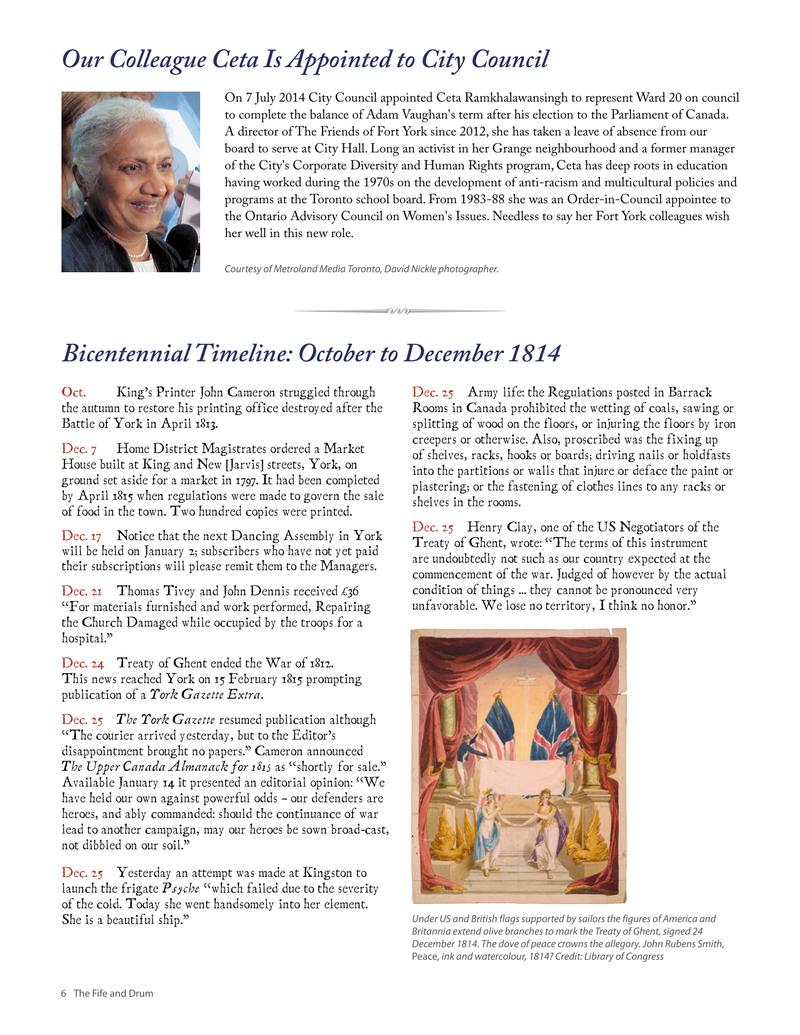
Dec. 24 Treaty of Ghent ended the War of 1812. This news reached York on 15 February 1815 prompting publication of a York Gazette Extra.
Dec. 25 The York Gazette resumed publication although “The courier arrived yesterday, but to the Editor’s disappointment brought no papers.” Cameron announced The Upper Canada Almanack for 1815 as “shortly for sale.” Available January 14 it presented an editorial opinion: “We have held our own against powerful odds – our defenders are heroes, and ably commanded: should the continuance of war lead to another campaign, may our heroes be sown broad-cast, not dibbled on our soil.”
Dec. 25 Yesterday an attempt was made at Kingston to launch the frigate Psyche “which failed due to the severity of the cold. Today she went handsomely into her element. She is a beautiful ship.”
Dec. 25 Army life: the Regulations posted in Barrack Rooms in Canada prohibited the wetting of coals, sawing or splitting of wood on the floors, or injuring the floors by iron creepers or otherwise. Also, proscribed was the fixing up of shelves, racks, hooks or boards; driving nails or holdfasts into the partitions or walls that injure or deface the paint or plastering; or the fastening of clothes lines to any racks or shelves in the rooms.
Dec. 25 Henry Clay, one of the US Negotiators of the Treaty of Ghent, wrote: “The terms of this instrument are undoubtedly not such as our country expected at the commencement of the war. Judged of however by the actual condition of things … they cannot be pronounced very unfavorable. We lose no territory, I think no honor.”
Original printed pages