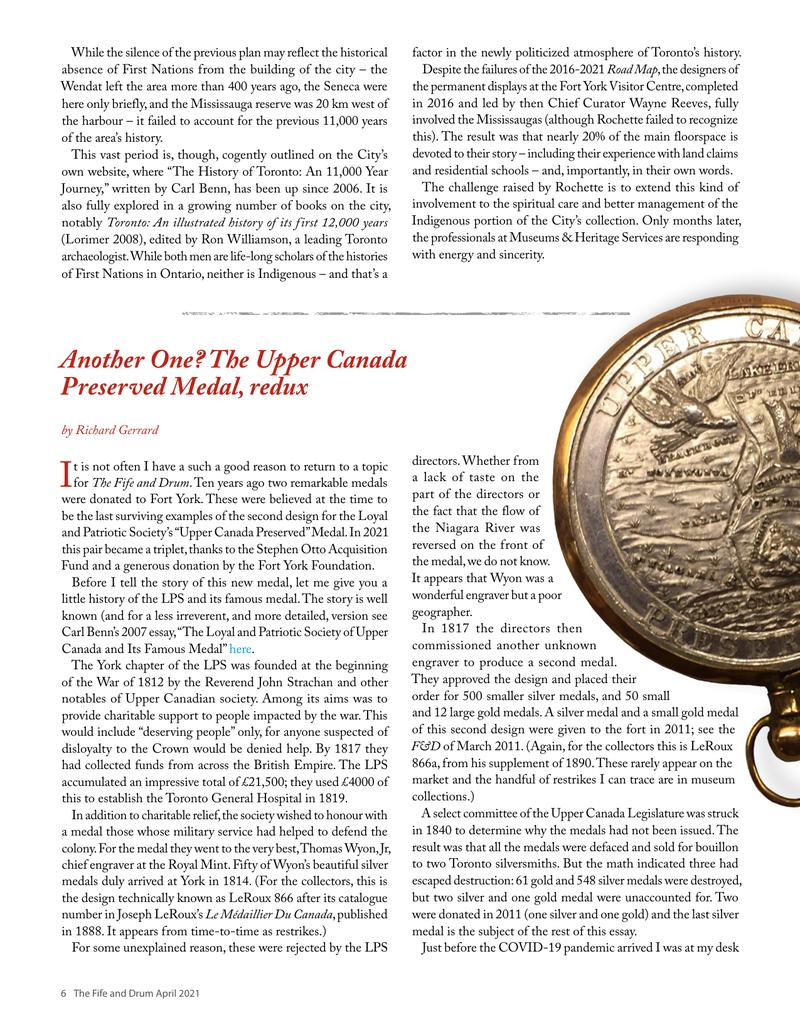
It is not often I have a such a good reason to return to a topic for The Fife and Drum. Ten years ago two remarkable medals were donated to Fort York. These were believed at the time to be the last surviving examples of the second design for the Loyal and Patriotic Society’s “Upper Canada Preserved” Medal. In 2021 this pair became a triplet, thanks to the Stephen Otto Acquisition Fund and a generous donation by the Fort York Foundation.
Before I tell the story of this new medal, let me give you a little history of the LPS and its famous medal. The story is well known (and for a less irreverent, and more detailed, version see Carl Benn’s 2007 essay, “The Loyal and Patriotic Society of Upper Canada and Its Famous Medal” here.
The York chapter of the LPS was founded at the beginning of the War of 1812 by the Reverend John Strachan and other notables of Upper Canadian society. Among its aims was to provide charitable support to people impacted by the war. This would include “deserving people” only, for anyone suspected of disloyalty to the Crown would be denied help. By 1817 they had collected funds from across the British Empire. The LPS accumulated an impressive total of £21,500; they used £4000 of this to establish the Toronto General Hospital in 1819.
In addition to charitable relief, the society wished to honour with a medal those whose military service had helped to defend the colony. For the medal they went to the very best, Thomas Wyon, Jr, chief engraver at the Royal Mint. Fifty of Wyon’s beautiful silver medals duly arrived at York in 1814. (For the collectors, this is the design technically known as LeRoux 866 after its catalogue number in Joseph LeRoux’s Le Médaillier Du Canada, published in 1888. It appears from time-to-time as restrikes.)
For some unexplained reason, these were rejected by the LPS directors. Whether from a lack of taste on the part of the directors or the fact that the flow of the Niagara River was reversed on the front of the medal, we do not know. It appears that Wyon was a wonderful engraver but a poor geographer.
In 1817 the directors then commissioned another unknown engraver to produce a second medal. They approved the design and placed their order for 500 smaller silver medals, and 50 small and 12 large gold medals. A silver medal and a small gold medal of this second design were given to the fort in 2011; see the F&D of March 2011. (Again, for the collectors this is LeRoux 866a, from his supplement of 1890. These rarely appear on the market and the handful of restrikes I can trace are in museum collections.)
A select committee of the Upper Canada Legislature was struck in 1840 to determine why the medals had not been issued. The result was that all the medals were defaced and sold for bouillon to two Toronto silversmiths. But the math indicated three had escaped destruction: 61 gold and 548 silver medals were destroyed, but two silver and one gold medal were unaccounted for. Two were donated in 2011 (one silver and one gold) and the last silver medal is the subject of the rest of this essay.
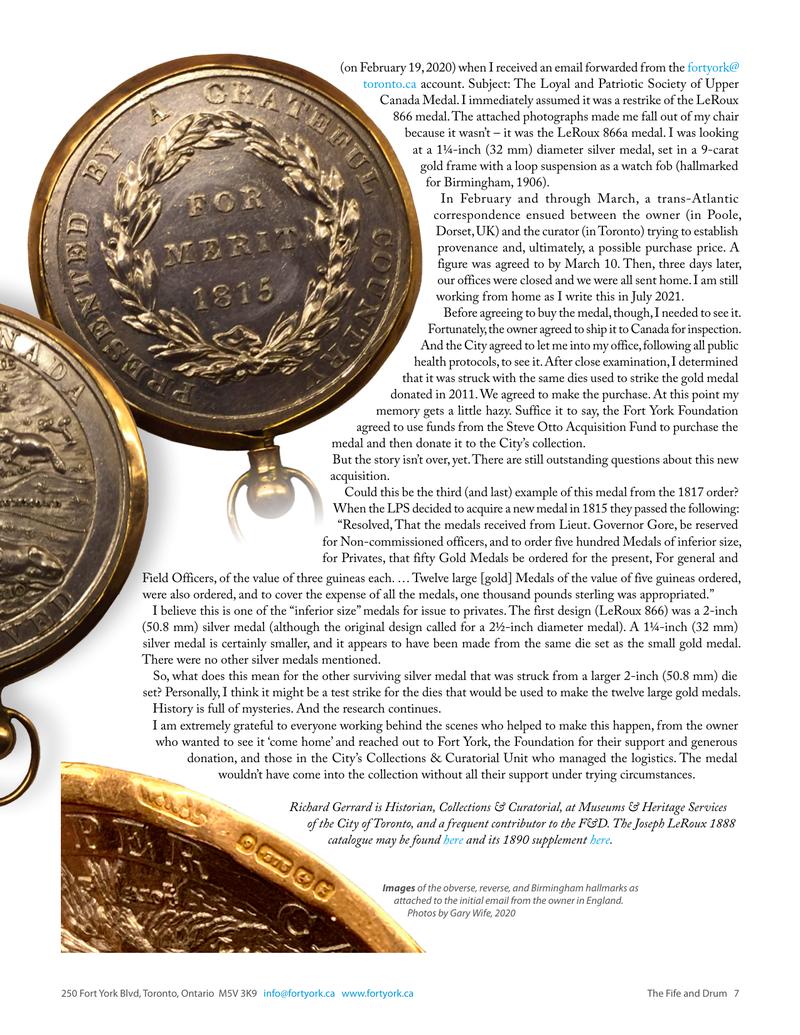
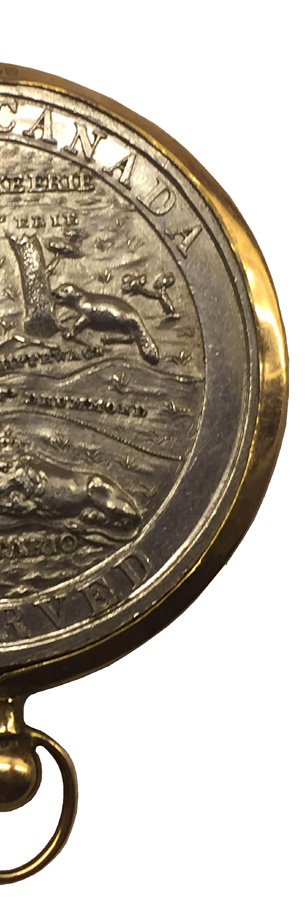
Just before the COVID-19 pandemic arrived I was at my desk (on February 19, 2020) when I received an email forwarded from the fortyork@toronto.ca account. Subject: The Loyal and Patriotic Society of Upper Canada Medal. I immediately assumed it was a restrike of the LeRoux 866 medal. The attached photographs made me fall out of my chair because it wasn’t – it was the LeRoux 866a medal. I was looking at a 1¼-inch (32 mm) diameter silver medal, set in a 9-carat gold frame with a loop suspension as a watch fob (hallmarked for Birmingham, 1906).
In February and through March, a trans-Atlantic correspondence ensued between the owner (in Poole, Dorset, UK) and the curator (in Toronto) trying to establish provenance and, ultimately, a possible purchase price. A figure was agreed to by March 10. Then, three days later, our offices were closed and we were all sent home. I am still working from home as I write this in July 2021.
Before agreeing to buy the medal, though, I needed to see it. Fortunately, the owner agreed to ship it to Canada for inspection. And the City agreed to let me into my office, following all public health protocols, to see it. After close examination, I determined that it was struck with the same dies used to strike the gold medal donated in 2011. We agreed to make the purchase. At this point my memory gets a little hazy. Suffice it to say, the Fort York Foundation agreed to use funds from the Steve Otto Acquisition Fund to purchase the medal and then donate it to the City’s collection.
But the story isn’t over, yet. There are still outstanding questions about this new acquisition.
Could this be the third (and last) example of this medal from the 1817 order? When the LPS decided to acquire a new medal in 1815 they passed the following: “Resolved, That the medals received from Lieut. Governor Gore, be reserved for Non-commissioned officers, and to order five hundred Medals of inferior size, for Privates, that fifty Gold Medals be ordered for the present, For general and Field Officers, of the value of three guineas each. … Twelve large [gold] Medals of the value of five guineas ordered, were also ordered, and to cover the expense of all the medals, one thousand pounds sterling was appropriated.”
I believe this is one of the “inferior size” medals for issue to privates. The first design (LeRoux 866) was a 2-inch (50.8 mm) silver medal (although the original design called for a 2½-inch diameter medal). A 1¼-inch (32 mm) silver medal is certainly smaller, and it appears to have been made from the same die set as the small gold medal. There were no other silver medals mentioned.
So, what does this mean for the other surviving silver medal that was struck from a larger 2-inch (50.8 mm) die set? Personally, I think it might be a test strike for the dies that would be used to make the twelve large gold medals. History is full of mysteries. And the research continues.
I am extremely grateful to everyone working behind the scenes who helped to make this happen, from the owner who wanted to see it ‘come home’ and reached out to Fort York, the Foundation for their support and generous donation, and those in the City’s Collections & Curatorial Unit who managed the logistics. The medal wouldn’t have come into the collection without all their support under trying circumstances.
Original printed pages