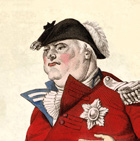
Many ordinary people enjoy more than Andy Warhol’s fifteen minutes of fame before resuming their modest lives. James Brock’s time in the limelight of Upper Canada lasted about fifteen months from October 1811 until late 1812, but left a lasting mark on Toronto. Paradoxically, his imprint on the city in the name of ‘Brockton’ has proven more indelible than Brock Street, as lower Spadina was called until 1884 in honour of his famous kinsman, Sir Isaac Brock.
Frequently said to be Isaac’s brother or nephew, James was actually a first cousin. Isaac’s father John and James’s father Henry were brothers. James was born at St. Peter Port, Guernsey, on April 3 1773, to Henry Brock and Suzanne de Sausmarez, both members of prominent families. He was raised in comfortable circumstances in “Belmont,” a large house with extensive grounds, and likely began his education in one of the local clergy-run schools where he was taught in French, the working language on the island until the late 19th century. At about age ten he may have left Guernsey to go to school in England. If his father hoped James would follow him into commerce, he was disappointed; by the time the lad was eighteen he had decided to enter the army.
In early 1791 he was gazetted a Cornet, the lowest rank of officer, in the 2nd [Queens] Regiment of Dragoon Guards. Likely his father purchased his commission for £500 to £1000. James’s rise is traced through the Army Lists: appointed Captain in April 1794, he became a Major in June 1799, following a transfer to the 16th Queen’s Light Dragoons. In 1803 his cousin Isaac, who commanded the 49th (Hertfordshire) Regiment of Foot, recruited him to succeed John Savery Brock, Isaac’s brother, as the regiment’s Paymaster. This was a plum appointment. Regulations of 1797 pegged a Paymaster’s pay at 15/- a day, the same as a Lieut. Colonel; only the Colonel got more. His duties included arranging the delivery of specie, paying the soldiers’ wages, keeping and submitting regular financial records.
James set out for Canada on the Spring fleet of 1804, arriving in Quebec on July 20. Probably he went directly to Fort George in Upper Canada where the 49th was posted. Barely two years later in November 1806, however, he earnestly petitioned for leave to return to England to deal with ‘peculiar Family circumstances,’ and did not return to his post until 1809 or 1810. Even then, he and Isaac saw little of one another here. Said the latter, writing to his brother Irving in 1811, “I seldom hear from James Brock, who dislikes writing to such a degree, that he hazards the loss of a friend rather than submit to the trouble.” However, that didn’t stop Isaac from making James his private secretary for civil matters when he became Administrator of Upper Canada later that year during Lieutenant-Governor Sir Francis Gore’s absence in England. James was given six months leave to take up his appointment and moved to the seat of government at York.
It seems obvious that James disliked York. When at the end of July 1812 he married Susannah Lucy Quirke Short, a daughter of the Anglican minister at Three Rivers, they made their home in Kingston. That September Isaac said in a letter, “James Brock is likewise at Kingston. I believe he considers it more his interest to remain with the 49th than to act as my private secretary; indeed, the salary is a mere pittance.” Knowing how poorly paid James was, Isaac saw additional compensation directed his way in the form of land. In March 1812, the wheels began turning to grant James up to 1200 acres. Four hundred acres were at the mouth of the Black River in [South] Marysburgh Township, near Picton; another 400 were in Binbrook Township, south of Hamilton. But the most valuable lands were at York: 100 acres in Park Lot 30 north of Lot [Queen] Street, a short distance west of present-day Dufferin Street, and 240 acres bounded by Lot Street, Lake Ontario, Dufferin Street and Jameson Avenue.
James had no time to improve or occupy these lands before war broke out. In October, 1812, Sir Isaac, the ‘Hero of Upper Canada,’ fell at Queenston, unaware that four days earlier he had been made a Knight Commander (K.B.) of the Order of the Bath. Unmarried, he left no will. Within three weeks James, as his closest relative in the province, and Capt. J. B. Glegg, his aide-de-camp, had petitioned for and been granted custody of his estate by the Court of Probate for Upper Canada.
Their petition for administration attached a list of effects such as furnishings, wines, linens, books, horses and harness. Unlike his cousin, Sir Isaac owned no real estate in Upper Canada, so most of his effects were located in Government House at Fort York. In early November some items were sold privately to six of his closest colleagues. By far the largest buyer was Major-Gen. Roger Hale Sheaffe who spent £602 on wines and household goods; James bought tableware and linens. Most of the books and assorted other effects were set aside to be auctioned later.(see ‘The Library of Major General Sir Isaac Brock,’ Fife & Drum, March 2008)
James then took sail from York for Kingston aboard the sloop Elizabeth, which was captured as it neared its destination by the U.S. Schooner Growler and brought into Sacket’s Harbor. There he became briefly a prisoner of war but was paroled by U.S. Commodore Isaac Chauncey at the request of Col. John Vincent, the British commander at Kingston. When safely back on British soil James reported to Sheaffe on the enemy’s preparedness at Sacket’s Harbor.
Until he was exchanged for another prisoner in April 1813, James remained on parole but accompanied the 49th as it moved from Kingston to Fort George. In May, a withering American attack forced the British to abandon the fort, leaving their wives and children behind. In a show of chivalry Isaac Chauncey had Brock’s wife Lucy and the spouse of another officer transported in a U.S. warship to Sacket’s Harbor and then, under a flag of truce, to Kingston. James caught up with her there in October. After wintering in Montreal, the regiment spent 1814 in Lower Canada moving between St. John’s [Saint-Jean-sur-Richelieu], Odelltown [Lacolle] and Isle aux Noix. In 1815 it shipped back to England. A decade later James saw service, still as Paymaster for the 49th, at the Cape of Good Hope and in Bengal. He drew his last breath in the latter place, at Berhampore on 27 March 1830, a victim of cholera.
When James made his will at the Cape of Good Hope in September, 1828, he left his entire estate to his wife Lucy. They had no children. The only lands in Upper Canada he sold before his death were 100 acres on the lakeshore near York to James Fitzgibbon, his old comrade in the 49th. Soon after his demise, however, Lucy parted with the rest of the lakeshore lands at York to John Dunn and William Gwynne, both of whom are now recalled by street names in the area. She also divested herself of the land in Binbrook, but delayed until 1850 finding buyers for either her South Marysburgh property or for Park Lot 30, by then on the edge of Toronto.

So far as we know, Lucy Brock never lived in Toronto. But it is a testimony to her shrewdness and the good advice she was given that she undertook the subdivision of Park Lot 30 herself when it was ripe for development, rather than to sell it as one or two large parcels. While the area had come to be known as Brockton by 1850, her approach ensured that James’s name would attach itself even more firmly. In May 1850 surveyor John Tully was commissioned to prepare a plan of subdivision for Lot 30, with an axial road up the centre and twenty long and narrow lots facing Dundas Street where it intersected with Brock Avenue. Then she began offering building lots to smallholders; the first sale was made in July 1850. By the time she died in 1859 she had made more than three dozen such sales, a practice continued by her executors.
No incorporated village named Brockton existed until 1881, and it lasted only until 1884 when it was amalgamated with the City of Toronto.
Original printed pages