

There is strong public support for expanding and improving the network of pedestrian and bicycle paths throughout the City. Activists are finding encouragement in the Official Plan, the Pedestrian Charter adopted in 2002 and the Mayor’s Climate Change and Clean Air Action Plan. Intensive residential development on all four sides of Fort York makes planning the open spaces of the district a priority and key component of the Central Waterfront Secondary Plan. One by one the barriers to access at Fort York have been overcome, but the last remaining one is the rail corridor to the north. The Fort York pedestrian and cycle bridge will overcome that barrier and connect communities north of Front Street to the waterfront. The Executive Committee who championed the projects also recommended that the Mayor and Deputy Mayor find funding partners for the actual design and construction of the bridge.
Connecting Fort York to the residential and commercial community to the north is not a new idea. Long before there was a rail corridor, a wooden bridge crossed Garrison Creek to link the fort with Front Street and the Town of York.
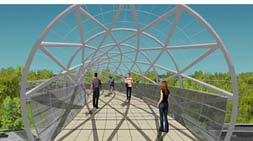
For more than ten years Councillor Joe Pantalone who represents the area has been looking for a way to bridge the rail corridor to join the Niagara Neighbourhood to Fort York and the lake. A relocated Bailey bridge at the the foot of Tecumseh, and an outrigger hung off the truss bridge on Bathurst Street were two early proposals. Neither met the requirements of all stakeholders.
The community has grown remarkably in the last 10 years, and the interest in walking and cycling has grown along with it. Today 7000 people live in the area north of the rail corridor bounded by Queen Street, Dufferin and Bathurst. As approved residential developments are completed that number will increase. Both Strachan Avenue and Bathurst Street have become busy thoroughfares.
In 2001 City officials responsible for culture, parks and recreation commissioned the Fort York and Garrison Common Parks and Open Space Design and Implementation Plan. Approved by Council in the fall of 2001, the report included a proposal for a so-called land bridge – a structure having a deck broad and strong enough to carry trees and planters-just east of Strachan Avenue, linking Stanley Park to the Garrison Common. But crossing rail corridors is not a simple thing, and while the idea was endorsed, it was not developed.
The 16.6 ha. (41-acre) Heritage Conservation District at Fort York occupies a strategic position in the north-south and east-west waterfront network of paths for pedestrians and cyclists. The Martin Goodman Trail and Queen’s Quay are well-established links across the Lake Ontario shoreline. With the development of the Railway Lands, the Linear Park along the south side of the rail corridor will provide a second eastwest pathway. The parks and open spaces of the north-south Garrison Creek chain of pedestrian routes would connect through Fort York to Coronation Park intersecting both the Linear Park and Martin Goodman trails. The missing link, of course, is across the rail corridor.
Toronto Culture, determined not to overlook a good idea when its time finally came, identified an opportunity when City-owned land on Wellington Street south of Stanley Park was re-zoned as parkland in 2006. Culture commissioned Du Toit Allsopp Hillier (dTAH) to revisit their concept for the land bridge, within the context of plans for CN Rail, Go Transit and the proposed Front Street Extension.

Bob Allsopp and Peter Smith from dTAH worked on the project with David Dennis Design and Arup Canada. The bridge has been designed to fit both the existing condition of the rail lines and roads in the corridor and their future alignment. The bridge became a lighter, more affordable structure that could be elevated sufficiently above the active rail lines and pre-fabricated in four equal spans of 48 metres.
It has been designed in such a way that it could be built in advance of the Front Street Extension, lifted aside during road construction, and replaced on the structural supports when road and rail construction is complete. In plan, the bridge is curved to permit the necessary structural supports to be built outside of the existing and proposed transportation allowances. Extending the arc of the curve at the ground will connect with the new driveway to Fort York, completed in 2006.
Assuming the Environmental Assessment is initiated in 2008 and capital funding for the project is secured, the Fort York pedestrian bridge could be completed by 2012 in time for the Bicentennial Celebrations commemorating the War of 1812.
Original printed pages


