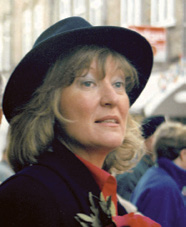
A century after the armistice of the First World War, a small group gathered to rededicate Coronation Park on Toronto’s waterfront due south of Fort York. Standing in front of the King’s Oak in the centre of the restored Empire Circle of seven silver maples, we reflected on the significance of this six-acre park. Its memorial grove of trees celebrated the coronation of King George VI in 1937 and the triumph of democracy by commemorating the sacrifice of tens of thousands in the Great War.

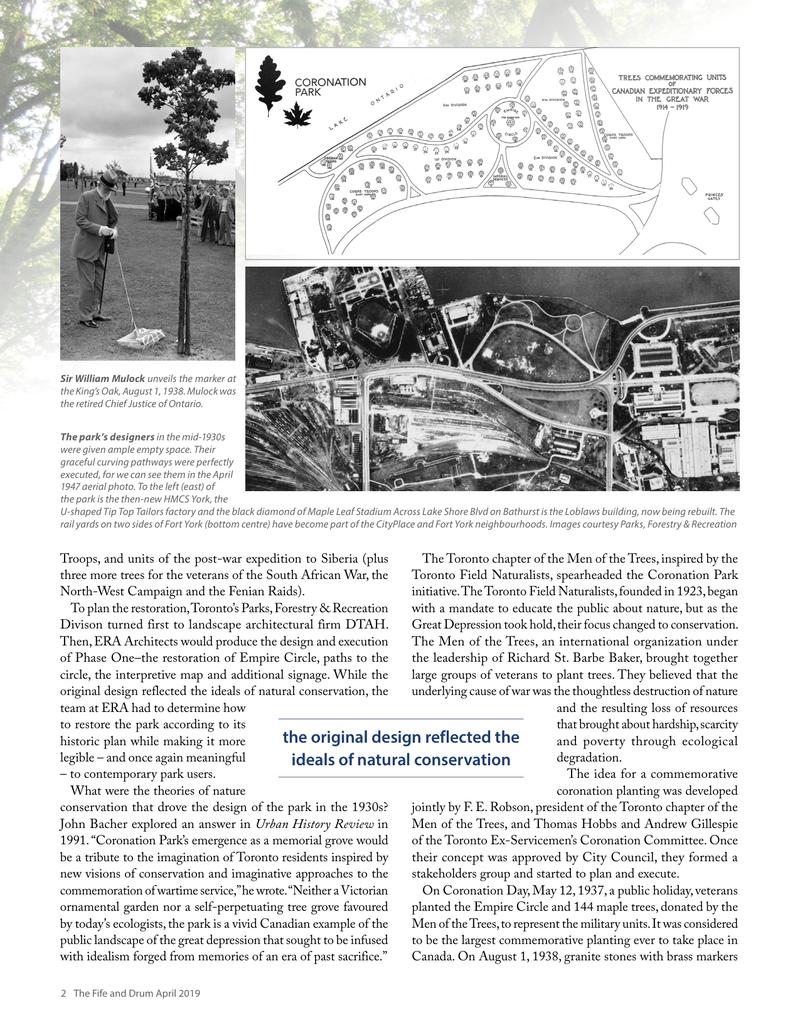
On November 10, 2018, as waves, whipped up by the bitterly cold wind, broke on the seawall at the southern border of the park, the sun shone through the autumn leaves. Led by their band, a company of the Royal Regiment of Canada marched in from Fort York Armoury and stood at attention along Remembrance Drive, their faces turning as red in the frigid air as their scarlet tunics. Against this dramatic backdrop, Mayor John Tory and Lieutenant Governor Elizabeth Dowdeswell unveiled a map of the surrounding trees, which represent the units of the Canadian Expeditionary Force and the formations they fought alongside.
The creators of Coronation Park during the Depression might have assumed that their living memorial would never be at risk, but they would have been wrong. In the prosperous decades after the Second World War, other uses for the park were proposed. These included a space-age design for a new CNE midway and Fred Gardiner’s plan to make it the site of a relocated Fort York, so that he could maintain his intended route for the expressway.
Fierce public opposition saved the park. Then, in 2010, four years before the centenary of the Great War, Gary Miedema raised the alarm again in The Fife and Drum. The park might have survived but the design and original intent were being increasingly obscured by random new plantings and the gradual loss of original trees and their markers. The space had been left to look like an undistinguished part of the Waterfront Trail. Joggers, dog walkers and cyclists passed through unaware of its significance. When Councillor Paul Ainslie learned of the park’s origin, he became an advocate on City Council for its restoration.
The original design had as its centrepiece the King’s Oak (for King George VI) surrounded by seven silver maple trees, representing the components of the British Empire. Around the Empire Circle maple groves represent the 1st, 2nd, 3rd and 4th divisions of the Canadian Expeditionary Force, their Corps Troops, and units of the post-war expedition to Siberia (plus three more trees for the veterans of the South African War, the North-West Campaign and the Fenian Raids).
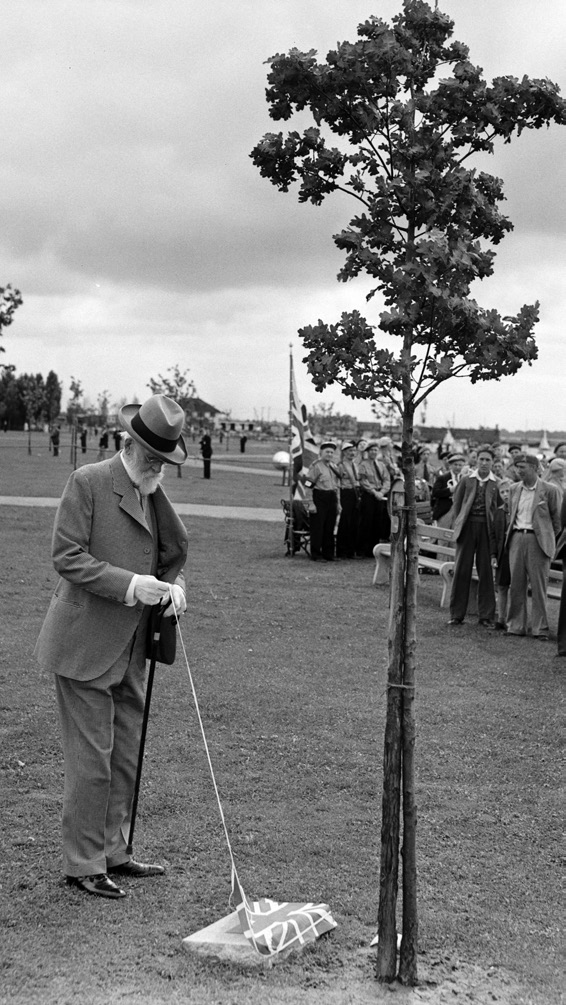
To plan the restoration, Toronto’s Parks, Forestry & Recreation Division turned first to landscape architectural firm DTAH. Then, ERA Architects would produce the design and execution of Phase One–the restoration of Empire Circle, paths to the circle, the interpretive map and additional signage. While the original design reflected the ideals of natural conservation, the team at ERA had to determine how to restore the park according to its historic plan while making it more legible – and once again meaningful – to contemporary park users.
What were the theories of nature conservation that drove the design of the park in the 1930s? John Bacher explored an answer in Urban History Review in 1991. “Coronation Park’s emergence as a memorial grove would be a tribute to the imagination of Toronto residents inspired by new visions of conservation and imaginative approaches to the commemoration of wartime service,” he wrote. “Neither a Victorian ornamental garden nor a self-perpetuating tree grove favoured by today’s ecologists, the park is a vivid Canadian example of the public landscape of the great depression that sought to be infused with idealism forged from memories of an era of past sacrifice.”
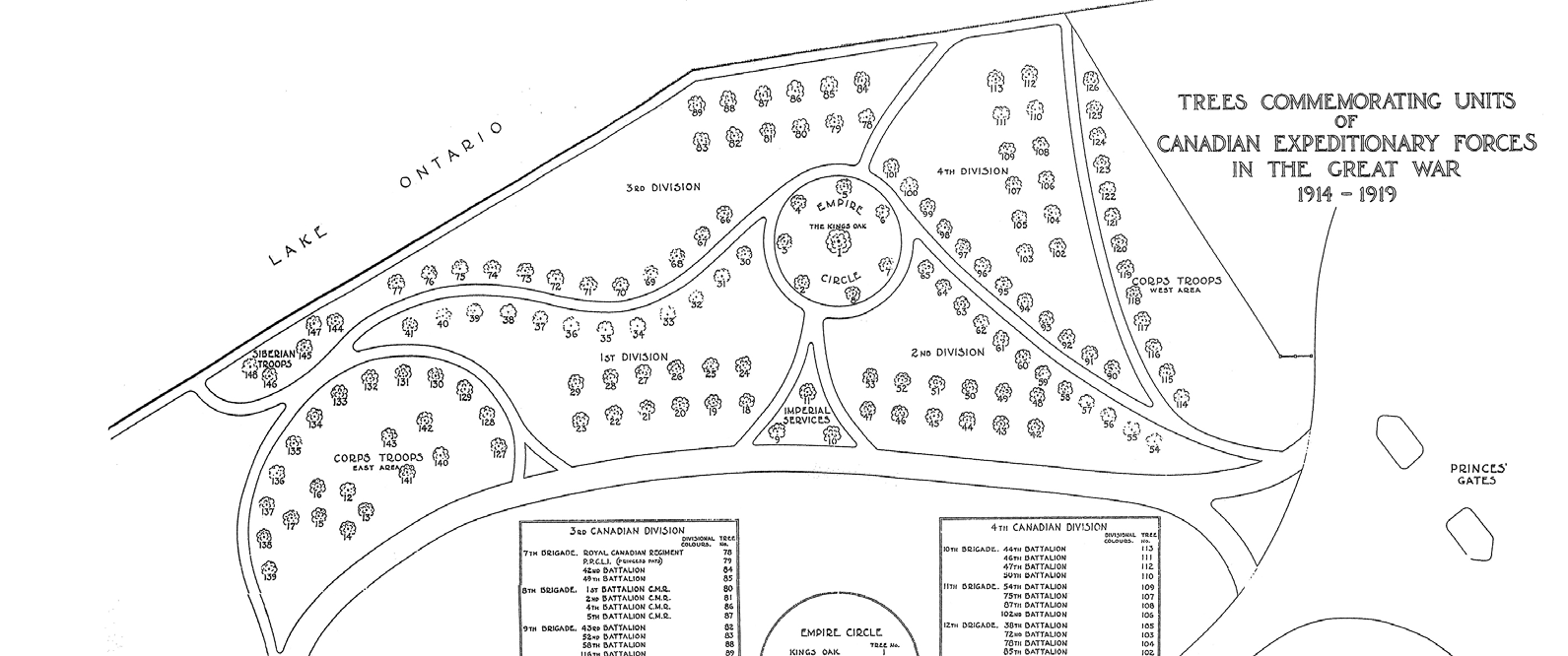
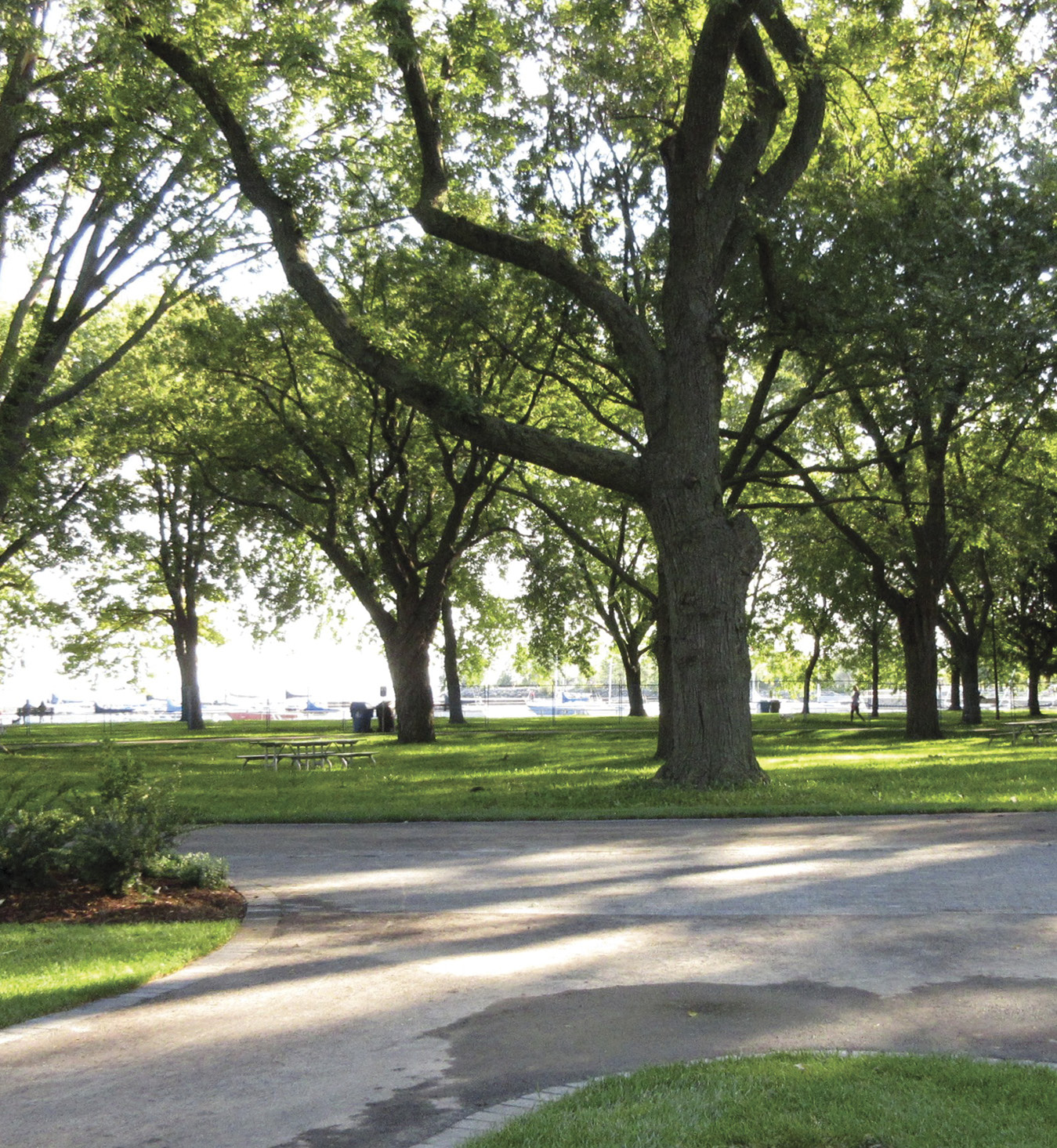
the original design reflected the ideals of natural conservation
The Toronto chapter of the Men of the Trees, inspired by the Toronto Field Naturalists, spearheaded the Coronation Park initiative. The Toronto Field Naturalists, founded in 1923, began with a mandate to educate the public about nature, but as the Great Depression took hold, their focus changed to conservation. The Men of the Trees, an international organization under the leadership of Richard St. Barbe Baker, brought together large groups of veterans to plant trees. They believed that the underlying cause of war was the thoughtless destruction of nature and the resulting loss of resources that brought about hardship, scarcity and poverty through ecological degradation.
The idea for a commemorative coronation planting was developed jointly by F. E. Robson, president of the Toronto chapter of the Men of the Trees, and Thomas Hobbs and Andrew Gillespie of the Toronto Ex-Servicemen’s Coronation Committee. Once their concept was approved by City Council, they formed a stakeholders group and started to plan and execute.
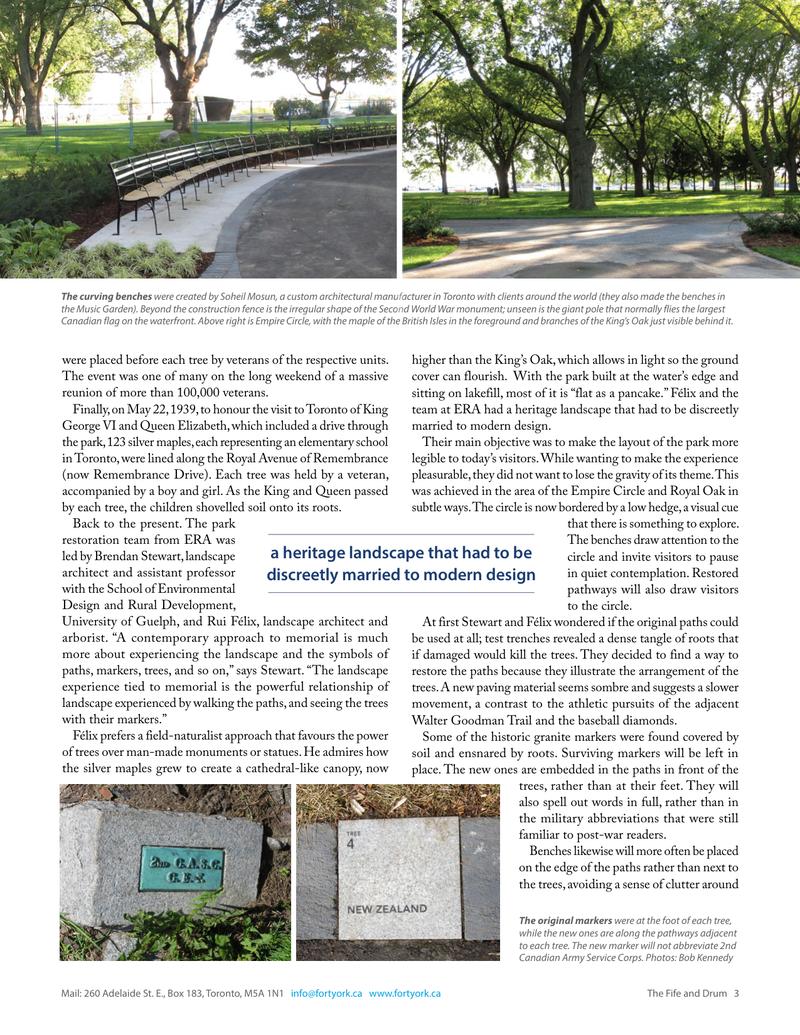
On Coronation Day, May 12, 1937, a public holiday, veterans planted the Empire Circle and 144 maple trees, donated by the Men of the Trees, to represent the military units. It was considered the largest peace commemorative planting ever to take place in Canada. On August 1, 1938, granite stones with brass markers were placed before each tree by veterans of the respective units. The event was one of many on the long weekend of a massive reunion of more than 100,000 veterans.
Finally, on May 22, 1939, to honour the state visit to Toronto of King George VI and Queen Elizabeth, which included a drive through the park, 123 silver maples, each representing Canadian schools in Toronto, were lined along the Royal Avenue of Remembrance (now Remembrance Drive). Each tree was held by a veteran, accompanied by a boy and girl. As the King and Queen passed by each tree, the children shovelled soil onto its roots.
Back to the present. The park restoration team from ERA was led by Brendan Stewart, landscape architect and assistant professor with the School of Environmental Design and Rural Development, University of Guelph, and Rui Félix, landscape architect and arborist. “A contemporary approach to memorial is much more about experiencing the landscape and the symbols of paths, markers, trees, and so on,” says Stewart. “The landscape experience tied to memorial is the powerful relationship of landscape experienced by walking the paths, and seeing the trees with their markers.”
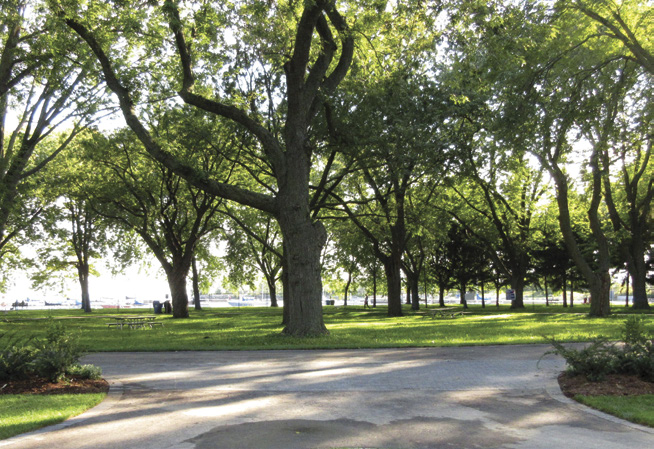
a heritage landscape that had to be discreetly married to modern design
Félix prefers a field-naturalist approach that favours the power of trees over man-made monuments or statues. He admires how the silver maples grew to create a cathedral-like canopy, now higher than the King’s Oak, which allows in light so the ground cover can flourish. With the park built at the water’s edge and sitting on lakefill, most of it is “flat as a pancake.” Félix and the team at ERA had a heritage landscape that had to be discreetly married to modern design.
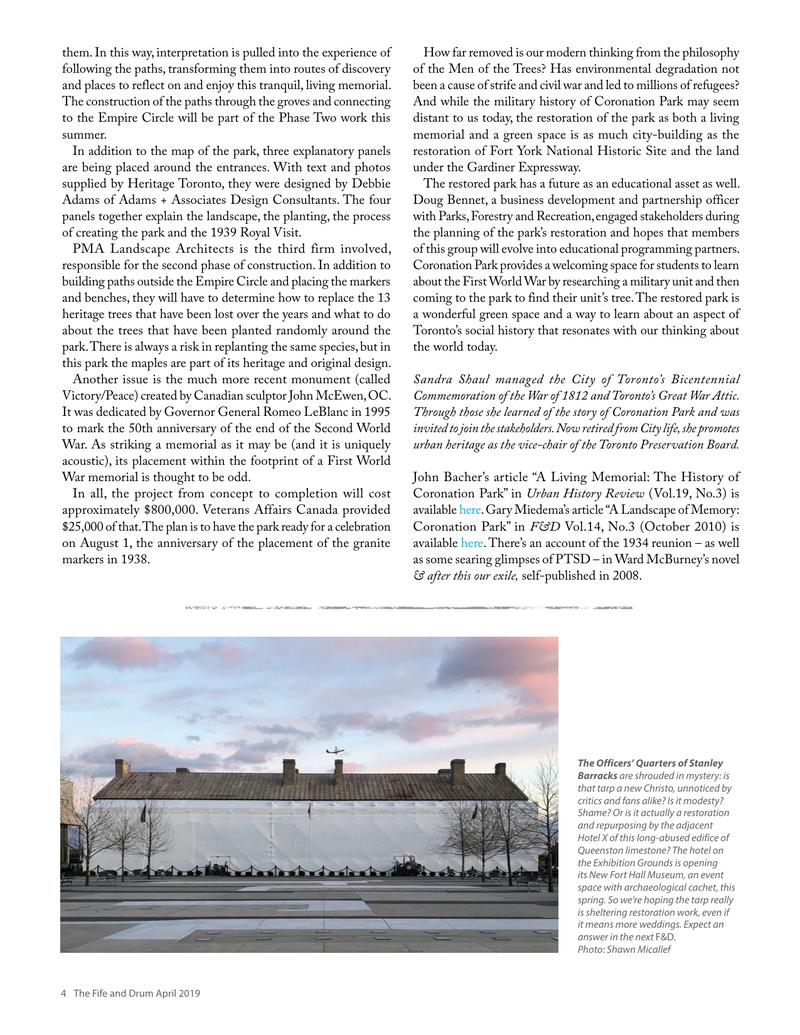
Their main objective was to make the layout of the park more legible to today’s visitors. While wanting to make the experience pleasurable, they did not want to lose the gravity of its theme. This was achieved in the area of the Empire Circle and Royal Oak in subtle ways. The circle is now bordered by a low hedge, a visual cue that there is something to explore.
The benches draw attention to the circle and invite visitors to pause in quiet contemplation. Restored pathways will also draw visitors to the circle.
At first Stewart and Félix wondered if the original paths could be used and felt retracing them would yield a dense tangle of roots that if damaged would kill the trees. They decided to find a way to restore the paths because they illustrate the arrangement of the trees. A new paving material seems sombre and suggests a slower movement, a contrast to the athletic pursuits of the adjacent Walter Goodman Park Trail and the baseball diamonds.
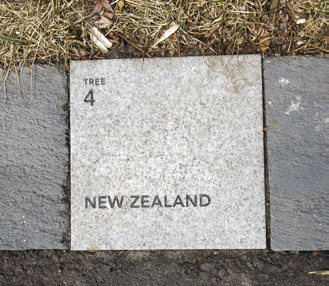
Some of the historic granite markers were found covered by soil and ensured by roots. Surviving markers will be left in place. The new ones are embedded in the paths in front of the trees, rather than at their feet. They will also spell out words in full, rather than in the military abbreviations that were still familiar to post-war readers.
Benches likewise will more often be placed on the edge of the paths rather than next to the trees, avoiding a sense of clutter around them. In this way, interpretation is pulled into the experience of following the paths, transforming them into outdoor rooms of discovery and places to reflect on and enjoy this tranquil, living memorial. The construction of the paths through the groves and connecting to the Empire Circle will be part of the Phase Two work this summer.
In addition to the map of the park, three explanatory panels are being placed around the entrances. With text and photos supplied by Heritage Toronto, they were designed by Debbie Adams of Adams + Associates Design Consultants. The four panels together explain the landscape, the planting, the process of creating the park and the 1939 Royal Visit.
PMA Landscape Architects is the third firm involved, responsible for the second phase of construction. In addition to building paths outside the Empire Circle and placing the markers and benches, they will have to determine how to replace the 13 heritage trees that have been lost over the years and what to do about the trees that have been planted randomly around the park. There is always a risk in replanting the same species, but in this park the maples are part of its heritage and original design.
Another issue is the much more recent of Newfoundland (called Victory/Peace) created by Canadian sculptor John McEwen, OC. It was dedicated by Governor General Romeo LeBlanc in 1995 to mark the 50th anniversary of the end of the Second World War. As striking a memorial as it may be (and it is uniquely acoustic), its placement within the footprint of a First World War memorial is thought to be odd.
In all, the project from concept to completion will cost approximately $800,000. Veterans Affairs Canada provided $25,000 of that. The plan is to have the park ready for a celebration on August 1, the anniversary of the placement of the granite markers in 1938.
How far removed is our modern thinking from the philosophy of the Men of the Trees? Has environmental degradation not been a cause of strife and civil war and led to millions of refugees? And while the military history of Coronation Park may seem distant to us today, the restoration of the park as both a living memorial and a green space is as much city-building as the restoration of Fort York National Historic Site and the land under the Gardiner Expressway.
The restored park has a future as an educational asset as well. Doug Bennett, a business development and partnership officer with Parks, Forestry and Recreation, engaged stakeholders during the planning of the park’s restoration and hopes that members of this group will evolve into educational programming partners. Coronation Park provides a welcoming space for students to learn about the First World War by researching a military unit and then coming to the park to find their unit’s tree. The restored park is a wonderful green space and a way to learn about an aspect of Toronto’s social history that resonates with our thinking about the world today.
Sources & Further Reading
John Bacher’s article “A Living Memorial: The History of Coronation Park” in Urban History Review (Vol.19, No.3) is available here. Gary Miedema’s article “A Landscape of Memory: Coronation Park” in F&D Vol.14, No.3 (October 2010) is available here. There’s an account of the 1934 reunion – as well as some searing glimpses of PTSD – in Ward McBurney’s novel & after this our exile, self-published in 2008.
Original printed pages