Between 1905 and 1909 it wasn’t a foreign invasion but an internal attack that threatened the very existence of Fort York. When a proposal to run a street railway through the Toronto landmark was presented to City Council, battle lines were drawn to save this important historic site. The struggle was waged by a coalition of historical, patriotic, and military groups which banded together to fight the destructive initiative put forward by civic administrators and municipal politicians.
In the 1904-05 Secretary’s Report to the Women’s Canadian Historical Society (WCHS), the organization’s position was spelled out: “Your Society has lent its aid and influence in opening the campaign against the demolition of the remains of Old Fort, Toronto. This is, without doubt, the most pressing interest of the moment, and one in which all who value the past and hope to build well for the future will support … it should be a matter of interest to every citizen and to the Province in general.”
Another partner in the battle was the Ontario Historical Society (OHS). A special meeting was held on 7 October 1905 “… to consider a proposition made by Mr. E.B. Biggar, that the O.H.S. should lend countenance to a civic movement (started by Miss Jean E. Geeson) for the preservation of the Old Fort Grounds.” After a very well-attended public gathering held at Fort York, a motion was approved by the OHS Council; it was agreed that the OHS would follow through with “… continued vigilance and action to prevent further desecration, and to restore and maintain the fort as an historical monument.” Frederic Barlow Cumberland, the 2nd vice-president, was at the forefront of the OHS campaign.
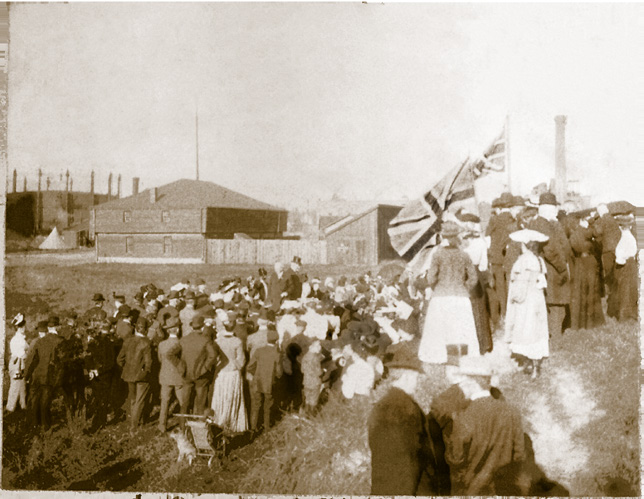
This issue became an instant public cause. Petitions were signed, meetings held, and deputations made to the Board of Education, the City Council, and Board of Control. Toronto newspapers supported attempts to save the fort, and sided with efforts for its preservation. The WCHS was cautious in its reflections: “Whether the objections made to such vandalism have been strongly enough voiced, or the public made to see the commercial value as well as the sentimental value of the preservation to the city of the only stockade fort in the land, remains to be seen.”
As a result of public pressure, Toronto mayor Thomas Urquhart stated that the city did not intend to interfere with the fort’s preservation. Plans for the Bathurst Street streetcar were tabled. In an interview, Urquhart proclaimed: “It was no doubt due to the energetic action of the Women’s Canadian Historical Society, the Daughters of the Empire, and those who worked with them, that the by-law was defeated.” It appeared that the building of the Bathurst Street Bridge and the trolley line through the Old Fort grounds had been rejected.
Unfortunately this was not the case. In April of 1906 a newly elected mayor and City Council resurrected the project. In addition, Mayor Emerson Coatsworth proposed that a portion of the fort become a shunting yard for the Grand Trunk Railway. The OHS immediately responded with a resolution that condemned the plan. It also orchestrated a letter writing campaign by affiliated historical societies to protest. These efforts proved to be momentarily successful. Public sentiment against the project resulted in defeat of the by-law. However this victory turned out to be short-lived.
By October 1907 civic officials again called for new plans. Barlow Cumberland, now the OHS president, moved quickly to bolster the fortunes of the preservationists. He organized the Old Fort Protection Association (OFPA) which would “… make every effort to secure the proper restoration of the Old Fort and its historic grounds.” The WCHS joined and issued the following optimistic statement: “The controversy over the Old Fort … has waged intermittently throughout the year. It is not settled yet, but it is hoped some definitive concession by which the Fort will be preserved may be arrived at during the coming year.”
In January 1908 new mayor Joseph Oliver announced plans to continue with the trolley track. Preservationists responded with another round of protest. Growing public reaction resulted in deferral of the city’s plans. A tentative agreement was struck: the city would re-survey the land, and the OHS would pay for reconstruction plans of the fort. Under Cumberland’s supervision, an architect was hired to draw up this plan. Political jockeying continued. The OHS sent a circular asking its members to lobby municipal, provincial, and federal politicians. In an abrupt move, Prime Minister Wilfrid Laurier prohibited streetcars running through Fort York, and required that the city restore it. The proposed restoration model was unveiled in January 1909.

Fort York had been saved from imminent destruction. The preservationists had won the day. In the future, more challenges would arise, but these would be battles that others would have to fight!
Original printed pages