“Why, single men in barricks don’t grow into plaster saints;”
Rudyard Kipling, “Tommy”
Religion at Fort York is an elusive subject. The records preserve information about official religion: the names of chaplains, their duties and remunerations, church plans, baptisms and burials. It is harder to speak of lived religion, meaning what was believed, practised, and prayed within the garrison community. In the absence of data, it is tempting to accept stereotypes about the harddrinking and profane redcoat, and to think that religion had little to do with the British soldiery of the 1800s. While the average soldier may have been more comfortable in a tavern than on church parade, he may also have been more devout than is commonly supposed.
Official Religion
The Establishment of the Church of England defined the role of the state and the Church: the former had an obligation to provide support for the Church in the form of salaries and buildings; the latter had a duty to cultivate a pious and loyal population. From 1759 to 1870, Canada was garrisoned by the regular British army. Officers customarily were English and Anglican, while the ranks were heavily Scots and Irish and, if religious, often were Roman Catholic, Presbyterian, or members of a ‘dissenting’ denomination such as the Methodist or Baptist. While the chaplains the government provided to the army were nearly all from the established Church of England, there were some exceptions, drawn from the Catholic and Presbyterian traditions, among the Scottish regiments.
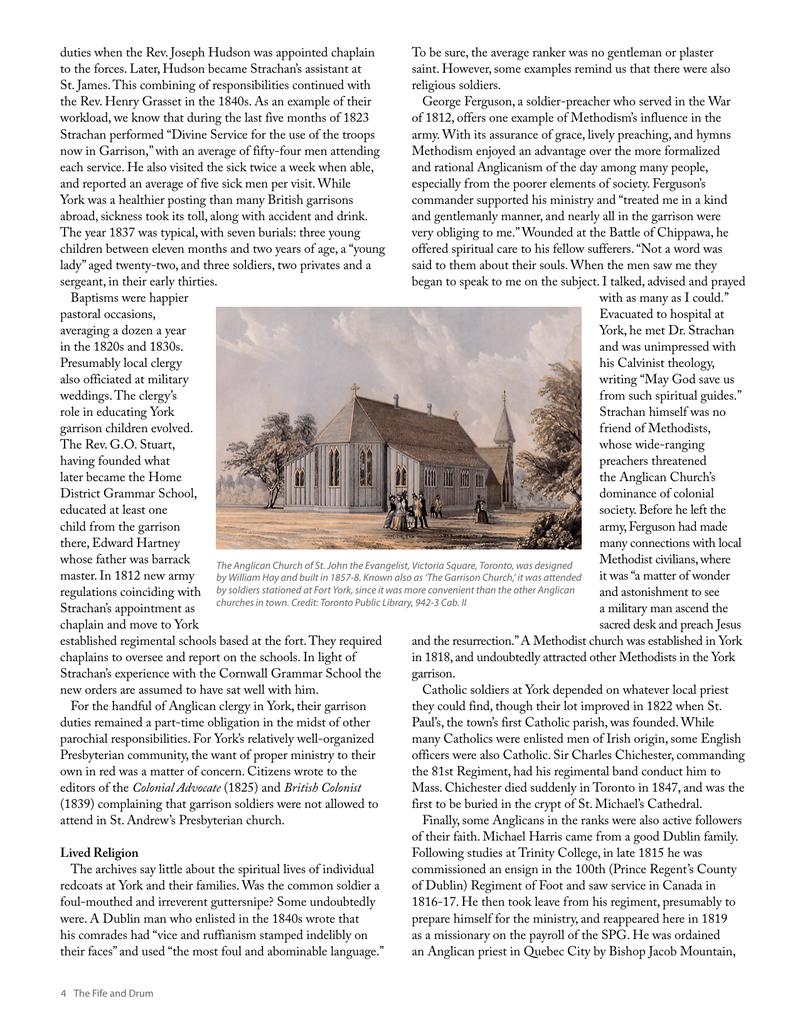
Chaplains’ duties found them leading church parades, compulsory worship in full dress that was probably not wildly popular with the troops, and occasionally consecrating regimental colours. Chaplains also visited the sick in hospital and took the opportunity for moral instruction, since “sickness is for the young and heedless a time of reflection,” according to John Owen, the British Army’s first Chaplain General.
Besides burying the dead, pastoral responsibilities included performing weddings and baptisms for soldiers allowed to raise families. In all these duties, he said the chaplain was expected to turn his flock into “an association of Men more decent & moral than can be found in any Other form.”
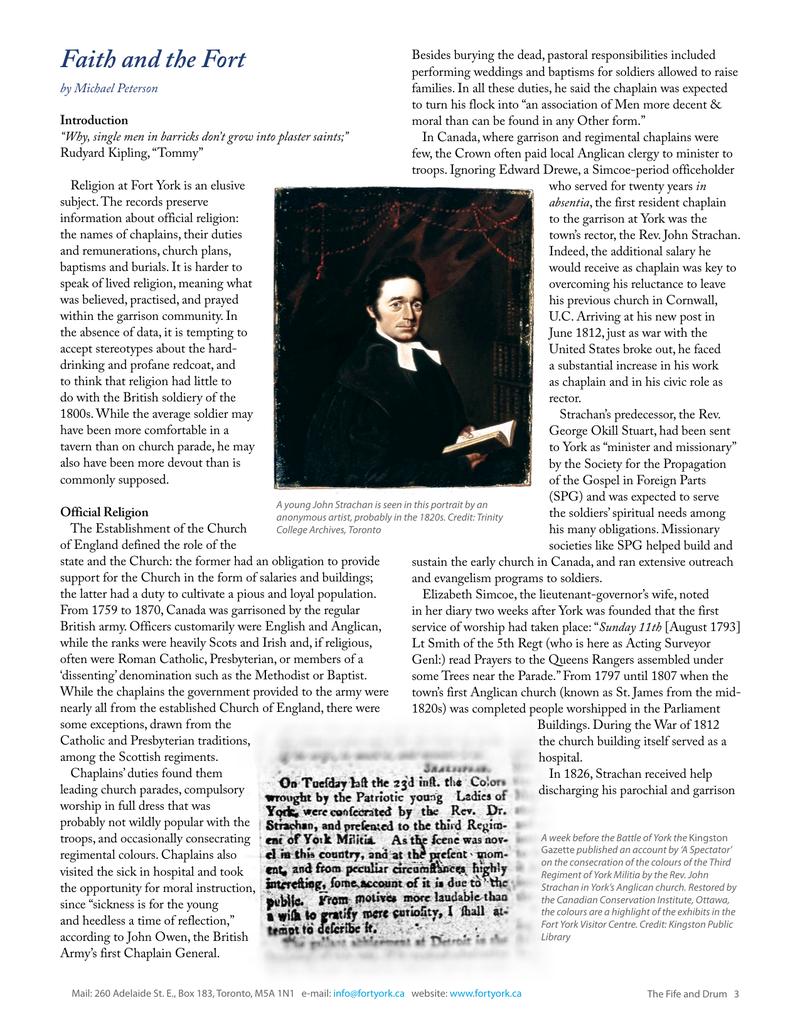
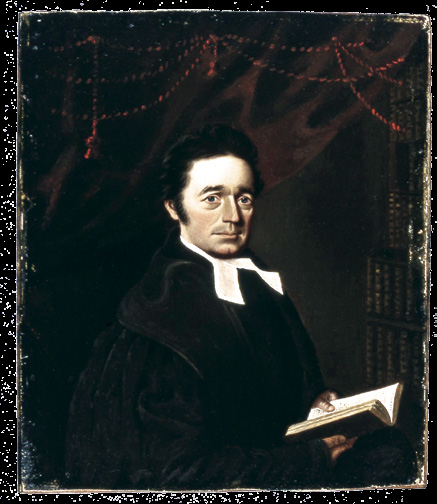
In Canada, where garrison and regimental chaplains were few, the Crown often paid local Anglican clergy to minister to troops. Ignoring Edward Drewe, a Simcoe-period officeholder who served for twenty years in absentia, the first resident chaplain to the garrison at York was the town’s rector, the Rev. John Strachan. Indeed, the additional salary he would receive as chaplain was key to overcoming his reluctance to leave his previous church in Cornwall, U.C. Arriving at his new post in June 1812, just as war with the United States broke out, he faced a substantial increase in his work as chaplain and in his civic role as rector.
Strachan’s predecessor, the Rev. George Okill Stuart, had been sent to York as “minister and missionary” by the Society for the Propagation of the Gospel in Foreign Parts (SPG) and was expected to serve the soldiers’ spiritual needs among his many obligations. Missionary societies like SPG helped build and sustain the early church in Canada, and ran extensive outreach and evangelism programs to soldiers.
Elizabeth Simcoe, the lieutenant-governor’s wife, noted in her diary two weeks after York was founded that the first service of worship had taken place: “Sunday 11th [August 1793] Lt Smith of the 5th Regt (who is here as Acting Surveyor Genl:) read Prayers to the Queens Rangers assembled under some Trees near the Parade.” From 1797 until 1807 when the town’s first Anglican church (known as St. James from the mid-1820s) was completed people worshipped in the Parliament Buildings. During the War of 1812 the church building itself served as a hospital.

In 1826, Strachan received help discharging his parochial and garrison duties when the Rev. Joseph Hudson was appointed chaplain to the forces. Later, Hudson became Strachan’s assistant at St. James. This combining of responsibilities continued with the Rev. Henry Grasset in the 1840s. As an example of their workload, we know that during the last five months of 1823 Strachan performed “Divine Service for the use of the troops now in Garrison,” with an average of fifty-four men attending each service. He also visited the sick twice a week when able, and reported an average of five sick men per visit. While York was a healthier posting than many British garrisons abroad, sickness took its toll, along with accident and drink. The year 1837 was typical, with seven burials: three young children between eleven months and two years of age, a “young lady” aged twenty-two, and three soldiers, two privates and a sergeant, in their early thirties.

Baptisms were happier pastoral occasions, averaging a dozen a year in the 1820s and 1830s. Presumably local clergy also officiated at military weddings. The clergy’s role in educating York garrison children evolved. The Rev. G.O. Stuart, having founded what later became the Home District Grammar School, educated at least one child from the garrison there, Edward Hartney whose father was barrack master. In 1812 army regulations coinciding with Strachan’s appointment as chaplain and move to York established regimental schools based at the fort. They required chaplains to oversee and report on the schools. In light of Strachan’s experience with the Cornwall Grammar School the new orders are assumed to have sat well with him.
For the handful of Anglican clergy in York, their garrison duties remained a part-time obligation in the midst of other parochial responsibilities. For York’s relatively well-organized Presbyterian community, the want of proper ministry to their own in red was a matter of concern. Citizens wrote to the editors of the Colonial Advocate (1825) and British Colonist (1839) complaining that garrison soldiers were not allowed to attend in St. Andrew’s Presbyterian church.
Lived Religion
The archives say little about the spiritual lives of individual redcoats and their families. Was the common soldier a foul-mouthed and irreverent guttersnipe? Some undoubtedly were. A Dublin man who enlisted in the 1840s wrote that his comrades had “vice and ruffianism stamped indelibly on their faces” and used “the most foul and abominable language.”
To be sure, the average ranker was no gentleman or plaster saint. However, some examples remind us that there were also religious soldiers.
George Ferguson, a soldier-preacher who served in the War of 1812, offers one example of Methodism’s influence in the army. With its assurance of grace, lively preaching, and hymns Methodism enjoyed an advantage over the more formalized and rational Anglicanism of the day among many people, especially from the poorer elements of society. Ferguson’s commander supported his ministry and “treated me in a kind and gentlemanly manner, and nearly all in the garrison were very obliging to me.” Wounded at the Battle of Chippawa, he offered spiritual care to his fellow sufferers. “Not a word was said to them about their souls. When the men saw me they began to speak to me on the subject. I talked, advised and prayed with as many as I could.”
Evacuated to hospital at York, he met Dr. Strachan and was unimpressed with his Calvinist theology, writing “May God save us from such spiritual guides.”
Strachan himself was no friend of Methodists, whose wide-ranging preachers threatened the Anglican Church’s dominance of colonial society. Before he left the army, Ferguson had made many connections with local Methodist civilians, where it was “a matter of wonder and astonishment to see a military man ascend the sacred desk and preach Jesus and the resurrection.” A Methodist church was established in York in 1818, and undoubtedly attracted other Methodists in the York garrison.
Catholic soldiers at York depended on whatever local priest they could find, though their lot improved in 1822 when St. Paul’s, the town’s first Catholic parish, was founded. While many Catholics were enlisted men of Irish origin, some English officers were also Catholic. Sir Charles Chichester, commanding the 81st Regiment, had his regimental band conduct him to Mass. Chichester died suddenly in Toronto in 1847, and was the first to be buried in the crypt of St. Michael’s Cathedral.
Finally, some Anglicans in the ranks were also active followers of their faith. Michael Harris came from a good Dublin family. Following studies at Trinity College, in late 1815 he was commissioned an ensign in the 100th (Prince Regent’s County of Dublin) Regiment of Foot and saw service in Canada in 1816-17. He then took leave from his regiment, presumably to prepare himself for the ministry, and reappeared here in 1819 as a missionary on the payroll of the SPG. He was ordained an Anglican priest in Quebec City by Bishop Jacob Mountain, and enjoyed a long clerical career in the Perth and Lanark areas of Upper Canada. Soldiers ordained preachers like Harris and Ferguson demonstrated that Methodism and other forms of Christianity in early Victorian Canada.
Without additional diaries or memoirs, it is difficult to say more about lived religion at Fort York during the British army’s time there. Further research might focus on the numerous missionary and evangelical societies active in the time, examining their presence in York and contacts with the fort. The circulation of devotional manuals such as Pilgrim’s Progress, religious tracts, and periodicals amongst the garrison can only be guessed at. Finally, the influence of the Garrison Church of St. John’s from the 1850s on as a centre of spiritual life at Fort York must be considered.
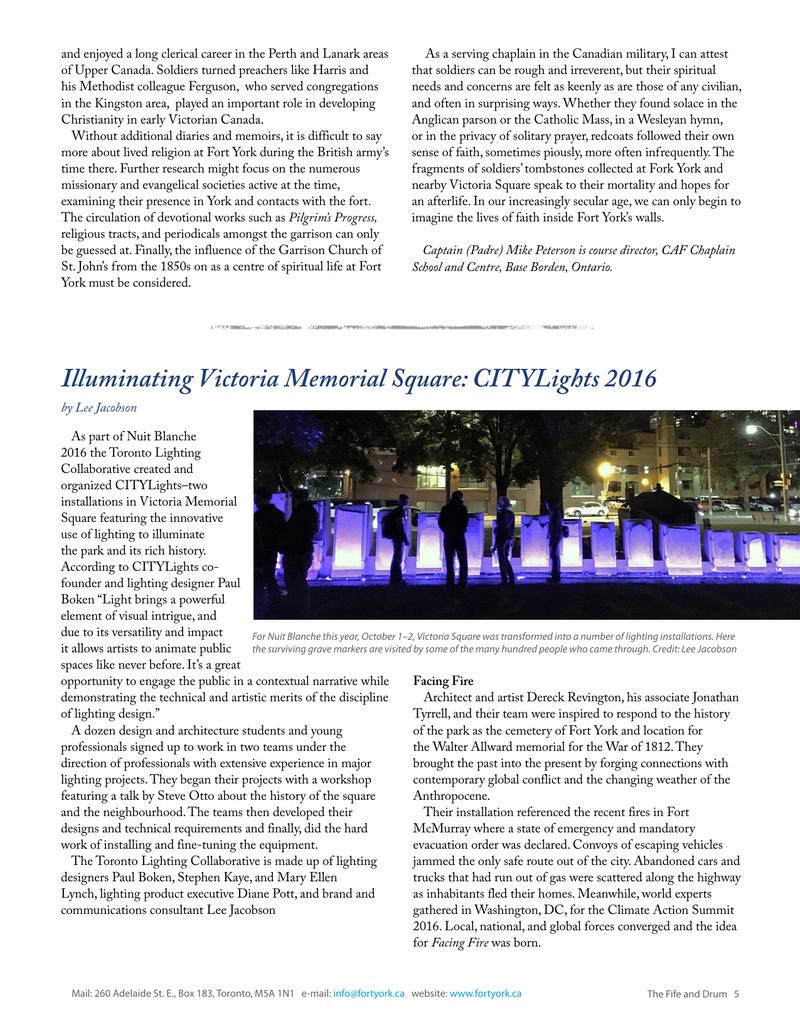
As a serving chaplain in the Canadian military, I can attest that soldiers can be rough and irreverent, but their spiritual needs and concerns are felt as keenly as are those of any civilian, and often in surprising ways. Whether they found solace in the Anglican parson or the Catholic Mass, in a Wesleyan hymn, or in the privacy of solitary prayer, redcoats followed their own sense of faith, sometimes piously, more often infrequently. The fragments of soldiers’ tombstones collected at Fort York and nearby Victoria Square speak to their mortality and hopes for an afterlife. In our increasingly secular age, we can only begin to imagine the lives of faith inside Fort York’s walls.
Original printed pages