Twenty-two miners and five soldiers died in an armed uprising at the Eureka goldfield at Ballarat, near Melbourne, Australia, in 1854, including Toronto-born Henry Ross, who had an important role in the rebellion. The event enjoys mythic status in Australian history for its unusual violence, its place in the development of democracy Down Under, and the debut of a miners’ flag incorporating the ‘Southern Cross’ and five stars. Ross is said to have designed the flag and had it made locally. His links with Fort York are interesting but less well known.
Henry was the tenth of James and Elizabeth Ross’s eleven children, having been raised on a 200-acre farm which James, a former tailor in York (now Toronto), settled about 1821 in Lot 3, Con. 2 west of Yonge Street, York Township. Located in midtown Toronto today, the land runs from Bathurst to Dufferin Streets midway between Eglinton and Lawrence Avenues. It was largely undeveloped until after World War II, but is now blanketed by light industry and modest housing. Here Henry was born in 1829. Probably he was educated at a primary school within walking distance from home, and when he was older was expected to help his father on the farm. Unlike some of his other siblings he seems to have had neither a profession nor a trade, which may account in part for his going to Australia. With six older brothers, his chances of being given land or inheriting the farm were slim.
Reports on Australia’s gold discoveries first appeared in Toronto’s Globe in April 1852, followed by dozens of notices for clipper ships and packets heading there from American ports. Groups of “merry Canadians” were said to be seen everywhere along the New York docks preparing to depart for what was described as “a new Jerusalem.” Ross left there on 27 July 1852 as a first-class passenger aboard the Magnolia, arriving at Melbourne four months later. The ship’s manifest listed his occupation as “Farmer”; he brought with him two trunks. Presumably he went directly to the ‘diggings’ which spread across a huge kidney-shaped area 100 km northwest of Melbourne, and settled at Ballarat, the main camp. Some ten thousand miners had already preceded him there.
The Colony of Victoria faced challenges maintaining order in the goldfields not unlike California before and the Klondike later. Matters were made no easier, however, by the Victoria government’s decision to administer the area through a quasi-military Gold Commission. The miners were angered by its unrepresentative makeup and heavy-handed efforts to raise revenues through Miners’ Licenses. Inspired by British Chartists, their protests were voiced at a series of ‘monster’ meetings held on Ballarat’s Bakery Hill in the Fall of 1854. Ross emerged as one of meetings’ principal speakers, addressing three thousand miners on November 1, and ten thousand on November 11. Another ex-Torontonian, Henry Bowyer Lane, Clerk of Works for building the Government Camp at Ballarat, left an eye-witness account of the latter meeting but took scant notice of Henry Ross’s speech. It is unlikely they ever met face-to-face.
As events unfolded over the next two weeks Ross’s views hardened and became militant. Also, he seemed to develop an uncanny sense of where things were headed. For example, he had the huge (8 ft. by 12 ft.) flag made to be raised at a meeting on November 29 even before the gathering opted for more aggressive tactics. It was there too that he was elected a ‘captain’ of one of their twelve armed divisions, explaining the rank by which he is referred sometimes.
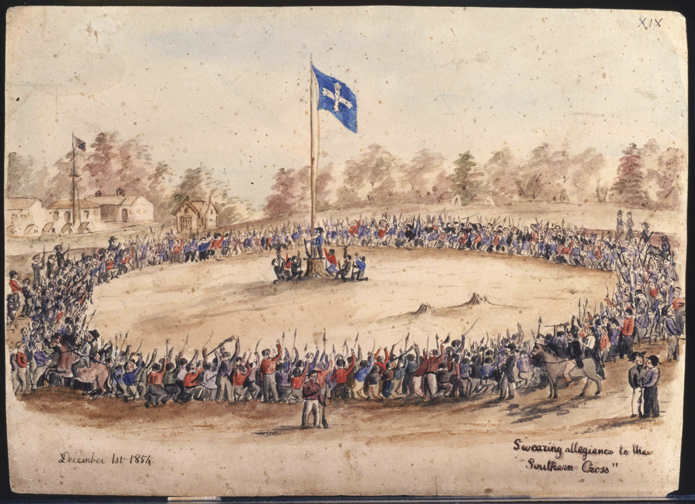
Ross’s activities the following day can be traced by the path of the flag, from which he was inseparable. He brought it to a meeting at Bakery Hill at noon then carried it at the head of a parade of miners to the Eureka Lead (pronounced ‘leed’) where a large stockade was built from timber and carts. Late in the afternoon he returned to Bakery Hill and again raised the banner. Their leader Peter Lalor then asked everyone to “swear by the Southern Cross to stand truly by each other and fight to defend their rights and liberties,” which is now a canon of Australian culture. The diggers finally marched back to Eureka to hoist the flag over the stockade.
Over December 1-2 their efforts to parley with the authorities and secure the release of some jailed comrades in return for renouncing violence were rebuffed. Meanwhile, Ross and his armed brigade scoured the countryside for intelligence, arms and supplies. For its part the government played for time while awaiting military and police reinforcements. At dawn on Sunday, December 3, it launched an attack on the stockade. The battle was over in less than twenty minutes after it had begun.

Unfortunately, Ross took a shot in the groin during the fray. Four comrades carried him to the nearby Star Hotel where he died two days later. One of them was Charles Doudiet, a digger and amateur artist who had been a fellow-passenger on the ship from New York and stayed to comfort him to the end. Ross was buried in the now-forgotten Eureka Burial Ground. Somewhere between 250 and 300 mourners marched solemnly in the cortege to his grave. Three years later his remains were exhumed and reinterred among his comrades near the diggers’ Monument in the Ballarat Old Cemetery. His grieving mother may have wished that, “Henery’s name be put on the monument in the Necroplas with the rest and his time of death. James first and Thomas and then Henery and when he was killed in that fatile cuntrey.” But no marker stands today on the Ross plot in Toronto’s Necropolis cemetery, let alone one that notes Henry’s passing.
“A Canadian, bold, brave and trusty . . . one of the best loved of those who fell.”
No fewer than five people writing later about the rebellion singled him out and paid him tribute. “A Canadian, bold, brave and trusty . . . one of the best loved of those who fell.” (W.B. Withers). “A gentleman in manners, and in appearance young, ardent.” (H.R. Nicholls). “Highly esteemed by all who knew him. He was beloved of the diggers for his good qualities and sterling character.” (Richard Allan). “Our lamented friend” (Frederick Vern) and “a fine man” (Thomas Pierson).
He remains nonetheless an enigmatic figure whose motives in joining the rebellion at Eureka are a mystery. Little in the loyal traditions of his family or his upbringing explains them. His grandfather, John Ross, was a veteran of the Revolutionary War and sometime Barrackmaster at Fort York. His father, James Ross, a private and later a corporal in the 3rd Regiment of York Militia during the War of 1812, fought at the Battle of York and became a prisoner of war under the Terms of Capitulation. Henry’s uncle, John Ross, served at both Detroit and Queenston in 1812 and assisted with the burial of Sir Isaac Brock after the general’s death on Queenston Heights. He described that melancholy task to Benson J. Lossing, an American historian who visited Toronto in 1860 gathering material for his Pictorial Field Book of the War of 1812. Lossing left no record of what the father or uncle, both of whom outlived Henry, thought of his rendezvous with history.
Original printed pages