↗ View this article in the original PDF newsletter
Commons over the passage of a bill allowing the state to imprison and hold an individual for up to six weeks without charge? Has “no taxation without representation” (equally true in Canada as in the US) been overlooked by the “deemed rule” wherein expenditures (ie: taxpayer dollars) are “deemed” to have been approved by a committee of Parliament, and forwarded back to the chamber for approval when in fact the expenditures have not actually been either thoroughly examined or finally approved? In Canada there is no regular review process for the more than $100 billion dollars of tax expenditure programs. Has “habeas corpus” gone by the wayside when the Senate of Canada can act as judge, jury, and executioner and suspend three of its members, none of whom at that point had been charged with any crime let alone convicted of an offence? When national security practice in many countries includes detention without charge, are we still being true to Magna Carta? And what happened to “innocent until proven guilty” as a guiding principle of anglosphere justice when thousands are held in remand for months before trial and failure to have the cash for bail can produce a sentence wildly disproportionate to the alleged crime? The 800th anniversary of the Magna Carta and the display at Fort York this fall of one of the original documents provides a wonderful opportunity for Massey College and others to look at the substance and legacy of this document. The Massey College Quadrangle Society will be hosting an evening of examination, analysis, and debate on the importance, substance, and influence of this 13th century document on October 21st; a similar event is scheduled October 20 for The Friends of Fort York. Magna Carta may have been a tool to
provide barons with greater freedom; it may have been sealed by the King under duress; and it may have been annulled by a Pope in hope that it would fade into obscurity. But Magna Carta was an idea that could not be “unthought.” If we think about the battle between authoritarian and fascist regimes and Canadians and allies who stood firm against the Nazi onslaught, the UN battle against the totalitarian Communists who invaded Korea, in which Canada was so prominent, the present engagements around civil liberties, women’s equality, and environmental sanity, so much of the philosophical roots of all of these can be found in the Magna Carta. It was put succinctly by the signal leader of the 20th century: Here is a law which is above the King and which even he must not break. This reaffirmation of a supreme law and its expression in a general charter is the great work of Magna Carta; and this alone justifies the respect in which men have held it. (Sir Winston Churchill)
provide barons with greater freedom; it may have been sealed by the King under duress; and it may have been annulled by a Pope in hope that it would fade into obscurity. But Magna Carta was an idea that could not be “unthought.” If we think about the battle between authoritarian and fascist regimes and Canadians and allies who stood firm against the Nazi onslaught, the UN battle against the totalitarian Communists who invaded Korea, in which Canada was so prominent, the present engagements around civil liberties, women’s equality, and environmental sanity, so much of the philosophical roots of all of these can be found in the Magna Carta. It was put succinctly by the signal leader of the 20th century: Here is a law which is above the King and which even he must not break. This reaffirmation of a supreme law and its expression in a general charter is the great work of Magna Carta; and this alone justifies the respect in which men have held it. (Sir Winston Churchill) Hugh Segal is the 5th Master of Massey College at the University of Toronto. He was appointed to the Senate of Canada by the Right Honourable Paul Martin and chaired both Foreign Affairs and the Special Committee on Anti-terrorism. He is a former president of the Institute for Research on Public Policy in Montreal and a current senior fellow at the Munk School of Global Affairs. He is the Honourary Chair of the Navy League of Canada, President of the NATO Council of Canada, Co-Chair of the Prime Minister’s Advisory Board on the Public Service, and a Senior Fellow of the Canadian Defence and Foreign Affairs Institute. He was made a member of the Order of Canada in 2003.
Hugh Segal is the 5th Master of Massey College at the University of Toronto. He was appointed to the Senate of Canada by the Right Honourable Paul Martin and chaired both Foreign Affairs and the Special Committee on Anti-terrorism. He is a former president of the Institute for Research on Public Policy in Montreal and a current senior fellow at the Munk School of Global Affairs. He is the Honourary Chair of the Navy League of Canada, President of the NATO Council of Canada, Co-Chair of the Prime Minister’s Advisory Board on the Public Service, and a Senior Fellow of the Canadian Defence and Foreign Affairs Institute. He was made a member of the Order of Canada in 2003.
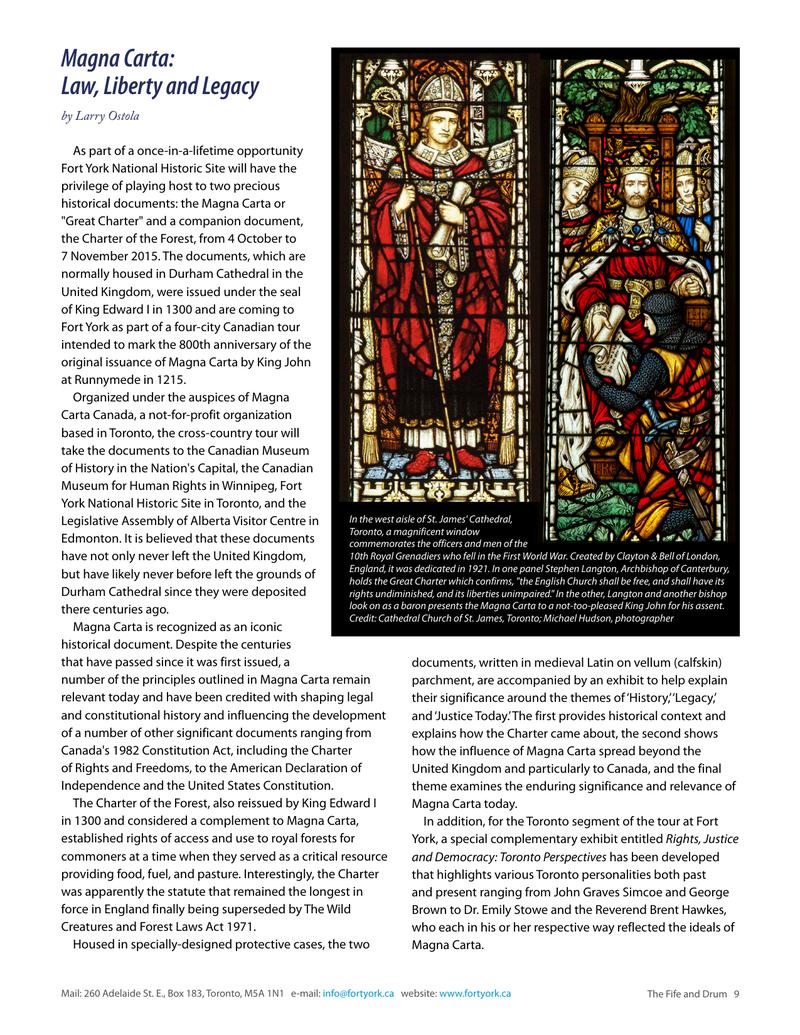
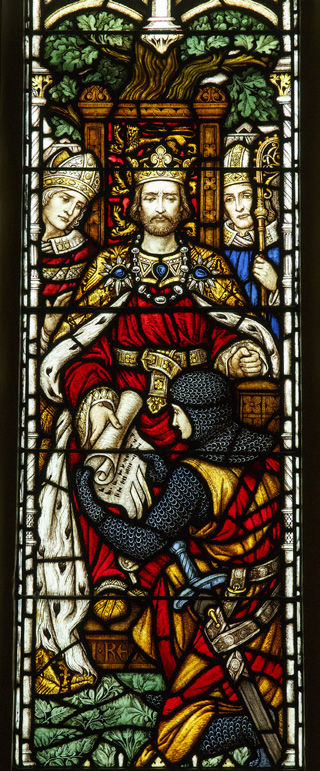
As part of a once-in-a-lifetime opportunity Fort York National Historic Site will have the privilege of playing host to two precious historical documents: the Magna Carta or “Great Charter” and a companion document, the Charter of the Forest, from 4 October to 7 November 2015. The documents, which are normally housed in Durham Cathedral in the United Kingdom, were issued under the seal of King Edward I in 1300 and are coming to Fort York as part of a four-city Canadian tour intended to mark the 800th anniversary of the original issuance of Magna Carta by King John at Runnymede in 1215. Organized under the auspices of Magna Carta Canada, a not-for-profit organization based in Toronto, the cross-country tour will take the documents to the Canadian Museum of History in the Nation’s Capital, the Canadian Museum for Human Rights in Winnipeg, Fort York National Historic Site in Toronto, and the In the west Legislative Assembly of Alberta Visitor Centre in Toronto, a magnificent Edmonton. It is believed that these documents commemorates have not only never left the United Kingdom, 10th Royal England, it but have likely never before left the grounds of holds the Great Durham Cathedral since they were deposited rights undiminished, look on as a there centuries ago. Credit: Cathedral Magna Carta is recognized as an iconic historical document. Despite the centuries that have passed since it was first issued, a number of the principles outlined in Magna Carta remain relevant today and have been credited with shaping legal and constitutional history and influencing the development of a number of other significant documents ranging from Canada’s 1982 Constitution Act, including the Charter of Rights and Freedoms, to the American Declaration of Independence and the United States Constitution. The Charter of the Forest, also reissued by King Edward I in 1300 and considered a complement to Magna Carta, established rights of access and use to royal forests for commoners at a time when they served as a critical resource providing food, fuel, and pasture. Interestingly, the Charter was apparently the statute that remained the longest in force in England finally being superseded by The Wild Creatures and Forest Laws Act 1971. Housed in specially-designed protective cases, the two
documents, written in medieval Latin on vellum (calfskin) parchment, are accompanied by an exhibit to help explain their significance around the themes of ‘History,’ ‘Legacy,’ and ‘Justice Today.’ The first provides historical context and explains how the Charter came about, the second shows how the influence of Magna Carta spread beyond the United Kingdom and particularly to Canada, and the final theme examines the enduring significance and relevance of Magna Carta today. In addition, for the Toronto segment of the tour at Fort York, a special complementary exhibit entitled Rights, Justice and Democracy: Toronto Perspectives has been developed that highlights various Toronto personalities both past and present ranging from John Graves Simcoe and George Brown to Dr. Emily Stowe and the Reverend Brent Hawkes, who each in his or her respective way reflected the ideals of Magna Carta.

The Fort York exhibit will also feature a speakers series with guests such as historian Dr. Carolyn Harris of the University of Toronto, Sukyana Pillay, executive director of the Canadian Civil Liberties Association, “Jane Doe” who won a landmark legal decision related to equality rights and security of the person, and others who through their work or experiences reflect different facets of the still-evolving meaning and relevance of Magna Carta. To reserve your tickets to see the exhibit Magna Carta: Law, Liberty and Legacy at Fort York National Historic Site please visit: toronto.ca/magnacarta
Larry Ostola is Director, Museums and Heritage Services, City of Toronto.
The Fort York exhibit will also feature a speakers series with guests such as historian Dr. Carolyn Harris of the University of Toronto, Sukyana Pillay, executive director of the Canadian Civil Liberties Association, “Jane Doe” who won a landmark legal decision related to equality rights and security of the person, and others who through their work or experiences reflect different facets of the still-evolving meaning and relevance of Magna Carta.
Magna Carta: Law, Liberty and Legacy Sun. October 4 to Sat. November 7 Sat. to Tues. 10 am to 4 pm, Wed. to Fri. 10 am to 8 pm Visitor Centre This year marks the 800th anniversary of King John of England putting his royal seal on the Magna Carta (the Great Charter) in 1215. The Magna Carta and its companion document, the Charter of the Forest, set the groundwork for many concepts defining democratic life today in Canada, the United Kingdom, the United States, and many other countries. As symbols of justice, they act as reminders that those who govern do so only by the consent of the people. See these remarkable documents and a fascinating exhibition that explains their history and importance as well as an exhibit highlighting persons and events in Toronto who reflected the ideals of Magna Carta. Tickets can be purchased on-line at www.toronto.ca/magnacarta