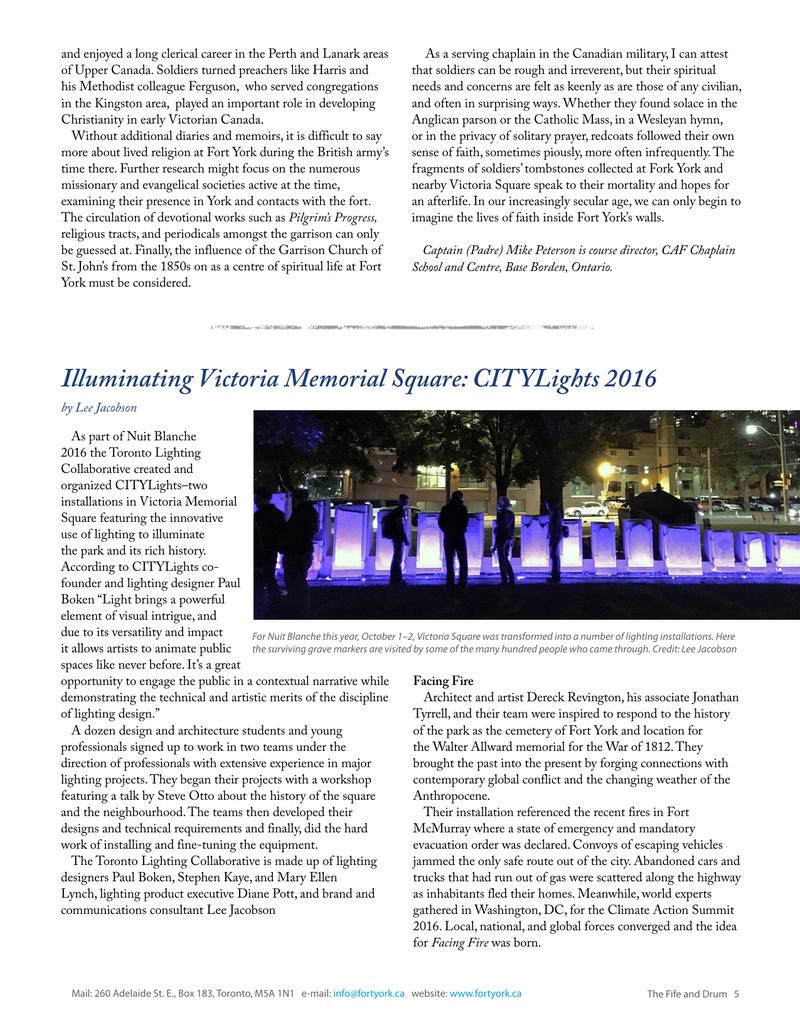
As part of Nuit Blanche 2016 the Toronto Lighting Collaborative created and organized CITYLights–two installations in Victoria Memorial Square featuring the innovative use of lighting to illuminate the park and its rich history. According to CITYLights cofounder and lighting designer Paul Boken “Light brings a powerful element of visual intrigue, and due to its versatility and impact it allows artists to animate public spaces like never before. It’s a great opportunity to engage the public in a contextual narrative while demonstrating the technical and artistic merits of the discipline of lighting design.”
A dozen design and architecture students and young professionals signed up to work in two teams under the direction of professionals with extensive experience in major lighting projects. They began their projects with a workshop featuring a talk by Steve Otto about the history of the square and the neighbourhood. The teams then developed their designs and technical requirements and finally, did the hard work of installing and fine-tuning the equipment.
The Toronto Lighting Collaborative is made up of lighting designers Paul Boken, Stephen Kaye, and Mary Ellen Lynch, lighting product executive Diane Pott, and brand and communications consultant Lee Jacobson
Facing Fire
Architect and artist Dereck Revington, his associate Jonathan Tyrrell, and their team were inspired to respond to the history of the park as the cemetery of Fort York and location for the Walter Allward memorial for the War of 1812. They brought the past into the present by forging connections with contemporary global conflict and the changing weather of the Anthropocene.
Their installation referenced the recent fires in Fort McMurray where a state of emergency and mandatory evacuation order was declared. Convoys of escaping vehicles jammed the only safe route out of the city. Abandoned cars and trucks that had run out of gas were scattered along the highway as inhabitants fled their homes. Meanwhile, world experts gathered in Washington, DC, for the Climate Action Summit 2016. Local, national, and global forces converged and the idea for Facing Fire was born.
Drawing these forces together in Victoria Memorial Square a cogent scene of “Fire and Flight” recalled the burning of the Town of York during the War of 1812. The design used moving light: the forest burning, emergency road flares arcing through the park between the raging fire projected on the trees, and an abandoned truck, door flung open, lights flashing, an empty gas can on the side of the road, a blue haze around the vehicle falling onto the Walter Allward memorial alongside. Around the truck visitors heard three interwoven audio narratives. One was about history–the War of 1812, Fort York burning, Parliament burning, the burning of the White House in Washington. A second featured audio clips from live radio broadcasts from day one of the Fort McMurray evacuation. And the third, was a refrain with both a male and female voice drawing the relations between them.
City Souls
Mary Ellen Lynch and Julia Ly’s team produced a companion installation to Facing Fire that served as a portal to the park, introducing visitors to the gravestones and the reason the park exists. It urged them to contemplate and engage with the historical significance of the space beneath whose grounds lie the remains of more than four hundred British soldiers, officials, citizens, local militia, their wives, their children: the souls who shaped the Town of York, Toronto, and Canada.
A field of illuminated blank screens in different hues became momentary canvases of light and shadow, capturing multiple shadows from visitors. These shadows, cast on and through the translucent fabric, implied the possible presence of other souls in the park that night. The placement of the screens encouraged visitors to walk among them, as if in a crowded old cemetery, and then ground lights guided them off the paved path to the actual remaining gravestones. The stones were lit with a subtly changing linear uplight that shifted from a very warm glow to a cool ghostly violet white.
As visitors turned away from the graves to face the fires of Facing Fire, they saw the ground in front dotted with four hundred fleeting lights representing the lost souls of the city buried here in Victoria Memorial Square. The installation reminds us of who we are, that our lives are fleeting, and that our actions leave impressions.
Original printed pages