Donald Graves’s interest in the War of 1812 is decades old. In 1982 he submitted his MA thesis to Carleton University; it was a study of Joseph Willcocks, the Company of Canadian Volunteers, and political disaffection in Upper Canada. Often described as the “pre-eminent” historian of early Canadian military history, Graves has published well beyond the boundaries of the period and of this country. In the process, he has acquired a deserved reputation not only for the quantity of his work but also for its quality.
And All Their Glory Past completes a trilogy, the first two volumes of which were published in the 1990s. As he puts it, “Long overdue, it is finished at last. . . .” Graves’s work is notable for the breadth and depth of his research, a wide-ranging perspective that includes all combatants, an intrinsic fairness in evaluating the participants and the problems they encountered, an ability to balance strategic concerns with tactical imperatives, a commitment to the soldier’s view whether private or general, and an appreciation for ground, logistics, administration, weather, communication, politics, and the weapons and technology of warfare. This accomplishment is no mean feat and, once again, Graves demonstrates convincingly his mastery of this wide array of subjects. He brings them together in a judicious, balanced, and fair assessment of the last years of the war in the northern theatre: “two major military (and naval) operations, separated by hundreds of miles and fought by five different land formations and four different naval squadrons.” Whereas the first two volumes of his trilogy concentrated “on the operational and tactical level of war,” this one has added the strategic. “Blending” the three levels “into one readable narrative” was, he admits, “a rather tricky task” but he has managed admirably and successfully.
In 1986, one of Canada’s most successful infantry battalion commanders of the Second War told me that the essential prerequisites for an infantry officer were “people and ground.” Graves handles both adroitly. He begins his book with the observation that “It is one thing to write about men who fought and died nearly two centuries ago; it is quite another to gaze at their mortal remains.” He had “this unique (and sobering) experience” in 1987 when he visited the archaeological site at Fort Erie containing the remains of thirty-one men who had died there in August/September 1814. He finished the book against the backdrop of the Canadian military mission in Afghanistan which will end in 2014. Over the course of more than thirty years of work on military history, Graves sees it as the responsibility of historians such as himself not to forget those who fight and sometimes die doing so. He has, it may be justly said, done his bit and more, whether they served in 1812-14 or 1944-45. Moreover, he is as fair in his treatment of the United States Army “poorly led, supplied and trained” as he is to the British, the militia, and the Natives.
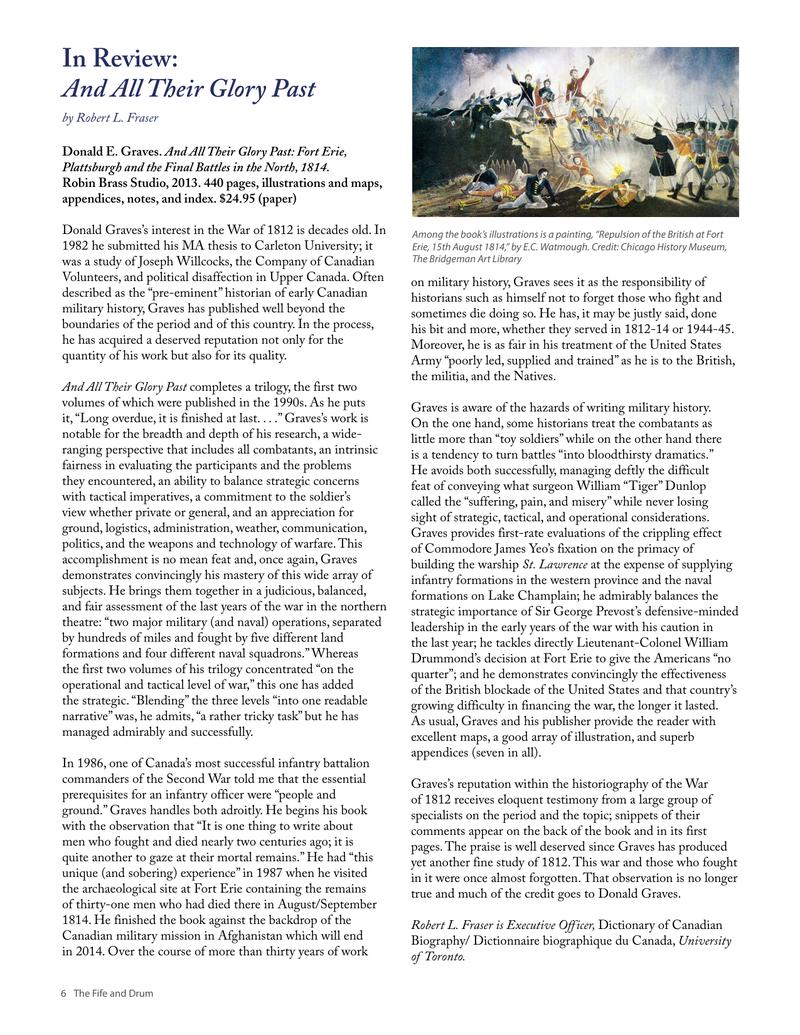
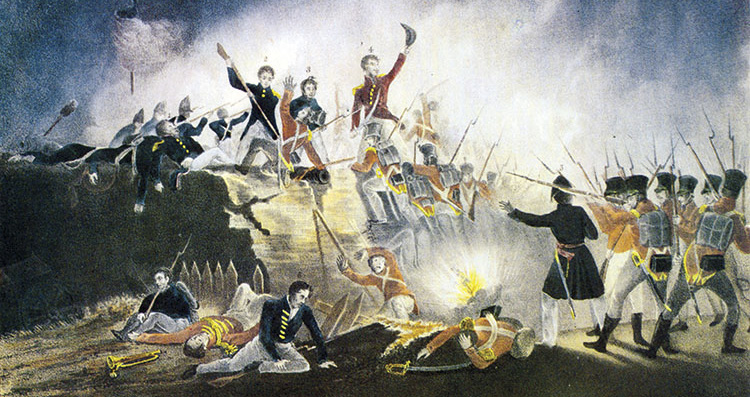
Graves is aware of the hazards of writing military history. On the one hand, some historians treat the combatants as little more than “toy soldiers” while on the other hand there is a tendency to turn battles “into bloodthirsty dramatics.” He avoids both successfully, managing deftly the difficult feat of conveying what surgeon William “Tiger” Dunlop called the “suffering, pain, and misery” while never losing sight of strategic, tactical, and operational considerations. Graves provides first-rate evaluations of the crippling effect of Commodore James Yeo’s fixation on the primacy of building the warship St. Lawrence at the expense of supplying infantry formations in the western province and the naval formations on Lake Champlain; he admirably balances the strategic importance of Sir George Prevost’s defensive-minded leadership in the early years of the war with his caution in the last year; he tackles directly Lieutenant-Colonel William Drummond’s decision at Fort Erie to give the Americans “no quarter”; and he demonstrates convincingly the effectiveness of the British blockade of the United States and that country’s growing difficulty in financing the war, the longer it lasted. As usual, Graves and his publisher provide the reader with excellent maps, a good array of illustration, and superb appendices (seven in all).
Graves’s reputation within the historiography of the War of 1812 receives eloquent testimony from a large group of specialists on the period and the topic; snippets of their comments appear on the back of the book and in its first pages. The praise is well deserved since Graves has produced yet another fine study of 1812. This war and those who fought in it were once almost forgotten. That observation is no longer true and much of the credit goes to Donald Graves.
Original printed pages