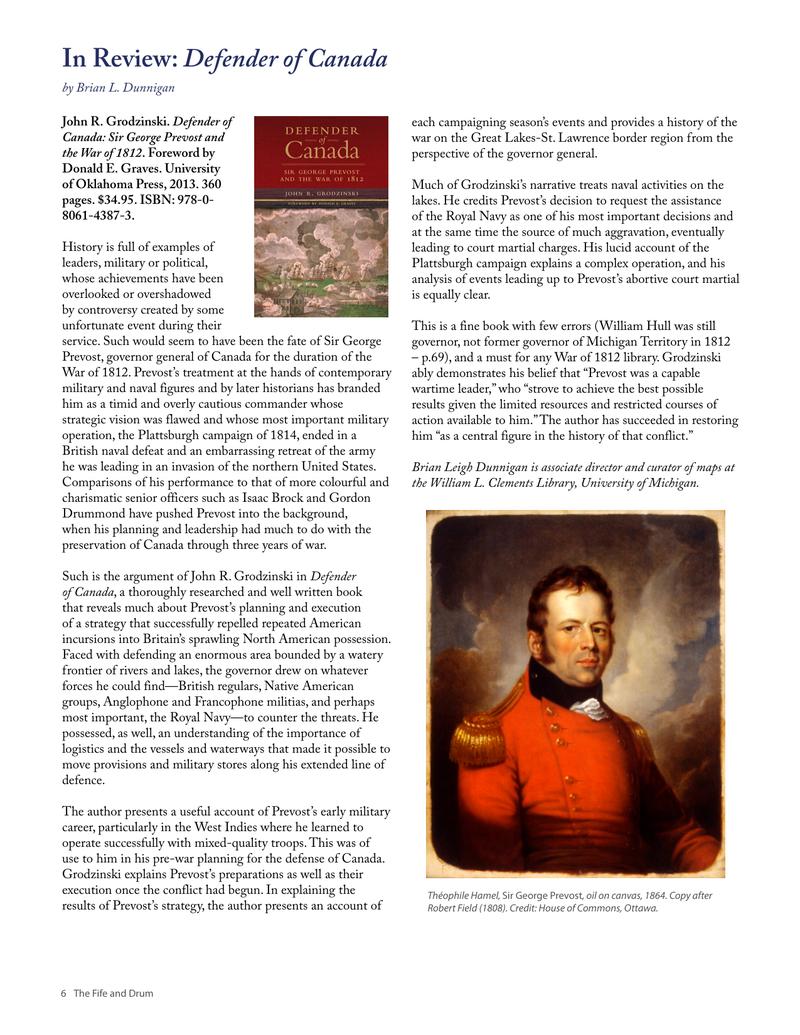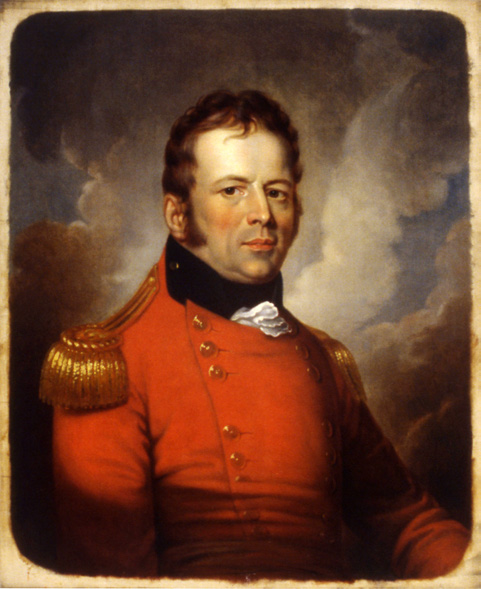
History is full of examples of leaders, military or political, whose achievements have been overlooked or overshadowed by controversy created by some unfortunate event during their service. Such would seem to have been the fate of Sir George Prevost, governor general of Canada for the duration of the War of 1812. Prevost’s treatment at the hands of contemporary military and naval figures and by later historians has branded him as a timid and overly cautious commander whose strategic vision was flawed and whose most important military operation, the Plattsburgh campaign of 1814, ended in a British naval defeat and an embarrassing retreat of the army he was leading in an invasion of the northern United States. Comparisons of his performance to that of more colourful and charismatic senior officers such as Isaac Brock and Gordon Drummond have pushed Prevost into the background, when his planning and leadership had much to do with the preservation of Canada through three years of war.
Such is the argument of John R. Grodzinski in Defender of Canada, a thoroughly researched and well written book that reveals much about Prevost’s planning and execution of a strategy that successfully repelled repeated American incursions into Britain’s sprawling North American possession. Faced with defending an enormous area bounded by a watery frontier of rivers and lakes, the governor drew on whatever forces he could find—British regulars, Native American groups, Anglophone and Francophone militias, and perhaps most important, the Royal Navy—to counter the threats. He possessed, as well, an understanding of the importance of logistics and the vessels and waterways that made it possible to move provisions and military stores along his extended line of defence.
The author presents a useful account of Prevost’s early military career, particularly in the West Indies where he learned to operate successfully with mixed-quality troops. This was of use to him in his pre-war planning for the defense of Canada. Grodzinski explains Prevost’s preparations as well as their execution once the conflict had begun. In explaining the results of Prevost’s strategy, the author presents an account of each campaigning season’s events and provides a history of the war on the Great Lakes-St. Lawrence border region from the perspective of the governor general.
Much of Grodzinski’s narrative treats naval activities on the lakes. He credits Prevost’s decision to request the assistance of the Royal Navy as one of his most important decisions and at the same time the source of much aggravation, eventually leading to court martial charges. His lucid account of the Plattsburgh campaign explains a complex operation, and his analysis of events leading up to Prevost’s abortive court martial is equally clear.

This is a fine book with few errors (William Hull was still governor, not former governor of Michigan Territory in 1812 – p.69), and a must for any War of 1812 library. Grodzinski ably demonstrates his belief that “Prevost was a capable wartime leader,” who “strove to achieve the best possible results given the limited resources and restricted courses of action available to him.” The author has succeeded in restoring him “as a central figure in the history of that conflict.”
Original printed pages