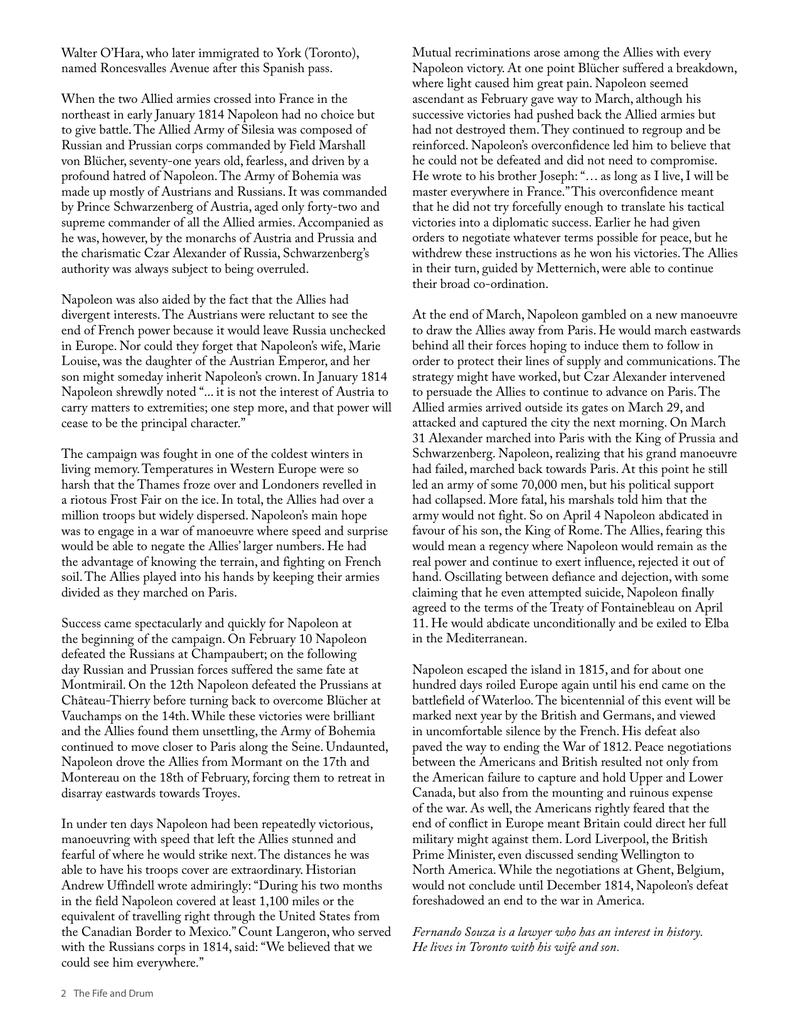
On 1 January 1814 Napoleon received a note from his brother Joseph Bonaparte expressing the hope “that the year which has just finished has exhausted all your ill-fortune.” The Allied armies were already on France’s frontiers. Napoleon would again have to demonstrate his prodigious military talent and lead a small army against overwhelming numbers to try to save his throne, and defy fortune. Yet it was not enough, and by 4 May 1814 he found himself aboard HMS Undaunted bound for the island of Elba.
The passage of two centuries makes it difficult to appreciate the extent to which Europe was convulsed by Napoleon’s wars. The French Revolution had ignited a revolutionary ideology that together with mass conscription allowed for wars on a scale unknown before that time. Europe was almost continuously at war during the first decades of the nineteenth century. The War of 1812 between Great Britain and the United States was occasioned, in part, by these wars. Britain fighting a desperate and, at times, lone battle against Napoleon found it militarily expedient to engage in practices that antagonized the United States. These actions included the impressment of American sailors and the blockade of European ports. The result was that the United States declared war in 1812 when it felt that its rights had too often been breached.

Napoleon was still the master of Europe in 1812 when he made the fateful decision that year to invade Russia. Of some 600,000 soldiers he led into that vast country it is estimated only about 120,000 survived. The campaign took a heavy toll on the Russians too. Historian Adam Zamoyski has written: “… between the Grande Armée’s cross of the Niemen at the end of June 1812, and the end of February 1813, about a million people died, fairly equally divided between the two sides.”
Napoleon survived the Russian campaign by abandoning the survivors of his Grande Armée and returning to Paris. He was able to raise a new army for a campaign in 1813. But after initial success, he gambled on winning a military victory though greatly outnumbered. In October near Leipzig his new army faced the armies of more than twenty European nations in what was to be the largest battle to that time, and unmatched until World War I. There were nearly 500,000 soldiers from almost every nation of Europe on the battlefield of Leipzig. The battle raged for three days and ended with a decisive defeat for Napoleon. Again, he was forced to retreat into France, his power in the German states and Poland broken.
Over half a million French lives were lost in 1813. Discontent with the privations of war and constraints imposed on continental trade began to grow and the year ended with opposition to Napoleon’s rule becoming vocal. France was now surrounded by its enemies on all sides.
Over half a million French lives were lost in 1813. Discontent with the privations of war and constraints imposed on continental trade began to grow and the year ended with opposition to Napoleon’s rule becoming vocal. France was now surrounded by its enemies on all sides. Wellington had already crossed the border from Spain late in 1813. With his Anglo-Portuguese-Spanish army he tied down Marshal Soult and more than 40,000 French troops that Napoleon could have used elsewhere. Wellington arrived via the Pass at Roncesvalles (‘valley of thorns’ in Spanish) where Roland, a leader under Charlemagne, had died heroically in 778 and was celebrated in the Chanson de Roland. One of Wellington’s officers, Colonel Walter O’Hara, who later immigrated to York (Toronto), named Roncesvalles Avenue after this Spanish pass.
When the two Allied armies crossed into France in the northeast in early January 1814 Napoleon had no choice but to give battle. The Allied Army of Silesia was composed of Russian and Prussian corps commanded by Field Marshall von Blücher, seventy-one years old, fearless, and driven by a profound hatred of Napoleon. The Army of Bohemia was made up mostly of Austrians and Russians. It was commanded by Prince Schwarzenberg of Austria, aged only forty-two and supreme commander of all the Allied armies. Accompanied as he was, however, by the monarchs of Austria and Prussia and the charismatic Czar Alexander of Russia, Schwarzenberg’s authority was always subject to being overruled.
Napoleon was also aided by the fact that the Allies had divergent interests. The Austrians were reluctant to see the end of French power because it would leave Russia unchecked in Europe. Nor could they forget that Napoleon’s wife, Marie Louise, was the daughter of the Austrian Emperor, and her son might someday inherit Napoleon’s crown. In January 1814 Napoleon shrewdly noted “… it is not the interest of Austria to carry matters to extremities; one step more, and that power will cease to be the principal character.”
The campaign was fought in one of the coldest winters in living memory. Temperatures in Western Europe were so harsh that the Thames froze over and Londoners revelled in a riotous Frost Fair on the ice. In total, the Allies had over a million troops but widely dispersed. Napoleon’s main hope was to engage in a war of manoeuvre where speed and surprise would be able to negate the Allies’ larger numbers. He had the advantage of knowing the terrain, and fighting on French soil. The Allies played into his hands by keeping their armies divided as they marched on Paris.
Success came spectacularly and quickly for Napoleon at the beginning of the campaign. On February 10 Napoleon defeated the Russians at Champaubert; on the following day Russian and Prussian forces suffered the same fate at Montmirail. On the 12th Napoleon defeated the Prussians at Château-Thierry before turning back to overcome Blücher at Vauchamps on the 14th. While these victories were brilliant and the Allies found them unsettling, the Army of Bohemia continued to move closer to Paris along the Seine. Undaunted, Napoleon drove the Allies from Mormant on the 17th and Montereau on the 18th of February, forcing them to retreat in disarray eastwards towards Troyes.
In under ten days Napoleon had been repeatedly victorious, manoeuvring with speed that left the Allies stunned and fearful of where he would strike next. The distances he was able to have his troops cover are extraordinary. Historian Andrew Uffindell wrote admiringly: “During his two months in the field Napoleon covered at least 1,100 miles or the equivalent of travelling right through the United States from the Canadian Border to Mexico.” Count Langeron, who served with the Russians corps in 1814, said: “We believed that we could see him everywhere.”
Mutual recriminations arose among the Allies with every Napoleon victory. At one point Blücher suffered a breakdown, where light caused him great pain. Napoleon seemed ascendant as February gave way to March, although his successive victories had pushed back the Allied armies but had not destroyed them. They continued to regroup and be reinforced. Napoleon’s overconfidence led him to believe that he could not be defeated and did not need to compromise. He wrote to his brother Joseph: “… as long as I live, I will be master everywhere in France.” This overconfidence meant that he did not try forcefully enough to translate his tactical victories into a diplomatic success. Earlier he had given orders to negotiate whatever terms possible for peace, but he withdrew these instructions as he won his victories. The Allies in their turn, guided by Metternich, were able to continue their broad co-ordination.
At the end of March, Napoleon gambled on a new manoeuvre to draw the Allies away from Paris. He would march eastwards behind all their forces hoping to induce them to follow in order to protect their lines of supply and communications. The strategy might have worked, but Czar Alexander intervened to persuade the Allies to continue to advance on Paris. The Allied armies arrived outside its gates on March 29, and attacked and captured the city the next morning. On March 31 Alexander marched into Paris with the King of Prussia and Schwarzenberg. Napoleon, realizing that his grand manoeuvre had failed, marched back towards Paris. At this point he still led an army of some 70,000 men, but his political support had collapsed. More fatal, his marshals told him that the army would not fight. So on April 4 Napoleon abdicated in favour of his son, the King of Rome. The Allies, fearing this would mean a regency where Napoleon would remain as the real power and continue to exert influence, rejected it out of hand. Oscillating between defiance and dejection, with some claiming that he even attempted suicide, Napoleon finally agreed to the terms of the Treaty of Fontainebleau on April 11. He would abdicate unconditionally and be exiled to Elba in the Mediterranean.
Napoleon escaped the island in 1815, and for about one hundred days roiled Europe again until his end came on the battlefield of Waterloo. The bicentennial of this event will be marked next year by the British and Germans, and viewed in uncomfortable silence by the French. His defeat also paved the way to ending the War of 1812. Peace negotiations between the Americans and British resulted not only from the American failure to capture and hold Upper and Lower Canada, but also from the mounting and ruinous expense of the war. As well, the Americans rightly feared that the end of conflict in Europe meant Britain could direct her full military might against them. Lord Liverpool, the British Prime Minister, even discussed sending Wellington to North America. While the negotiations at Ghent, Belgium, would not conclude until December 1814, Napoleon’s defeat foreshadowed an end to the war in America.
Original printed pages