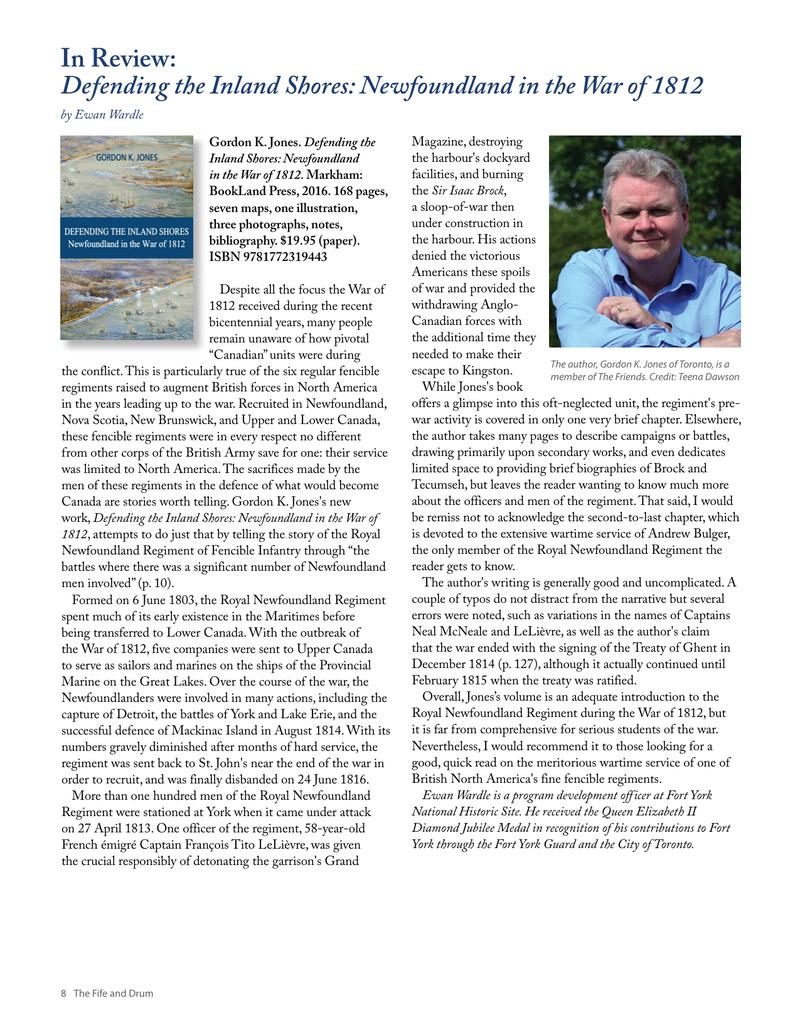
Despite all the focus the War of 1812 received during the recent bicentennial years, many people remain unaware of how pivotal “Canadian” units were during the conflict. This is particularly true of the six regular fencible regiments raised to augment British forces in North America in the years leading up to the war. Recruited in Newfoundland, Nova Scotia, New Brunswick, and Upper and Lower Canada, these fencible regiments were in every respect no different from other corps of the British Army save for one: their service was limited to North America. The sacrifices made by the men of these regiments in the defence of what would become Canada are stories worth telling. Gordon K. Jones’s new work, Defending the Inland Shores: Newfoundland in the War of 1812, attempts to do just that by telling the story of the Royal Newfoundland Regiment of Fencible Infantry through “the battles where there was a significant number of Newfoundland men involved” (p. 10).
Formed on 6 June 1803, the Royal Newfoundland Regiment spent much of its early existence in the Maritimes before being transferred to Lower Canada. With the outbreak of the War of 1812, five companies were sent to Upper Canada to serve as sailors and marines on the ships of the Provincial Marine on the Great Lakes. Over the course of the war, the Newfoundlanders were involved in many actions, including the capture of Detroit, the battles of York and Lake Erie, and the successful defence of Mackinac Island in August 1814. With its numbers gravely diminished after months of hard service, the regiment was sent back to St. John’s near the end of the war in order to recruit, and was finally disbanded on 24 June 1816.
More than one hundred men of the Royal Newfoundland Regiment were stationed at York when it came under attack on 27 April 1813. One officer of the regiment, 58-year-old French émigré Captain François Tito LeLièvre, was given the crucial responsibly of detonating the garrison’s Grand Magazine, destroying the harbour’s dockyard facilities, and burning the Sir Isaac Brock, a sloop-of-war then under construction in the harbour. His actions denied the victorious Americans these spoils of war and provided the withdrawing Anglo-Canadian forces with the additional time they needed to make their escape to Kingston.

While Jones’s book offers a glimpse into this oft-neglected unit, the regiment’s prewar activity is covered in only one very brief chapter. Elsewhere, the author takes many pages to describe campaigns or battles, drawing primarily upon secondary works, and even dedicates limited space to providing brief biographies of Brock and Tecumseh, but leaves the reader wanting to know much more about the officers and men of the regiment. That said, I would be remiss not to acknowledge the second-to-last chapter, which is devoted to the extensive wartime service of Andrew Bulger, the only member of the Royal Newfoundland Regiment the reader gets to know.
The author’s writing is generally good and uncomplicated. A couple of typos do not distract from the narrative but several errors were noted, such as variations in the names of Captains Neal McNeale and LeLièvre, as well as the author’s claim that the war ended with the signing of the Treaty of Ghent in December 1814 (p. 127), although it actually continued until February 1815 when the treaty was ratified.
Overall, Jones’s volume is an adequate introduction to the Royal Newfoundland Regiment during the War of 1812, but it is far from comprehensive for serious students of the war. Nevertheless, I would recommend it to those looking for a good, quick read on the meritorious wartime service of one of British North America’s fine fencible regiments.
Original printed pages