From outside the visitor centres at many historical and natural sites seem to have little in common. While most contain many similar functions—admissions desks, orientation theatres, galleries, classrooms, restrooms, restaurants, kitchens, gift shops, offices, storage rooms and the like—they’re stylistic shape-shifters and rarely resemble one another. Some are faded back to avoid competing with what they support; others, the work of star architects, are given prominence. Both qualities exist in the latest, remarkable example of this building type, opening at Fort York on 19 September 2014.
After World War II when North Americans were given mobility and leisure to travel more widely, they needed to better understand the places they visited, and to have their human needs cared for too. Hence, the Visitor Centre emerged. The term was coined in the mid-1950s by the US National Park Service as it modernized after a tenfold increase in visitation from 1931 to 1948. Then in 1956 Congress spurred things on by authorizing the decade-long Mission 66 program to improve the national parks. In 110 of them visitor centres were built, introducing this new kind of building to the world.
Leading American sites like Gettysburg had decades of experience to inform the upgrading process. Its battlefield had been an attraction since shortly after the Civil War when nonprofits and private interests began assembling some of the land that forms the present-day park. For-hire guides took visitors round, and a major attraction apart from the sense of history that pervaded the place was a privately-owned 19th century cyclorama of Pickett’s Charge relocated to Gettysburg in 1913 after being on display for several years in Boston and Newark.
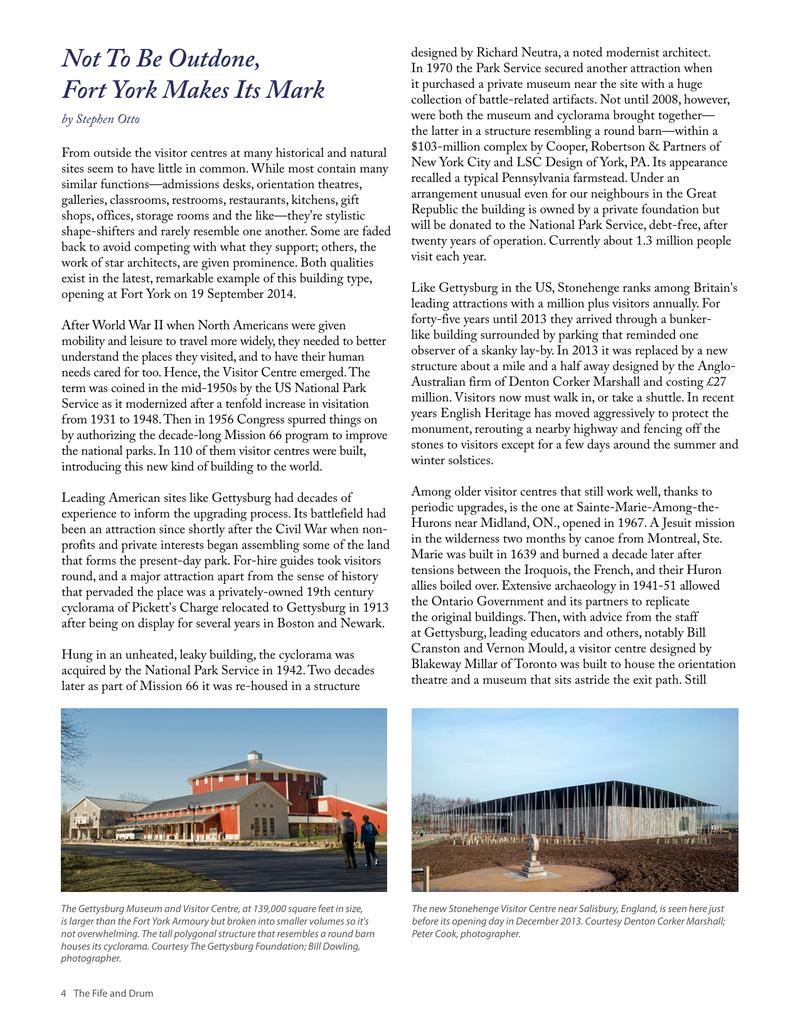
Hung in an unheated, leaky building, the cyclorama was acquired by the National Park Service in 1942. Two decades later as part of Mission 66 it was re-housed in a structure designed by Richard Neutra, a noted modernist architect. In 1970 the Park Service secured another attraction when it purchased a private museum near the site with a huge collection of battle-related artifacts. Not until 2008, however, were both the museum and cyclorama brought together—the latter in a structure resembling a round barn—within a $103-million complex by Cooper, Robertson & Partners of New York City and LSC Design of York, PA. Its appearance recalled a typical Pennsylvania farmstead. Under an arrangement unusual even for our neighbours in the Great Republic the building is owned by a private foundation but will be donated to the National Park Service, debt-free, after twenty years of operation. Currently about 1.3 million people visit each year.
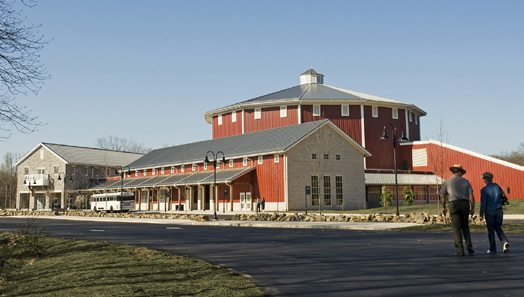
Like Gettysburg in the US, Stonehenge ranks among Britain’s leading attractions with a million plus visitors annually. For forty-five years until 2013 they arrived through a bunkerlike building surrounded by parking that reminded one observer of a skanky lay-by. In 2013 it was replaced by a new structure about a mile and a half away designed by the Anglo-Australian firm of Denton Corker Marshall and costing £27 million. Visitors now must walk in, or take a shuttle. In recent years English Heritage has moved aggressively to protect the monument, rerouting a nearby highway and fencing off the stones to visitors except for a few days around the summer and winter solstices.

Among older visitor centres that still work well, thanks to periodic upgrades, is the one at Sainte-Marie-Among-the-Hurons near Midland, ON., opened in 1967. A Jesuit mission in the wilderness two months by canoe from Montreal, Ste. Marie was built in 1639 and burned a decade later after tensions between the Iroquois, the French, and their Huron allies boiled over. Extensive archaeology in 1941-51 allowed the Ontario Government and its partners to replicate the original buildings. Then, with advice from the staff at Gettysburg, leading educators and others, notably Bill Cranston and Vernon Mould, a visitor centre designed by Blakeway Millar of Toronto was built to house the orientation theatre and a museum that sits astride the exit path. Still
Original printed pages