Until recently, the Fort York Library was a little known resource tucked away in the back of the 1815 Senior Officers’ Quarters. Like many other administrative offices at the fort, it took up the space of a Senior Officer’s bedroom, a room 15 by 20 feet, with a brick fireplace and two lovely, deeply set and shuttered windows. Now one might think this would make a wonderful library. Maybe so, in a domestic setting, but although the ceiling leaks had been stopped, they were never repaired, so the peeling paint and damp was still in evidence. The shelves were rather ramshackle metal affairs not very securely fixed to the historic walls, and an old wooden catalogue and some filing cabinets obscured the fireplace. Two desks sporting computers were crammed in along with some old wooden shelving overflowing with the collection of journals, training manuals, old display materials and uncatalogued books. In a nearby office were the map files, a large, disorganized slide collection and two big cardboard boxes containing Carl Benn’s photos.
Since there had been drastic cutbacks at the fort, there was no one on staff who could spare the time to look after this collection. However, the library was very necessary to the staff for research on the fort, military music, the kitchen program and military life in the 19th century. Returned books lay everywhere and piles of recent journals and photos testified to the constant use of the library. This matter was brought to my attention as a history teacher and librarian early in my first term as a director of the Friends. I recruited a friend, Heather Cirulis, to help me. We volunteer at the library every Thursday, and have tried to create some order out of chaos. We have reorganized and indexed the journals, maps, plans and photographs. It has been a labour of love. In the process, we have learned a great deal about the fort and military life in early Canada. We have also been impressed by the depth of knowledge and enthusiasm displayed by the staff, who are very generous with their time and advice. How lucky we are to have them!
We also look after acquisitions, especially since the fort staff now welcome classes for World War One tours and the collection is weak in that area. All these new books, and many old ones, need to be processed and catalogued. Another wonderful asset to the Friends and the fort is Christine Mosser, recently retired from Toronto Reference Library, who has undertaken to catalogue the uncatalogued, process the books and bring the shelf list up to date. This is a huge task and Christine has laboured faithfully to complete it. What would the fort do without its volunteers?
When I explained to the History and Archaeology Committee how poor were the conditions in the old library, it was determined to find a new temporary home for the collection; temporary, because we hope to put this collection in the new Visitor Centre, close to the staff offices. Board chairs Joe Gill and Stephen Otto both embraced the idea and David O’Hara, the administrator, agreed to find us a location in the Blue Barracks. New shelving was securely fixed to the walls, larger flat map files were located and the Friends bought new filing cabinets for the vertical file and photo collection. Finally, the books and journals and other research materials were moved into the new space more than two years ago. We also acquired a very useful and attractive library table made from the salvaged old Queen’s Wharf timber. Recently we have bought a computer and printer so that research, cataloguing and indexing can be done in the Blue Barracks rather than the old library.
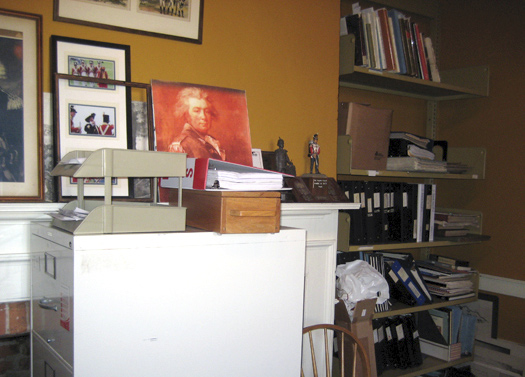

Our next endeavour is to purchase a scanner, so that researchers can scan maps and photos etc. on the spot. Heather and I have yet to organize the slide collection. I think we’ve been putting it off, hoping that the slides will be obsolete by the time we get to them! However, creating order out of chaos is addictive to some of us – and we’ll probably feel that since they have become artefacts by that time, we should index them anyway!
The new library may be temporary, but it is as organized and useful as we can make it. Thanks to the Friends of Fort York this new facility will make it easier for the staff and the general public to access the fort’s rather impressive collection of materials on Toronto military history.
Original printed pages