On Tuesday, November 17, Mayor John Tory, Councillors Cressy and Layton, Waterfront Toronto CEO John Campbell, civic planner Ken Greenberg, and local citizen representatives came to Fort York Visitor Centre to announce Project: Under Gardiner, a partnership of private philanthropy and civic planning that promises to revive the dead zone beneath the Gardiner Expressway. Very special guests at the event were philanthropists Judy and Wilmot Matthews, who have offered an astonishing $25 million to make this project happen. “Toronto is going to get used to saying yes to things like this,” Mayor Tory declared, promising a completed project by 1 July 2017.
The Under Gardiner plan should confirm the central place Fort York National Historic Site will occupy in the new landscape of waterfront Toronto.
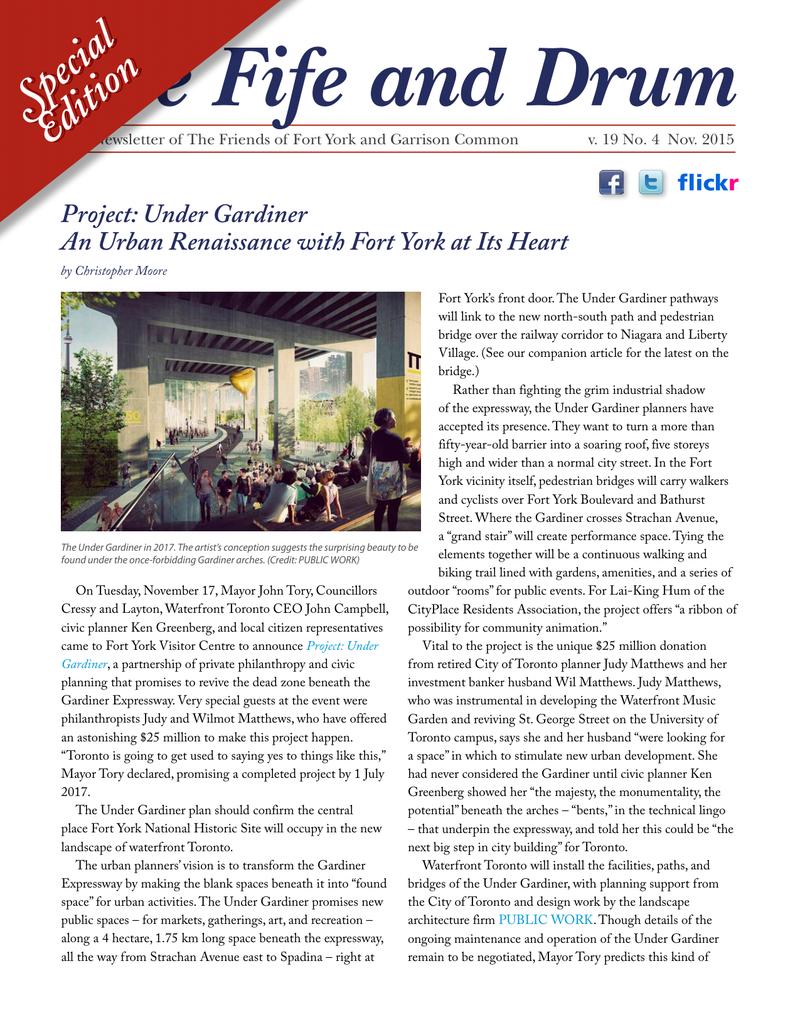
The urban planners’ vision is to transform the Gardiner Expressway by making the blank spaces beneath it into “found space” for urban activities. The Under Gardiner promises new public spaces – for markets, gatherings, art, and recreation – along a 4 hectare, 1.75 km long space beneath the expressway, all the way from Strachan Avenue east to Spadina – right at Fort York’s front door. The Under Gardiner pathways will link to the new north-south path and pedestrian bridge over the railway corridor to Niagara and Liberty Village. (See our companion article for the latest on the bridge.)
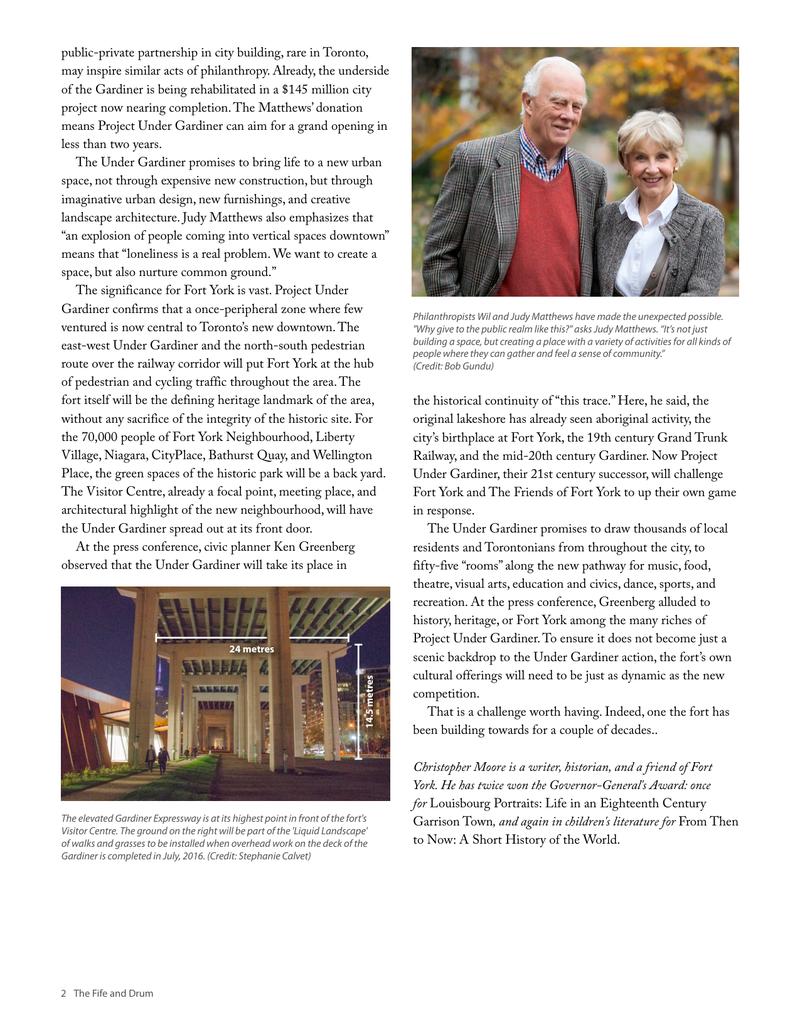
Rather than fighting the grim industrial shadow of the expressway, the Under Gardiner planners have accepted its presence. They want to turn a more than fifty-year-old barrier into a soaring roof, five storeys high and wider than a normal city street. In the Fort York vicinity itself, pedestrian bridges will carry walkers and cyclists over Fort York Boulevard and Bathurst Street. Where the Gardiner crosses Strachan Avenue, a “grand stair” will create performance space. Tying the elements together will be a continuous walking and biking trail lined with gardens, amenities, and a series of outdoor “rooms” for public events. For Lai-King Hum of the CityPlace Residents Association, the project offers “a ribbon of possibility for community animation.”
Vital to the project is the unique $25 million donation from retired City of Toronto planner Judy Matthews and her investment banker husband Wil Matthews. Judy Matthews, who was instrumental in developing the Waterfront Music Garden and reviving St. George Street on the University of Toronto campus, says she and her husband “were looking for a space” in which to stimulate new urban development. She had never considered the Gardiner until civic planner Ken Greenberg showed her “the majesty, the monumentality, the potential” beneath the arches – “bents,” in the technical lingo – that underpin the expressway, and told her this could be “the next big step in city building” for Toronto.
Waterfront Toronto will install the facilities, paths, and bridges of the Under Gardiner, with planning support from the City of Toronto and design work by the landscape architecture firm PUBLIC WORK. Though details of the ongoing maintenance and operation of the Under Gardiner remain to be negotiated, Mayor Tory predicts this kind of public-private partnership in city building, rare in Toronto, may inspire similar acts of philanthropy. Already, the underside of the Gardiner is being rehabilitated in a $145 million city project now nearing completion. The Matthews’ donation means Project Under Gardiner can aim for a grand opening in less than two years.
The Under Gardiner promises to bring life to a new urban space, not through expensive new construction, but through imaginative urban design, new furnishings, and creative landscape architecture. Judy Matthews also emphasizes that “an explosion of people coming into vertical spaces downtown” means that “loneliness is a real problem. We want to create a space, but also nurture common ground.”
The significance for Fort York is vast. Project Under Gardiner confirms that a once-peripheral zone where few ventured is now central to Toronto’s new downtown. The east-west Under Gardiner and the north-south pedestrian route over the railway corridor will put Fort York at the hub of pedestrian and cycling traffic throughout the area. The fort itself will be the defining heritage landmark of the area, without any sacrifice of the integrity of the historic site. For the 70,000 people of Fort York Neighbourhood, Liberty Village, Niagara, CityPlace, Bathurst Quay, and Wellington Place, the green spaces of the historic park will be a back yard. The Visitor Centre, already a focal point, meeting place, and architectural highlight of the new neighbourhood, will have the Under Gardiner spread out at its front door.
At the press conference, civic planner Ken Greenberg observed that the Under Gardiner will take its place in


the historical continuity of “this trace.” Here, he said, the original lakeshore has already seen aboriginal activity, the city’s birthplace at Fort York, the 19th century Grand Trunk Railway, and the mid-20th century Gardiner. Now Project Under Gardiner, their 21st century successor, will challenge Fort York and The Friends of Fort York to up their own game in response.
The Under Gardiner promises to draw thousands of local residents and Torontonians from throughout the city to fifty-five “rooms” along the new pathway for music, food, theatre, visual arts, education and civics, dance, sports, and recreation. At the press conference, Greenberg alluded to history, heritage, or Fort York among the many riches of Project Under Gardiner. To ensure it does not become just a scenic backdrop to the Under Gardiner action, the fort’s own cultural offerings will need to be just as dynamic as the new competition.
That is a challenge worth having. Indeed, one the fort has been building towards for a couple of decades.
Original printed pages