Fort York National Historic Site encompasses 43 acres of structural foundations, earthworks, burials, and a battlefield. The structures built, altered, torn down, burned down, and blown up before and after the War of 1812 include buildings, batteries, stockades, and palisades. Traces of pre-19th century camps remain, perhaps, in the clay ground under one or more layers of fill. Even without buildings, activities are sometimes visible from physical alterations to the soil. Distinctive artifacts make it possible to track the presence of individuals, regiments, and First Nations. At the foot of slopes around the fort, and in slight depressions, discarded objects are preserved.
The complexity of this record has been tackled by various archaeologists over many years, work usually limited to mitigating disturbances in the land as underground services were installed. But with plans forming to commemorate the War of 1812 Bicentennial, might there not be a renewed role for archaeology at Fort York? The opportunity arises specifically from plans to construct a visitor interpretation centre on Fort York Boulevard, on the south flank of Garrison Common, and from plans to extensively improve and interpret the landscape around the fort. It also seems logical to consider archaeology as part of any plan to commemorate the Bicentennial at related sites, including that of the first parliament buildings burned during the American occupation in 1813. (See: <www.archaeologicalservices.on.ca/project_6.htm>)
Archaeology itself is a form of commemoration, an active exploring of events involving people from the past and their contexts. It is creative in that any evidence found requires interpretation. The remains are given meaning as we bring perspective to them from a viewpoint unavoidably grounded in the present. Archaeology is a test of our generation’s power to recreate the past.
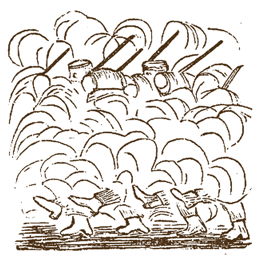
The site of the grand magazine explosion, the crater, can be explored archaeologically but understood in many ways: as an enhanced natural feature (the hollow where it was originally sited); as a building (the magazine itself); as an event (the explosion); as a site of possible burial and commemoration in the aftermath of this gruesome event; and as an accumulating midden (the filling-in of the crater by garbage throughout the 19th century). Ground hogs might ultimately frustrate archaeological ambitions, however, at least on the ramparts where the crater is situated: their constant burrowing is known to mix archaeological deposits, making it difficult to interpret stratification.
A properly designed research programme of archaeology, involving excavation, curation, and interpretation, is an expensive, long-term investment. Any archaeological exploration would undoubtedly begin with extensive geophysical survey of the area for whatever information about sediments could be gleaned with as little disturbance as possible. This is a key principle of archaeology: excavation is destructive and the resource non-renewable. It should follow a detailed management plan and be used extremely carefully. Our exploration of evidence is only as good as current thinking, practice, and technology allow. Once removed from the ground, there is no possibility of re-examining the context and relationships of artifacts, soil features, and structural remains. Techniques improve over time (e.g., the ability to recover and analyse DNA from organic residues on artifacts) so staging an excavation over years, or decades, improves the chances that new methods will be applied to the evidence.
The early railcut under the Gardiner Expressway brings an opportunity for archaeological interpretation: it slices through the original Lake Ontario shoreline, the Garrison Reserve, and the battlefield. If exposed, the cut’s long, deep profile might be an exciting window on the past – a cross-section through a landscape and its archaeological deposits.
The finding of the Queen’s Wharf in lakefill south of the original shoreline in 2006, and the current exploration of the Garrison Creek mouth under the Bathurst Street bridge, remind us that the lakebed itself is an archaeological site. Lake-filling in stages along the shore since about 1850 has created the conditions for deep burial and sometimes spectacular preservation of deposits that would otherwise have rotted or been removed.
Archaeological evidence relating to the fort’s history extends well beyond the National Historic Site boundaries. To the west, the grounds of Exhibition Place, backyards in Parkdale, and the embankment north of Lakeshore Blvd near Sunnyside, now emblazoned with corporate names, are all part of the battlefield of 27 April 1813, which extends from Fort York to the east side of Humber Bay. Topographic features are part of this archaeological landscape. Whereas earthworks were constructed to define the western edge of the fort, other defensive features were natural. The western battery in the grounds of the CNE, for instance, was sited on the edge of a ravine, now buried, but possibly containing sediment and material from 1813.
The grand magazine crater lies at an epicentre – both of the events of that day in 1813 and of an archaeological landscape today.
The Best of Times
City-building is exhilarating, if sometimes messy, but those connected closely with Fort York have seldom had ten days packed as full of constructive dialogue about projects on the fort’s perimeter as they experienced during the last half of June.
On June 17 the Urban Design Section of the City’s Planning Division held a public meeting where a presentation was
Original printed pages