Aristotle believed that mimesis was far more than the mere copying of nature or art, but the innate desire of the human condition to record, to represent, and to interact with knowledge. It was the act of recording art, the representation of that art and the public and private interaction with that art in which new knowledge is gained. CyArk and Iron Mountain have now brought this notion of mimesis to realization for the entire Fort York site with their latest achievement in the digital mimicry, and more importantly, the safe storage of that data for future generations of historical explorers.
CyArk has engaged digital conservation at sites such as Mount Rushmore National Memorial and Angkor Wat
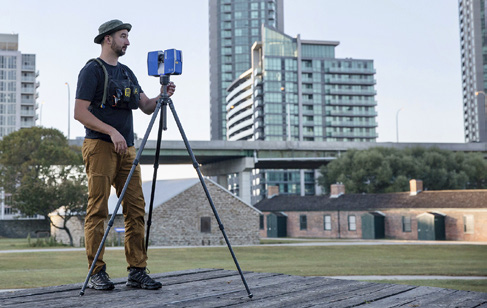
Founded in 2003 as a non-profit technological organization, CyArk specializes in the digital capture of important heritage and archaeological landscapes across the world. Over the last fourteen years CyArk has engaged digital conservation at sites such as Mount Rushmore National Memorial and Angkor Wat with hundreds of landscapes virtually captured in seven continents. In an innovative and generous partnership with Iron Mountain, a company known more for storing important physical documents and objects, CyArk has been able to not only digitally scan the full Fort York historical site, but now has the means to constantly engage with the material without fear of loss or degradation. In combination, this amounts to preserving a slice of time in which the data can be constantly explored, reimagined, and repurposed for future use.
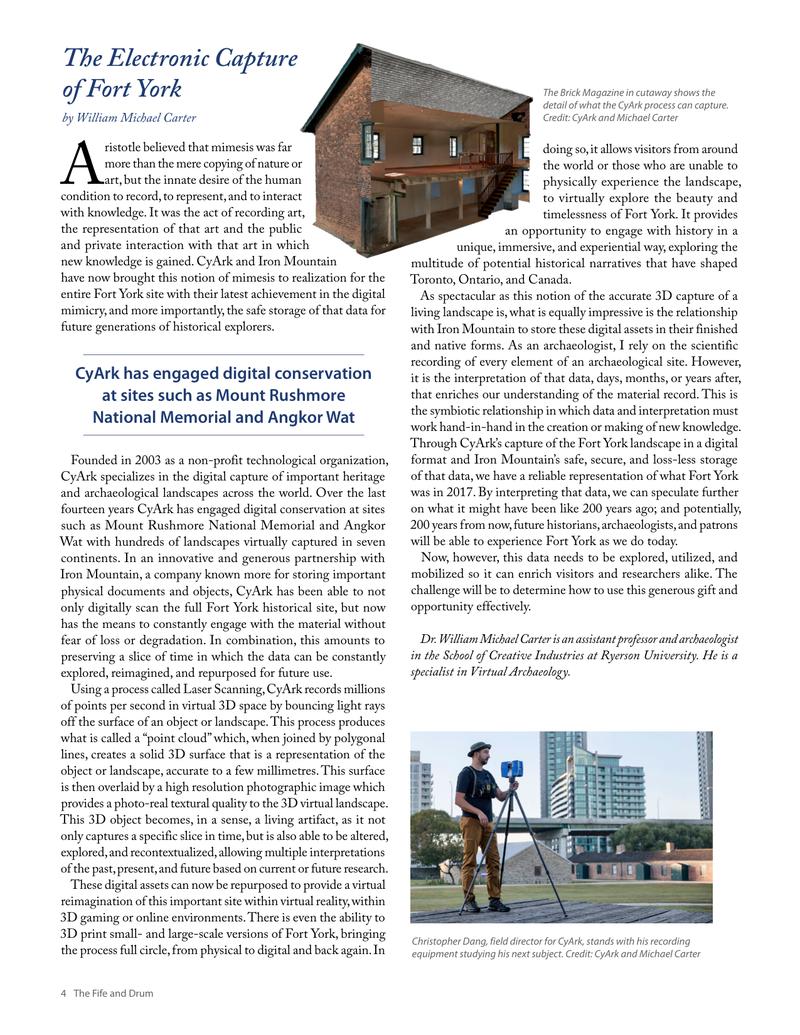
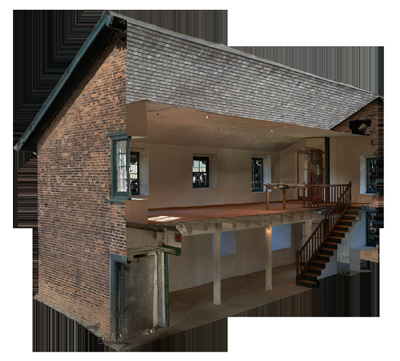
Using a process called Laser Scanning, CyArk records millions of points per second in virtual 3D space by bouncing light rays off the surface of an object or landscape. This process produces what is called a “point cloud” which, when joined by polygonal lines, creates a solid 3D surface that is a representation of the object or landscape, accurate to a few millimetres. This surface is then overlaid by a high resolution photographic image which provides a photo-real textural quality to the 3D virtual landscape. This 3D object becomes, in a sense, a living artifact, as it not only captures a specific slice in time, but is also able to be altered, explored, and recontextualized, allowing multiple interpretations of the past, present, and future based on current or future research.
These digital assets can now be repurposed to provide a virtual reimagination of this important site within virtual reality, within 3D gaming or online environments. There is even the ability to 3D print small- and large-scale versions of Fort York, bringing the process full circle, from physical to digital and back again. In doing so, it allows visitors from around the world or those who are unable to physically experience the landscape, to virtually explore the beauty and timelessness of Fort York. It provides an opportunity to engage with history in a unique, immersive, and experiential way, exploring the multitude of potential historical narratives that have shaped Toronto, Ontario, and Canada.
As spectacular as this notion of the accurate 3D capture of a living landscape is, what is equally impressive is the relationship with Iron Mountain to store these digital assets in their finished and native forms. As an archaeologist, I rely on the scientific recording of every element of an archaeological site. However, it is the interpretation of that data, days, months, or years after, that enriches our understanding of the material record. This is the symbiotic relationship in which data and interpretation must work hand-in-hand in the creation or making of new knowledge. Through CyArk’s capture of the Fort York landscape in a digital format and Iron Mountain’s safe, secure, and loss-less storage of that data, we have a reliable representation of what Fort York was in 2017. By interpreting that data, we can speculate further on what it might have been like 200 years ago; and potentially, 200 years from now, future historians, archaeologists, and patrons will be able to experience Fort York as we do today.
Now, however, this data needs to be explored, utilized, and mobilized so it can enrich visitors and researchers alike. The challenge will be to determine how to use this generous gift and opportunity effectively.
Original printed pages