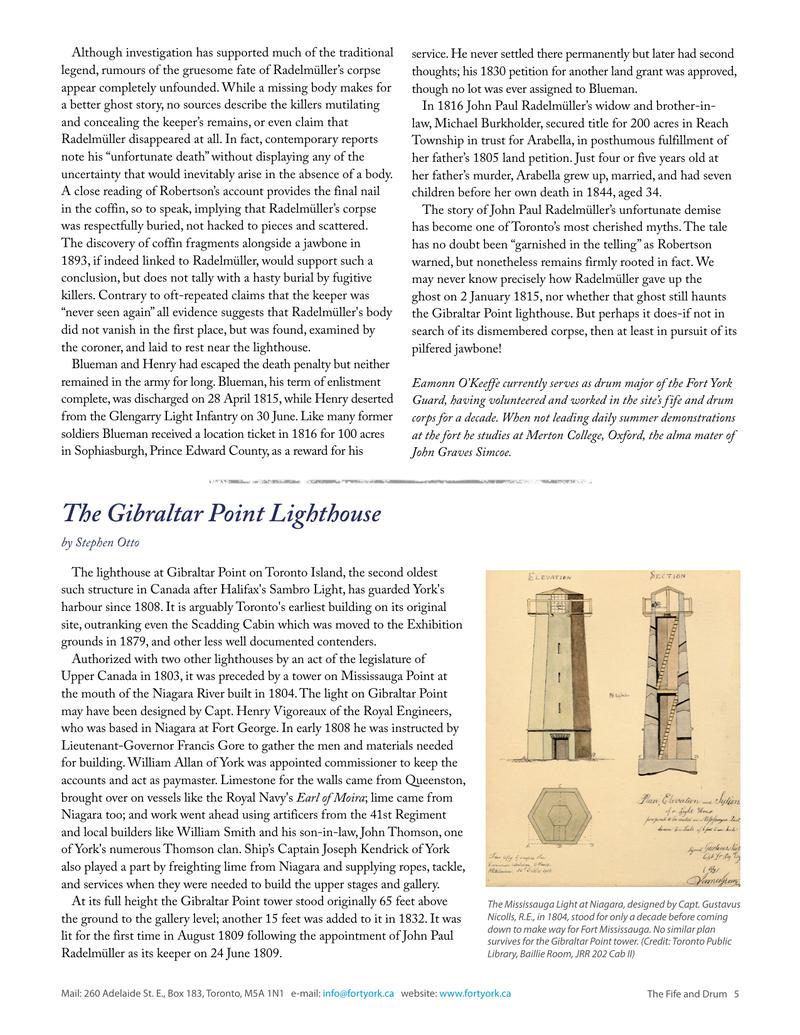
The lighthouse at Gibraltar Point on Toronto Island, the second oldest such structure in Canada after Halifax’s Sambro Light, has guarded York’s harbour since 1808. It is arguably Toronto’s earliest building on its original site, outranking even the Scadding Cabin which was moved to the Exhibition grounds in 1879, and other less well documented contenders.
Authorized with two other lighthouses by an act of the legislature of Upper Canada in 1803, it was preceded by a tower on Mississauga Point at the mouth of the Niagara River built in 1804. The light on Gibraltar Point may have been designed by Capt. Henry Vigoreaux of the Royal Engineers, who was based in Niagara at Fort George. In early 1808 he was instructed by Lieutenant-Governor Francis Gore to gather the men and materials needed for building. William Allan of York was appointed commissioner to keep the accounts and act as paymaster. Limestone for the walls came from Queenston, brought over on vessels like the Royal Navy’s Earl of Moira; lime came from Niagara too; and work went ahead using artificers from the 41st Regiment and local builders like William Smith and his son-in-law, John Thomson, one of York’s numerous Thomson clan. Ship’s Captain Joseph Kendrick of York also played a part by freighting lime from Niagara and supplying ropes, tackle, and services when they were needed to build the upper stages and gallery.
At its full height the Gibraltar Point tower stood originally 65 feet above the ground to the gallery level; another 15 feet was added to it in 1832. It was lit for the first time in August 1809 following the appointment of John Paul Radelmüller as its keeper on 24 June 1809.
Although investigation has supported much of the traditional legend, rumours of the gruesome fate of Radelmüller’s corpse appear completely unfounded. While a missing body makes for a better ghost story, no sources describe the killers mutilating and concealing the keeper’s remains, or even claim that Radelmüller disappeared at all. In fact, contemporary reports note his “unfortunate death” without displaying any of the uncertainty that would inevitably arise in the absence of a body. A close reading of Robertson’s account provides the final nail in the coffin, so to speak, implying that Radelmüller’s corpse was respectfully buried, not hacked to pieces and scattered. The discovery of coffin fragments alongside a jawbone in 1893, if indeed linked to Radelmüller, would support such a conclusion, but does not tally with a hasty burial by fugitive killers. Contrary to oft-repeated claims that the keeper was “never seen again” all evidence suggests that Radelmüller’s body did not vanish in the first place, but was found, examined by the coroner, and laid to rest near the lighthouse.
Blueman and Henry had escaped the death penalty but neither remained in the army for long. Blueman, his term of enlistment complete, was discharged on 28 April 1815, while Henry deserted from the Glengarry Light Infantry on 30 June. Like many former soldiers Blueman received a location ticket in 1816 for 100 acres in Sophiasburgh, Prince Edward County, as a reward for his service. He never settled there permanently but later had second thoughts; his 1830 petition for another land grant was approved, though no lot was ever assigned to Blueman.
In 1816 John Paul Radelmüller’s widow and brother-in-law, Michael Burkholder, secured title for 200 acres in Reach Township in trust for Arabella, in posthumous fulfillment of her father’s 1805 land petition. Just four or five years old at her father’s murder, Arabella grew up, married, and had seven children before her own death in 1844, aged 34.
The story of John Paul Radelmüller’s unfortunate demise has become one of Toronto’s most cherished myths. The tale has not doubt been “garnished in the telling” as Robertson warned, but nonetheless remains firmly rooted in fact. We may never know precisely how Radelmüller gave up the ghost on 2 January 1815, nor whether that ghost still haunts the Gibraltar Point lighthouse. But perhaps it does-if not in search of its dismembered corpse, then at least in pursuit of its pilfered jawbone!
Original printed pages