The end of the Great War did not mark the beginning of an era free from worries. The veterans of Flanders returned to Canada as the Spanish Influenza spread across the globe, taking more lives than the war itself. Meanwhile, the spectre of Bolshevism had reared its head. Lenin’s Bolsheviks toppled the Czar in 1917, removed Russia from the war, and unleashed a civil war in which some Canadians had fought on the side of the Whites. In 1919, the victorious Reds established a Communist International in Moscow to coordinate the worldwide revolution.
Some thought the Winnipeg General Strike had been the work of Moscow, and, in 1921, the RCMP believed that another uprising was planned in Vancouver. In Ottawa, the Defence Committee – precursor to the Department of National Defence – directed each military district to prepare detailed plans of how they would counter such an uprising. The plan developed for Toronto was comprehensive.
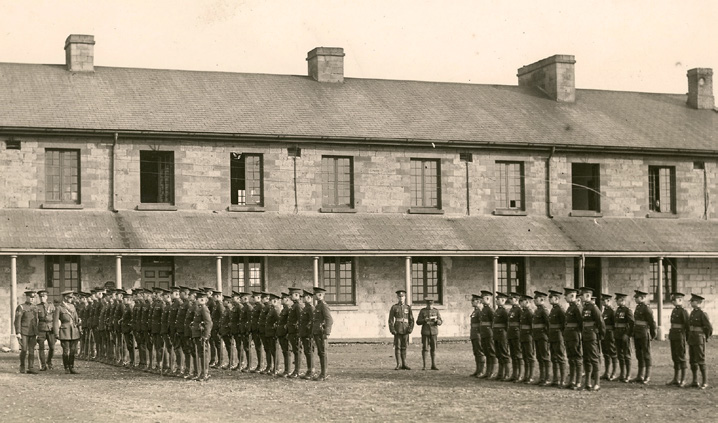
The city was part of Military District No.2, a large part of southern Ontario including Hamilton, St. Catharines, Brampton, Oshawa and the countryside stretching from the Niagara Peninsula up to Collingwood. Most of the soldiers in the district were part-timers of the Active Militia. In Toronto this was a sizeable force – more than 7,000 men – organized into seven infantry units, two mounted units, one machine gun unit and one artillery unit. The infantry units, from largest to smallest, were the 48th Regiment (Highlanders), the York Rangers, the Queen’s Own Rifles of Canada, the Toronto Regiment, the Mississauga Regiment, the Royal Grenadiers, and the Irish Regiment. The cavalry units were the Ontario Mounted Rifles and the Governor General’s Body Guard (for their present equivalents, see Sources & Further Reading). This force had plenty of Lee Enfield rifles, eight machine guns, and between eight and twelve serviceable howitzers. It did not have any vehicles or horses of its own. Horses were rented for training, but the government rates were generally too low to get good horses in the city.
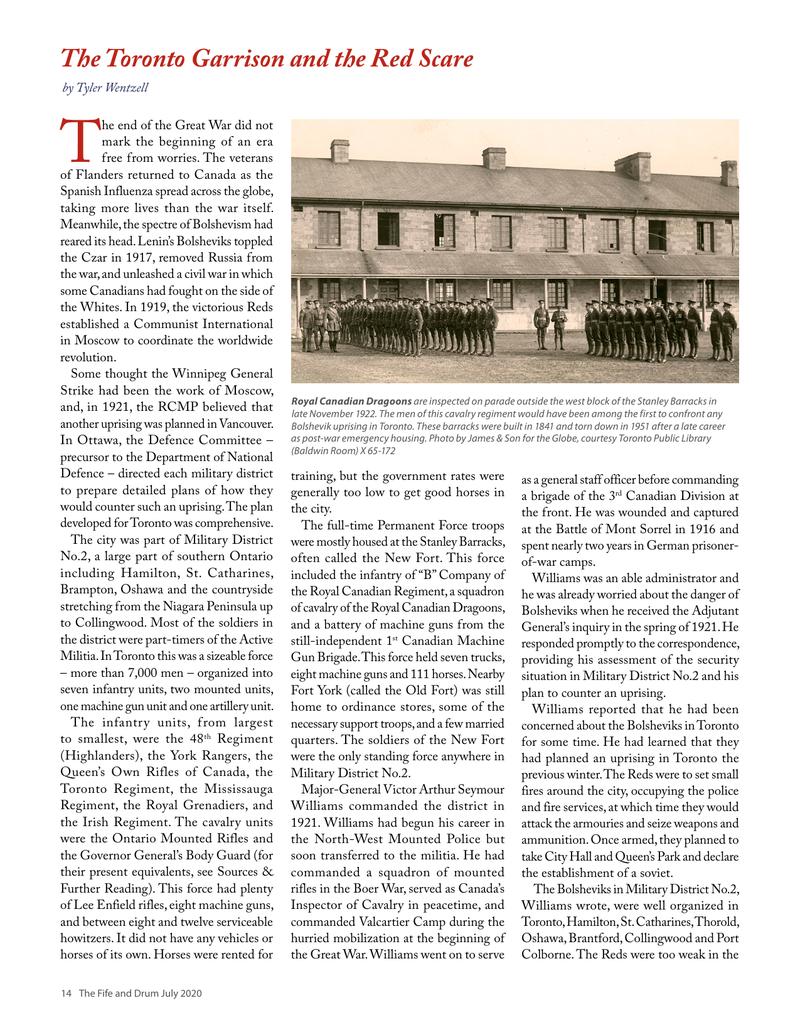
The full-time Permanent Force troops were mostly housed at the Stanley Barracks, often called the New Fort. This force included the infantry of “B” Company of the Royal Canadian Regiment, a squadron of cavalry of the Royal Canadian Dragoons, and a battery of machine guns from the still-independent 1st Canadian Machine Gun Brigade. This force held seven trucks, eight machine guns and 111 horses. Nearby Fort York (called the Old Fort) was still home to ordinance stores, some of the necessary support troops, and a few married quarters. The soldiers of the New Fort were the only standing force anywhere in Military District No.2.
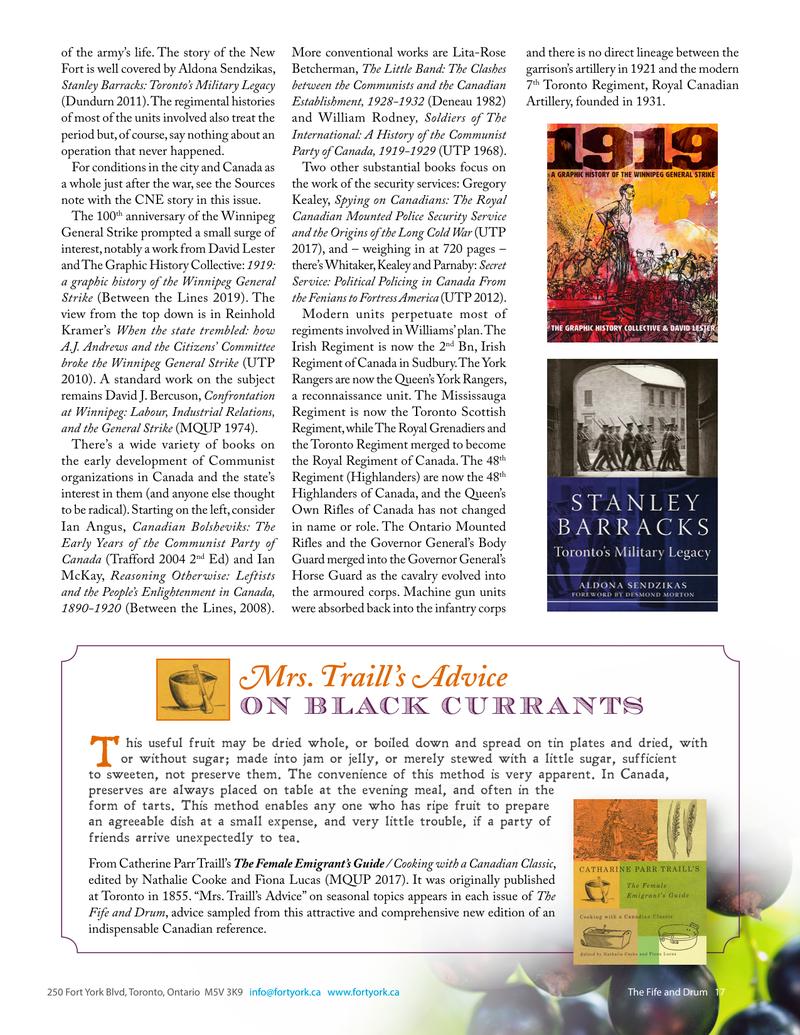
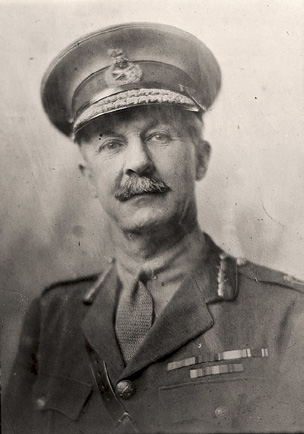
Major-General Victor Arthur Seymour Williams commanded the district in 1921. Williams had begun his career in the North-West Mounted Police but soon transferred to the militia. He had commanded a squadron of mounted rifles in the Boer War, served as Canada’s Inspector of Cavalry in peacetime, and commanded Valcartier Camp during the hurried mobilization at the beginning of the Great War. Williams went on to serve as a general staff officer before commanding a brigade of the 3rd Canadian Division at the front. He was wounded and captured at the Battle of Mont Sorrel in 1916 and spent nearly two years in German prisoner-of-war camps.
Williams was an able administrator and he was already worried about the danger of Bolsheviks when he received the Adjutant General’s inquiry in the spring of 1921. He responded promptly to the correspondence, providing his assessment of the security situation in Military District No.2 and his plan to counter an uprising.
Williams reported that he had been concerned about the Bolsheviks in Toronto for some time. He had learned that they had planned an uprising in Toronto the previous winter. The Reds were to set small fires around the city, occupying the police and fire services, at which time they would attack the armouries and seize weapons and ammunition. Once armed, they planned to take City Hall and Queen’s Park and declare the establishment of a soviet.
The Bolsheviks in Military District No.2, Williams wrote, were well organized in Toronto, Hamilton, St. Catharines, Thorold, Oshawa, Brantford, Collingwood and Port Colborne. The Reds were too weak in the smaller communities to be of much trouble on their own, but should an uprising occur in Toronto and Hamilton, where they were strongest, the smaller communities would likely follow suit. Williams considered the Reds of the Bloor-Dufferin dangerous in Toronto, which was home to their headquarters, describing them as “very powerful,” “well supplied with funds” and having “a large and dangerous following.”
There was no hard intelligence to substantiate Williams’ guess
Besides those already following the banner of Marx and Lenin, Williams was also concerned with the “disloyal” citizens of Toronto and environs who might join their cause when trouble began. Williams was well aware that ex-servicemen had played a role among both the strikers and the auxiliary police during the Winnipeg General Strike, but he believed most of Toronto’s veterans would act in support of the government. He agreed that “the large majority of the people in M.D. 2 are loyal and it is only the foreigners, Jews, Sinn Feiners, and a certain element of returned men (men who were always wasters and always will be) who are disloyal.”
Given the number of “disloyal” people and unemployed workers in the city, Williams thought that a large number of them might flock to the Bolshevik banner once an uprising began. He saw an insurrection of up to 20-30,000 workers as a possibility. At its most pessimistic interpretation, this meant that Williams thought that as many as one out of every eighteen Torontonians might join the uprising. There was no hard intelligence to substantiate Williams’ guess, so the assertion mostly speaks to how he viewed Toronto’s precarity.
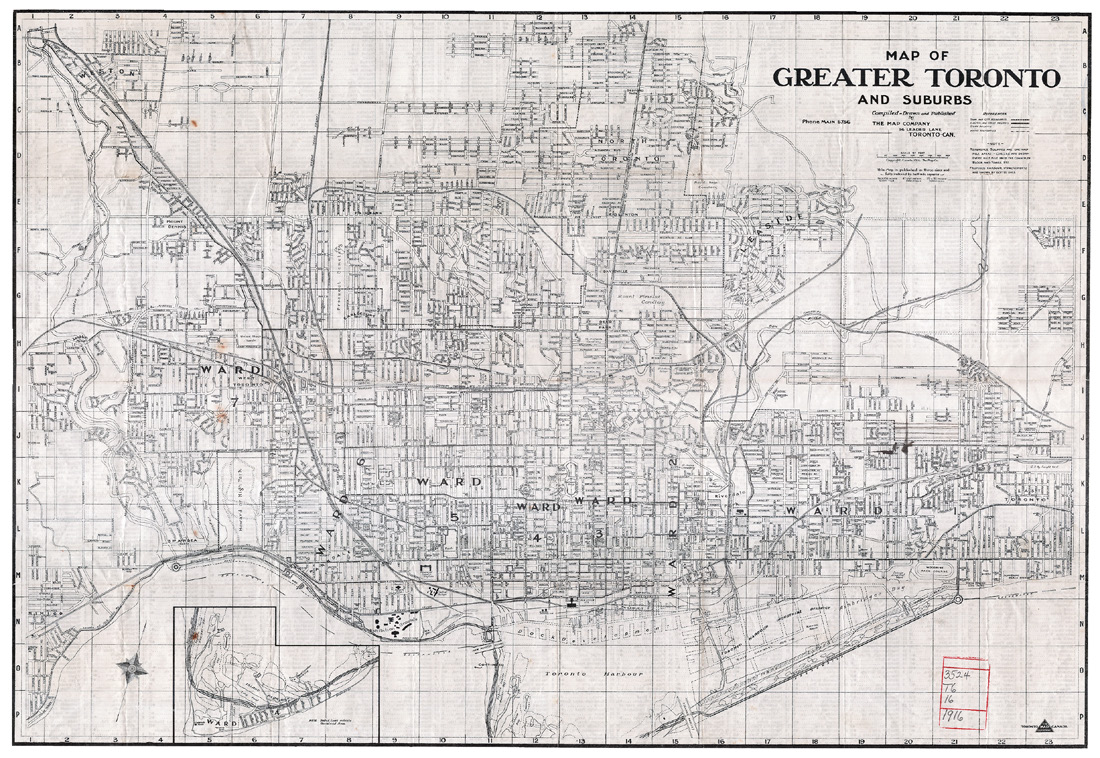
In the event of such an uprising in Toronto, Williams proposed the following scheme of manoeuvre. First, the Permanent Force soldiers at Stanley Barracks would secure their facilities, the nearby Exhibition Grounds, government installations as required, and weapons and ammunition throughout the city. Meanwhile, the Active Militia would be called out. Williams was confident that the militia “would turn out and fight if they were required to down Bolshevism.” If need be, Williams would also tap into the University of Toronto’s Canadian Officers Training Corps and the city’s three different veterans’ organizations around the city. He estimated that he could get 400 people from the COTC and 570 from among the navy veterans. The Great War Veterans’ Association had estimated they could muster 2000 auxiliaries during the affair’s previous winter.
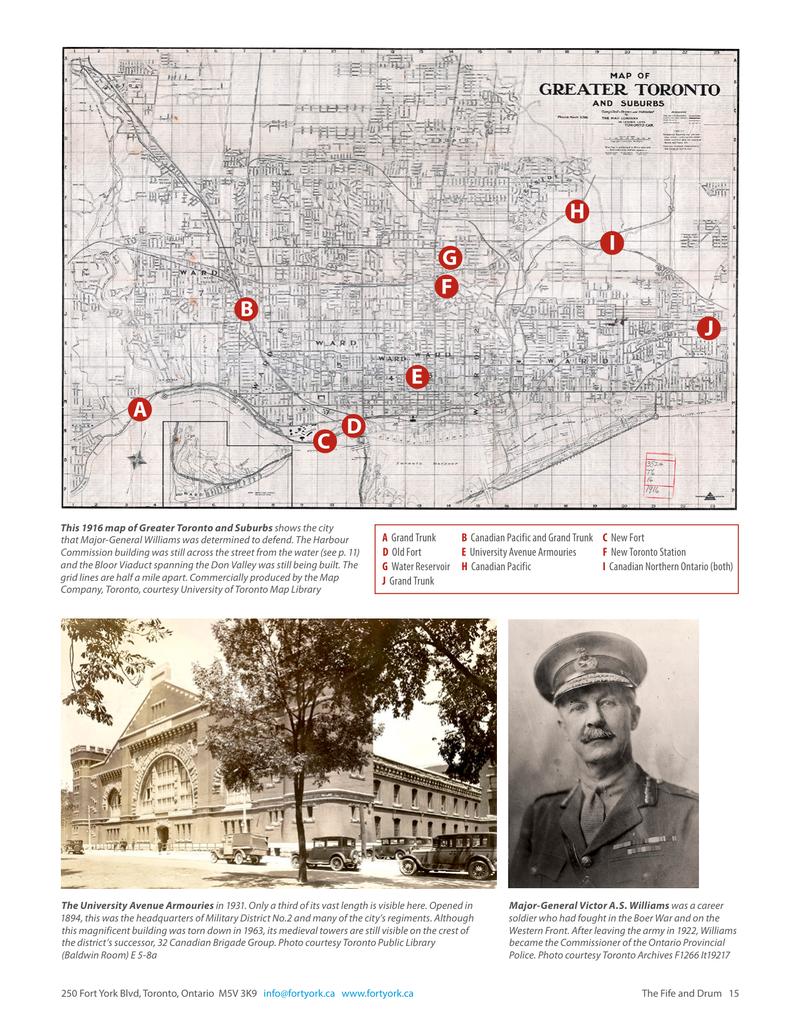
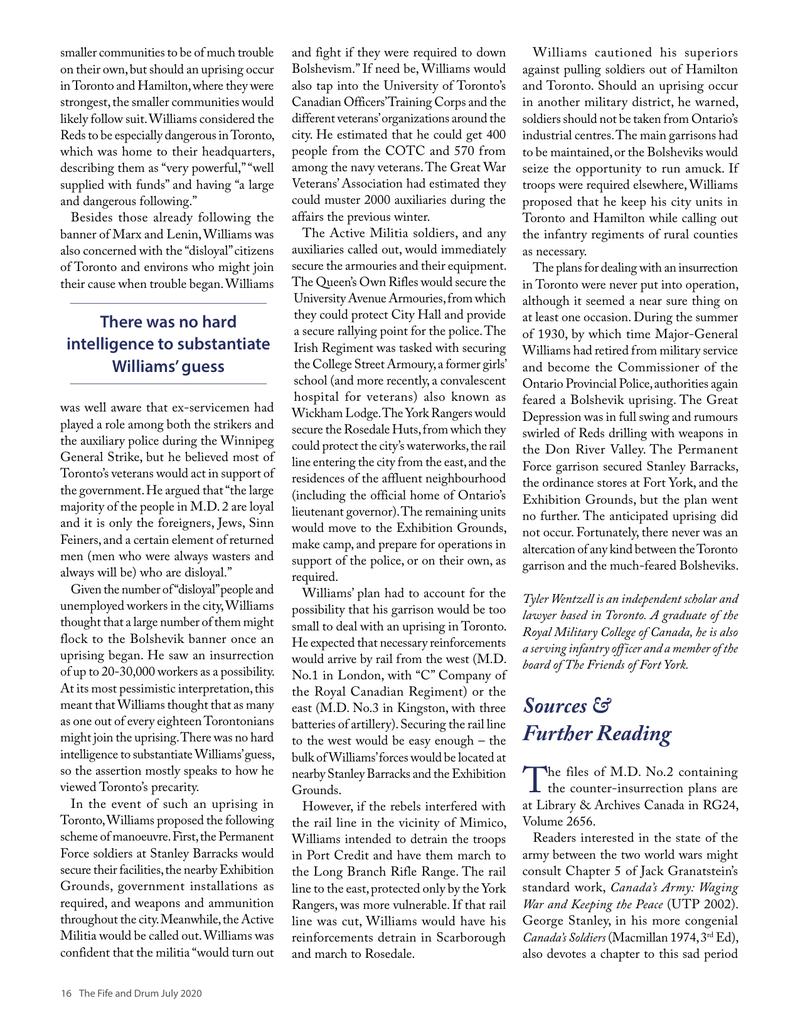
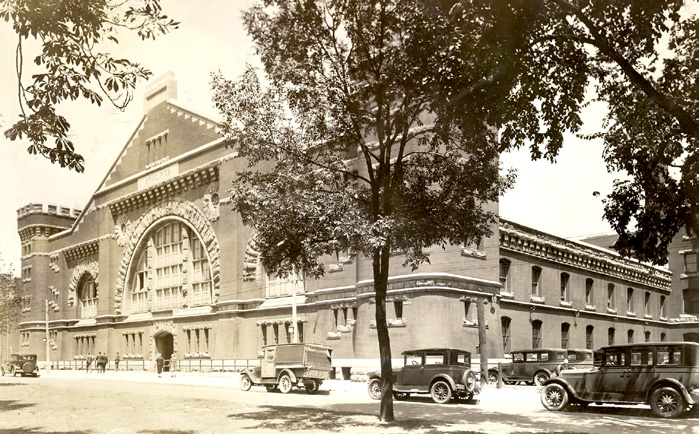
The Active Militia soldiers, and any auxiliaries called out, would immediately secure the armouries and their equipment. The Queen’s Own Rifles would secure the University Avenue Armouries, from which they could protect City Hall and provide a secure rallying point for the police. The Irish Regiment was tasked with securing the College Street Armoury, a former girls’ school (and more recently, a convalescent hospital for veterans) also known as Wyckham Lodge. The York Rangers would secure the Rosedale Huts, from which they could protect the city’s waterworks, the rail line cutting the city from the east, and the residences of the affluent neighbourhood (including the official home of Ontario’s lieutenant governor). The remaining units would move to the Exhibition Grounds, make camp, and prepare for operations in support of the police, or on their own, as required.
Williams’ plan had to account for the possibility that his garrison would be too small to deal with an uprising in Toronto. He expected that necessary reinforcements would arrive by rail from the west (M.D. No.1 in London, with “C” Company of the Royal Canadian Regiment) or the east (M.D. No.3 in Kingston, with three batteries of artillery). Securing the rail line to the west would be easy enough – the bulk of Williams’ forces would be located at nearby Stanley Barracks and the Exhibition Grounds.
However, if the rebels interfered with the rail line in the vicinity of Mimico, Williams intended to detrain the troops in Port Credit and have them march to the Long Branch Rifle Range. The rail line to the east, protected only by the York Rangers, was more vulnerable. If that rail line was cut, Williams would have his reinforcements detrain in Scarborough and march to Rosedale.
Williams cautioned his superiors against pulling soldiers out of Hamilton and Toronto. Should an uprising occur in another military district, he warned, soldiers should not be taken from Ontario’s industrial centres. The main garrisons had to be maintained, or the Bolsheviks would seize the opportunity to run amuck. If troops were required elsewhere, Williams proposed that he keep his city units in Toronto and Hamilton while calling out the infantry regiments of rural counties as necessary.
The plans for dealing with an insurrection in Toronto were never put into operation, although it seemed a near sure thing on at least one occasion. During the summer of 1930, by which time Major-General Williams had retired from military service and become the Commissioner of the Ontario Provincial Police, authorities again feared a Bolshevik uprising. The Great Depression was in full swing and rumours swirled of Reds drilling with weapons in the Don River Valley. The Permanent Force garrison secured Stanley Barracks, the ordinance stores at Fort York, and the Exhibition Grounds, but the plan went no further. The anticipated uprising did not occur. Fortunately, there never was an altercation of any kind between the Toronto garrison and the much-feared Bolsheviks.
Sources & Further Reading
The files of M.D. No.2 containing the counter-insurrection plans are at Library & Archives Canada in RG24, Volume 2656.
Readers interested in the state of the army between the two world wars might consult Chapter 5 of Jack Granatstein’s standard work, Canada’s Army: Waging War and Keeping the Peace (UTP 2002). George Stanley, in his more congenial Canada’s Soldiers (Macmillan 1974, 3rd Ed), also devotes a chapter to this sad period of the army’s life. The story of the New Forts is well covered by Aldona Sendzikas, Stanley Barracks: Toronto’s Military Legacy (Dundurn 2011). The regimental histories of most of the units involved also treat the period but, of course, say nothing about an operation that never happened.
For conditions in the city and Canada as a whole just after the war, see the Sources note with the CNE story in this issue.
The 100th anniversary of the Winnipeg General Strike prompted a small surge of interest, notably a work from David Lester and The Graphic History Collective, 1919: a graphic history of the Winnipeg General Strike (Between the Lines 2019). The view from the top down is in Reinhold Kramer’s When the state trembled: how A.J. Andrews and the Citizen’ Committee broke the Winnipeg General Strike (UTP 2010). A standard work on the subject remains David J. Bercuson, Confrontation at Winnipeg: Labour, Industrial Relations and the General Strike (MQUP 1974).
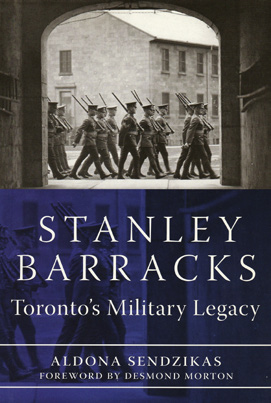
There’s a wide variety of books on the early development of Communist organizations in Canada and the state’s interest in them (and what anyone who ought to be radical). Starting on the left, consider Ian Angus, Canadian Bolsheviks: The Early Years of the Communist Party of Canada (Trafford 2004 2nd Ed) and Ian McKay, Reasoning Otherwise: Leftists and the Peoples Enlightenment in Canada, 1890-1920 (Between the Lines, 2008).
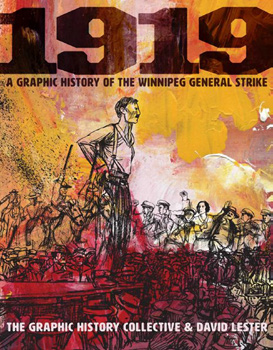
More conventional works are Lita-Rose Betcherman, The Little Band: The Clashes between the Communists and the Canadian Establishment 1928-1932 (Deneau 1982) and William Rodney, Soldiers of The International: A History of the Communist Party of Canada, 1919-1929 (UTP 1968).
Two other substantial books focus on the view of the security services: Gregory Kealey, Spying on Canadians: The Royal Canadian Mounted Police Security Service and the Origins of the Long Cold War (UTP 2017), and – weighing in at 720 pages – there’s Gregory Kealey and Pataraby: Secret Service: Political Policing in Canada From the Fenians to Fortress America (UTP 2012).

Modern units perpetuate most of those involved in Williams’ plan. The Irish Regiment is now the 2nd Bn, Irish Regiment of Canada in Sudbury. The York Rangers are now the Queen’s York Rangers, a reconnaissance unit. The Mississauga Regiment is now the Toronto Scottish Regiment, while The Royal Grenadiers and the Toronto Regiment merged to become the Royal Regiment of Canada. The 48th Regiment (Highlanders) are now the 48th Highlanders of Canada. The Queen’s Own Rifles of Canada has not changed in many years. The Toronto Mounted Rifles and the Governor General’s Body Guard merged into the Governor General’s Horse Guard at the cavalry evolved into the armoured corps. Machine gun units were absorbed back into the infantry corps and there is no direct lineage between the garrison’s artillery in 1921 and the modern 7th Toronto Regiment, Royal Canadian Artillery, founded in 1931.
Original printed pages