The first issue of Fife and Drum appeared on 24 May 1996 following a merger between The Friends of Fort York and Garrison Common and the Historic Fort York Volunteer Committee. Both groups were formed in 1994, the former to focus primarily on planning and public policy issues, and the latter to support and supplement the activities of the city-run National Historic Site.
The first Fife and Drum was a photocopied information sheet, with reports of meetings, lists of officers and phone numbers, but no illustrations. Still, there were signs of the new organization’s ambitions. It reported on a business plan that would give Fort York a new Visitor Centre, improved access, fresh programs, more marketing. City Council had recently approved a plan for “aggressive” development around Fort York, the newsletter noted, that might see 7000 people living there in thirty-five years.
Except for underestimating population growth by a factor of ten, the first Fife and Drum foresaw quite accurately the key events and concerns that would animate The Friends and their newsletter for the next twenty years. Extraordinary new development projects in the “Fort York Neighbourhood” would be one continuing story in Fife and Drum. The boost those developments gave to the fort’s presence and programming would be a second ongoing topic in the newsletter.
The third principal contribution of Fife and Drum was not at all anticipated in the first issue: its stealthy transformation from a newsletter into a magazine. Slowly, unannounced and seemingly unplanned, Fife and Drum began to offer its readers a flood of historical and cultural articles, always inspired by Fort York but with an endless range of informative, surprising, and sometimes simply amusing topics. Book reviews, historical essays, biographies, research reports, recipes, and architectural studies soon competed for space with reports on meetings and on urban planning initiatives that The Friends wanted to resist or push forward.

Fife and Drum on Programming at Fort York
The back issues of Fife and Drum, available at www.fortyork.ca/resources/newsletter-archive, are a window on how much goes on at Fort York. Most activities are handled by fort staff, of course, and in 2003 they initiated The Birthplace of Toronto, a separate newsletter written and produced by staff to circulate news of activities and developments. After a few issues, however, Birthplace was folded into Fife and Drum and continues to appear today, still staff-written and with its own masthead, in Fife and Drum‘s latter pages.
From the start, Fife and Drum reported on all fort activities in which The Friends were active:
- In the first issues, The Friends’ support for the first Fort York Festival, scheduled for the May long weekend of 1997, was a key preoccupation–including how the many Muskoka cottagers on The Friends board would be persuaded to stay in the city.
- In May 1998, Fife and Drum saluted the inauguration of the Fort York flagpole and its oversized Union Jack, a project initiated and funded by The Friends.
- As Celtic Fest 1999 was looming, The Friends held the first annual Georgian dinner, a $150-a-plate fundraiser.
- In June 2003, Fife and Drum called for volunteers to run parking at Fort York for the Molson Indy to raise funds for the Fife and Drum Corps, another enduring concern of The Friends. Also in 2003 The Friends helped with a staff reunion, attended by at least one whose connection dated back to 1959.
- In May 2004 volunteers were sought for an Earth Day cleanup around the fort and commons.
- Constantly, Fife and Drum provided plans for and reports on drum corps performances, military reenactments, and lecture series to promote the fort and military and civic history.
Fife and Drum in the City: Planning and Policy Issues
Fife and Drum‘s first issue announced a day-long “charrette” for planners, politicians, and preservationists to discuss the fort’s place in its rapidly changing neighbourhood. A deep engagement with planning and politics, and with the struggle to make and keep Fort York a prominent, defining actor in its community, has never been absent from its pages.
In January 2000, the great news was the announcement of Fort York Boulevard, “the most significant development since 1934” for Fort York. In July 2002, Fife and Drum hailed the street’s completion as giving the fort a whole new front entrance. By then, The Friends had also been through an expensive hearing at the Ontario Municipal Board, seeking to confirm height restrictions on the towers planned along the south side of the new street. That effort was declared “to no avail” in the April 2002 issue.
The OMB loss was one of the last big public planning defeats to be reported in Fife and Drum. The era when heritage activism mostly meant trying to ward off catastrophe was ending. In November 2003, the newsletter headlined a significant “defensive” triumph when the Historic Sites and Monuments Board of Canada, at the urging of The Friends, set firm boundaries for the national historic site around the fort and its environs–finally putting an end to city and provincial projects that blithely contemplated encroachments.
In 2005 Fife and Drum trumpeted the publication of Fort York: Adding New Buildings, the master plan for reviving Fort York’s interior space–and for adding a Visitor Centre just outside it. The Centre would require a huge fundraising campaign. Thus, in April 2007 the newsletter announced formation of the Fort York Foundation to raise millions for the Visitor Centre, Garrison Common improvements, and other capital projects.
Having made peace with the towers arising to the south, The Friends collaborated in the design of June Callwood Park, suggested heritage names for new streets in the area, and worked with transit planners on access and the design for a replacement of the Bathurst Street/Sir Isaac Brock Bridge. In May 2007, a special “Welcome” issue of Fife and Drum went to 930 new condo households in the now officially named Fort York Neighbourhood.
That year city planner Heather Inglis Baron contributed a long article describing the area.
This master planning of the Fort York Neighbourhood has been informed by and responds to its historically rich setting… Plans for the redevelopment of the Neighbourhood establish the fort’s prominence again by making its history and identity a part of street design, open space design, landscape interventions, and by including interpretive features… Interpretive signage will… encourage a greater understanding of the community’s location and rich traditions among residents and visitors.
Fife and Drum was declaring victory. There would be continuing struggles, of course. For example, the pedestrian bridge over the railway corridor was won, lost, and won again. By 2010, however, with the 1812 Bicentennial looming, the Patkau/Kearns plan for the Visitor Centre adopted, and Fort York Neighbourhood an established reality, the planning and preservationist aspirations that had inspired The Friends of Fort York and Garrison Common in 1996 were plainly being achieved.
From Newsletter to Magazine
In November 2003, without fanfare, Fife and Drum ceased being a mostly anonymous typescript handout and adopted the two-column, printed, illustrated format with signed articles still familiar to its readers today. About the same time, Ted Smollett, The Friends’ director, took over the layout of Fife and Drum. Later, his design expertise guided the appearance and content of the website www.fortyork.ca. In 2008-09 The Friends experimented with Drumroll, an all-digital mailing to flag special events between issues of the newsletter, but it was discontinued after seven numbers. Meanwhile, Fife and Drum abandoned snail mail to go all-electronic.
In June 1999, Fife and Drum had published its first purely historical essay, a carefully researched account of the Strachan Avenue Burying Ground. It was a few years before such essays became standard features, but in 2004-05 a series on “Garrison Common History” marked a permanent transformation from newsletter format to magazine style.
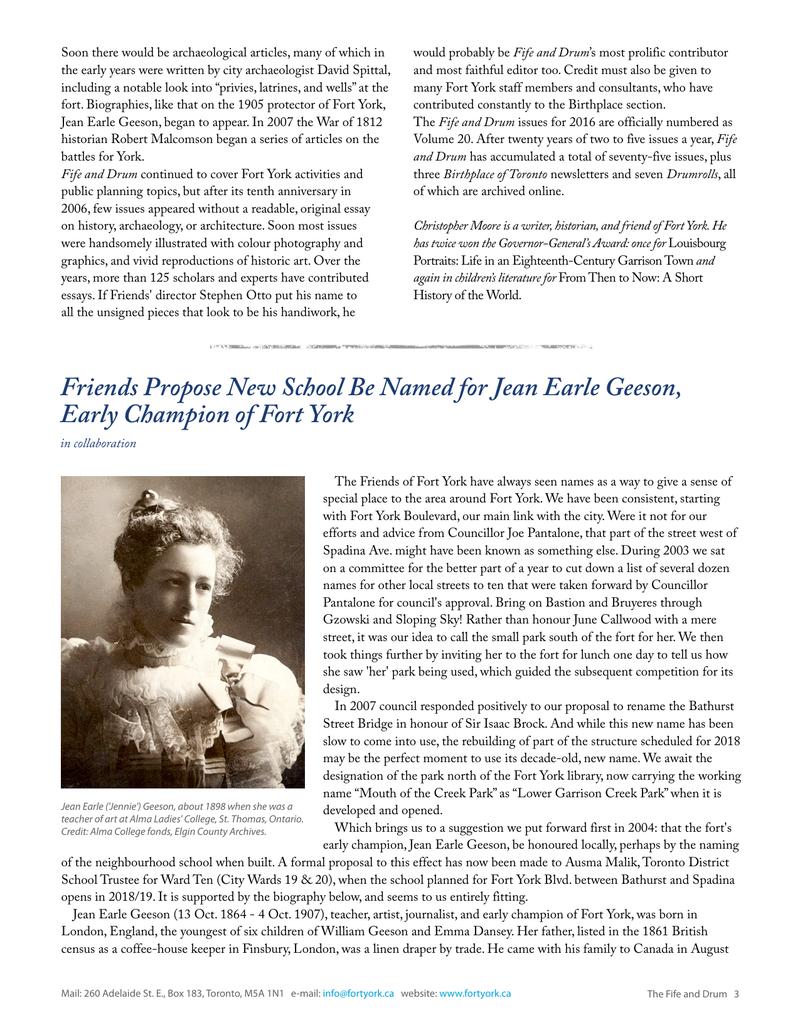
Soon there would be archaeological articles, many of which in the early years were written by city archaeologist David Spittal, including a notable look into “privies, latrines, and wells” at the fort. Biographies, like that on the 1905 protector of Fort York, Jean Earle Geeson, began to appear. In 2007 the War of 1812 historian Robert Malcomson began a series of articles on the battles of York.
Fife and Drum continued to cover Fort York activities and public planning topics, but after its tenth anniversary in 2006, few issues appeared without a readable, original essay on history, archaeology, or architecture. Soon most issues were handsomely illustrated with colour photographs and graphics, and vivid reproductions of historic art. Over the years, more than 125 scholars and experts have contributed essays. If Friends’ director Stephen Otto put his name to all the unsigned pieces that look to be his handiwork, he would probably be Fife and Drum‘s most prolific contributor and most faithful editor too. Credit must also be given to many Fort York staff members and consultants, who have contributed constantly to the Birthplace section.
The Fife and Drum issues for 2016 are officially numbered as Volume 20. After twenty years of two to five issues a year, Fife and Drum has accumulated a total of seventy-five issues, plus three Birthplace of Toronto newsletters and seven Drumrolls, all of which are archived online.
Original printed pages