

Well, the short answer is: “No one in their right mind.” At least, not any longer. This class of ceremonial object is from a time more refined and dignified than our own (no shiny chrome-plated shovels for us, thank you very much). In fact, this mason’s trowel was used for the laying of the cornerstone of a new and important building. It lives on as a physical document commemorating the same.
Which brings me to the object at hand, displayed below. It is the silver electroplated ceremonial trowel used to lay the cornerstone of the Church of St. John the Evangelist, sometimes called St. John’s (Anglican) Garrison Church, in Toronto.
How do we know this?
First, the object is conveniently engraved with a legend saying church of st. john // the evangelist // toronto // october 8th // 1892. So, our conclusion would not be a stretch for even the most curatorially challenged. But how do we know this was not added later, perhaps by some unscrupulous silver dealer for the purpose of deceiving an otherwise trusting public?
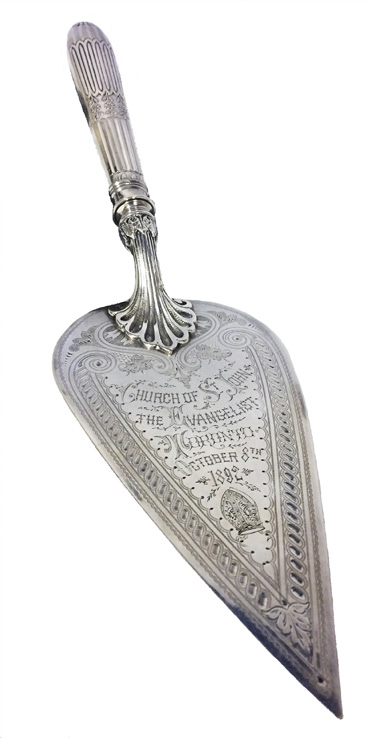
Second, the object has a plethora of other marks that tell us when, where, and by whom it was made. It’s stamped with B and B, two unidentified pictorial marks, and EP surmounted by crown, both inside a crest. This means it was made by the Sheffield, England, firm of Briddon Brothers, who operated from 1863 to 1910. It was probably purchased by a Toronto retailer from them, then engraved to the purchaser’s specification. And EP refers to electroplated silver, so this trowel is not solid sterling. All of this confirms the engraving as being contemporary with the object.
And third, at the end of the day, why bother to expensively engrave the date of an obscure event that relates to a long-demolished building?
We can also see that the handle is embossed Rd 146199. This is a Patent Office registration number. It was checked against the British, American and Canadian registration databases, and surprisingly matches none of the descriptions of the items registered under this number. I expect it’s a typo (these things happen). Oddly, this error supports the argument for authenticity.
The Church of St. John the Evangelist was the first garrison church for Fort York. It was located on Victoria Memorial Square (originally known as St. John’s Square and now part of Fort York National Historic Site). The first church was a frame building put up in 1858. It was replaced by a brick structure that opened in 1893, and the laying of its cornerstone in 1892 was the reason this object was purchased. As the neighbourhood evolved from residential to largely industrial, the building was deconsecrated and ultimately demolished in 1963. (For a fascinating history of the church, see http://www.wellingtonplace.org/history/church.php)
After the church closed, the Women’s Canadian Historical Society retrieved two pews and two signs from the church; these were donated in 1989 to the Toronto Historical Board and are now in the Historical collection of Museums & Heritage Services. Many more objects – including memorial plaques, windows, and regimental colours – were transferred to the Trinity Chapel at Canadian Forces Base Borden, Ontario.
Our trowel eventually turned up in an auction and was bought by Mary Williamson, an accomplished librarian and bibliographer in fine arts, to use as an elegant pie server. When she realized what she had, she was kind enough to donate it to the City’s collection – and we appreciate her thoughtfulness.
Original printed pages


